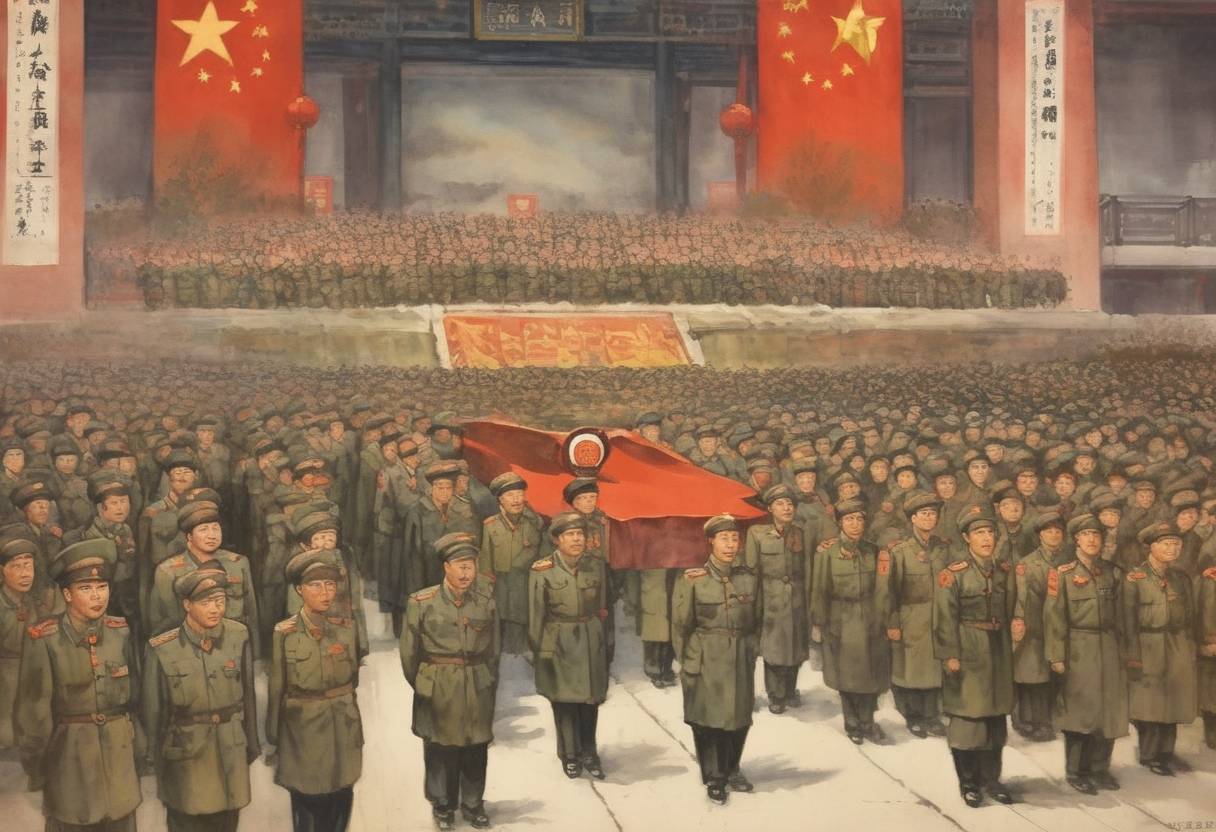
Proclamation of the People’s Republic of China
On October 1, 1949, a pivotal moment in 20th-century history unfolded as Mao Zedong proclaimed the establishment of the People’s Republic of China (PRC) from atop the Tiananmen Gate in Beijing. This event marked the culmination of the Chinese Civil War and the beginning of communist rule in China, fundamentally altering the nation’s political landscape.
Background
The Chinese Civil War, which had raged intermittently since the 1920s, was primarily a conflict between the Chinese Nationalist Party (Kuomintang, KMT) led by Chiang Kai-shek and the Communist Party of China (CPC) led by Mao Zedong. The war intensified after the end of World War II, as both parties vied for control of China following the defeat of the Japanese.
Key Events Leading Up to the Proclamation
- End of World War II (1945): With Japan’s surrender, the power vacuum in China led to renewed hostilities between the KMT and CPC.
- Civil War Resumes (1946): Despite attempts at mediation by the United States, full-scale civil war resumed in 1946.
- Communist Victories (1948-1949): The CPC gained significant ground, capturing key cities such as Nanjing and Shanghai, and forcing the KMT to retreat.
The Proclamation
On October 1, 1949, Mao Zedong declared the founding of the People’s Republic of China in a ceremony attended by thousands. This proclamation symbolized the victory of the communist forces and the establishment of a new government committed to Marxist-Leninist principles.
Significance of the Event
- End of the Civil War: The proclamation effectively ended decades of civil strife, although sporadic resistance continued in some regions.
- Shift in Global Politics: The establishment of the PRC marked a significant shift in the global balance of power during the Cold War, as China aligned itself with the Soviet Union.
- Impact on Taiwan: The KMT retreated to Taiwan, where it maintained the Republic of China government, leading to the ongoing cross-strait tensions.
Aftermath and Consequences
- Consolidation of Power: The CPC quickly moved to consolidate power, implementing land reforms and nationalizing industries.
- Social and Economic Changes: The new government embarked on ambitious social and economic reforms aimed at transforming China into a socialist state.
- International Recognition: Initially, the PRC faced limited international recognition, with many Western countries continuing to recognize the Republic of China in Taiwan as the legitimate government.
The proclamation of the People’s Republic of China on October 1, 1949, remains a defining moment in Chinese history, setting the stage for the country’s development into a major global power.