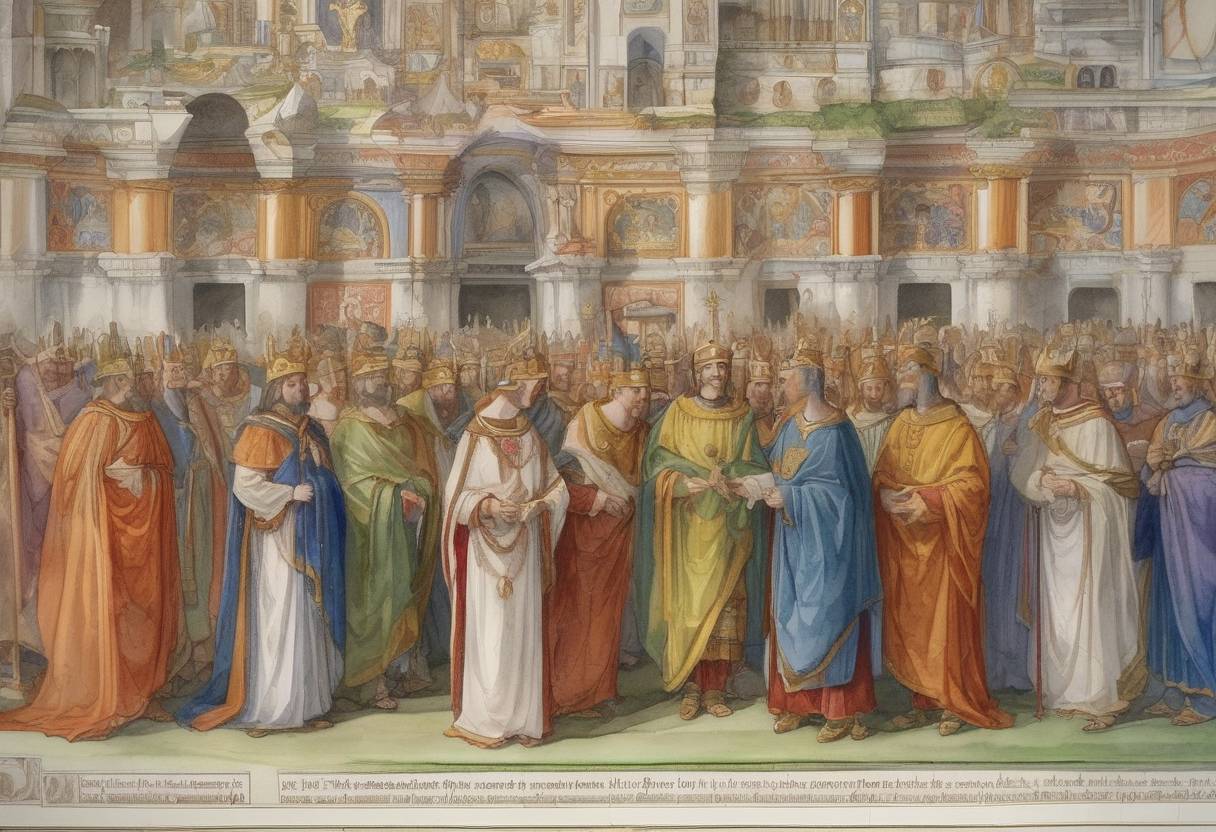
The Carolingian Renaissance and Charlemagne’s Coronation
The Carolingian Renaissance was a period of cultural and intellectual revival in Europe that took place during the late 8th and 9th centuries, primarily under the reign of Charlemagne and his successors. This era is symbolically marked by the coronation of Charlemagne as Emperor on December 25, 800.
Context and Background
The Carolingian Renaissance emerged in a time when Western Europe was experiencing fragmentation and decline following the fall of the Roman Empire. The Merovingian dynasty, which preceded the Carolingians, had seen a decline in centralized power and cultural achievements. The rise of the Carolingian dynasty, beginning with Pepin the Short and reaching its zenith under Charlemagne, marked a significant shift towards consolidation and revival.
Charlemagne’s Rise
- Charlemagne, also known as Charles the Great, became King of the Franks in 768 and later King of the Lombards in 774. His reign was characterized by military conquests, expansion of his empire, and efforts to unify and strengthen his realm.
- Charlemagne’s leadership was instrumental in the revival of learning and culture. He recognized the importance of education and literacy for effective governance and the spread of Christianity.
The Coronation on December 25, 800
Charlemagne’s coronation as Emperor by Pope Leo III on Christmas Day in the year 800 was a pivotal moment in European history. The ceremony took place at St. Peter’s Basilica in Rome.
Significance of the Coronation
- Restoration of the Roman Empire: The coronation symbolized the revival of the Western Roman Empire, which had collapsed in the 5th century. It marked the beginning of what would later be known as the Holy Roman Empire.
- Church and State Alliance: The event underscored the alliance between the Frankish monarchy and the Roman Catholic Church. It reinforced the idea of a Christian empire in the West, with the emperor as a protector of the Church.
- Legitimacy and Authority: By crowning Charlemagne, Pope Leo III sought to legitimize his own position and authority, as he had faced opposition and needed the support of a powerful ally.
The Carolingian Renaissance
The cultural and intellectual revival during this period was marked by several key developments:
- Educational Reforms: Charlemagne established schools and promoted the study of Latin, the language of the Church and administration. The Palace School at Aachen became a center of learning.
- Manuscript Preservation: Monasteries played a crucial role in copying and preserving classical texts, which helped to transmit ancient knowledge to future generations.
- Art and Architecture: Carolingian art and architecture saw a revival of Roman styles, with innovations that would influence medieval European culture.
Aftermath and Legacy
The Carolingian Renaissance laid the groundwork for the later developments of the High Middle Ages. It contributed to the preservation of classical knowledge, which would eventually fuel the intellectual movements of the 12th-century Renaissance and beyond.
- Cultural Influence: The revival of learning and culture during the Carolingian Renaissance had a lasting impact on European intellectual life.
- Political Structure: The coronation of Charlemagne set a precedent for the relationship between the papacy and European monarchs, influencing the political landscape of medieval Europe.
In summary, Charlemagne’s coronation on December 25, 800, was a defining moment that symbolized the Carolingian Renaissance, a period that significantly shaped the cultural and political trajectory of Europe.