Operation Banner: The End of a 38-Year Mission
2007 · Belfast, United Kingdom
Operation Banner, the British Army's longest continuous operation, officially ends in Northern Ireland after 38 years.
January 30, 1972
Bloody Sunday occurred in Derry, Northern Ireland, when British soldiers shot 26 unarmed civil rights protesters, killing 14.
Derry, Northern Ireland | British Army
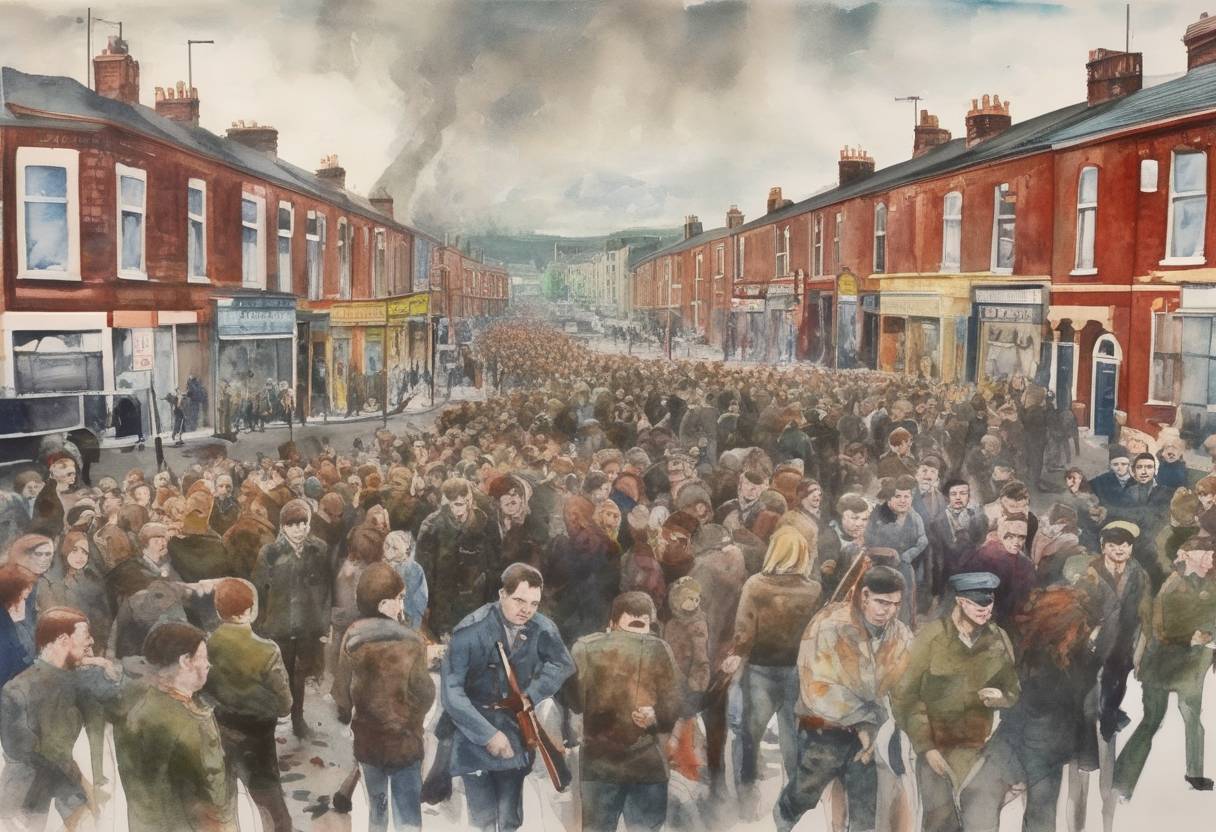
On January 30, 1972, a tragic and pivotal event unfolded in Derry, Northern Ireland, known as Bloody Sunday. This day marked a significant moment in the Northern Ireland conflict, often referred to as “The Troubles,” which spanned from the late 1960s to 1998.
The Troubles were rooted in a complex mix of political, nationalistic, and sectarian tensions between the predominantly Protestant unionists, who favored remaining part of the United Kingdom, and the mainly Catholic nationalists, who sought a united Ireland. Civil rights issues, including discrimination against Catholics in housing, employment, and voting, fueled widespread protests.
On January 30, 1972, the Northern Ireland Civil Rights Association organized a march in Derry to protest against internment without trial, a policy introduced by the British government in August 1971. The march was intended to be peaceful, drawing thousands of participants.
As the marchers proceeded, they encountered a barricade set up by the British Army’s 1st Battalion, Parachute Regiment. Tensions escalated, and soldiers opened fire on the unarmed protesters. In the chaos that ensued:
The immediate aftermath of Bloody Sunday was marked by widespread outrage and condemnation:
Two major inquiries were conducted to investigate the events of Bloody Sunday:
The Widgery Tribunal (1972): The initial inquiry, led by Lord Widgery, largely exonerated the soldiers and was widely criticized for its perceived bias and lack of thoroughness.
The Saville Inquiry (1998-2010): Initiated in 1998, this comprehensive investigation concluded that the shootings were “unjustified and unjustifiable.” It found that none of the victims posed a threat, and the soldiers’ actions were deemed excessive.
In 2010, following the publication of the Saville Report, British Prime Minister David Cameron formally apologized for the events of Bloody Sunday, acknowledging the wrongful actions of the soldiers.
Bloody Sunday remains a deeply significant event in the history of Northern Ireland. It highlighted the deep-seated issues within the region and underscored the need for political solutions to address the grievances of the Catholic community. The event is commemorated annually and continues to serve as a poignant reminder of the human cost of conflict.
Bloody Sunday played a crucial role in shaping the trajectory of The Troubles and the eventual peace process, culminating in the Good Friday Agreement of 1998, which sought to bring an end to decades of violence.
Source: en.wikipedia.org