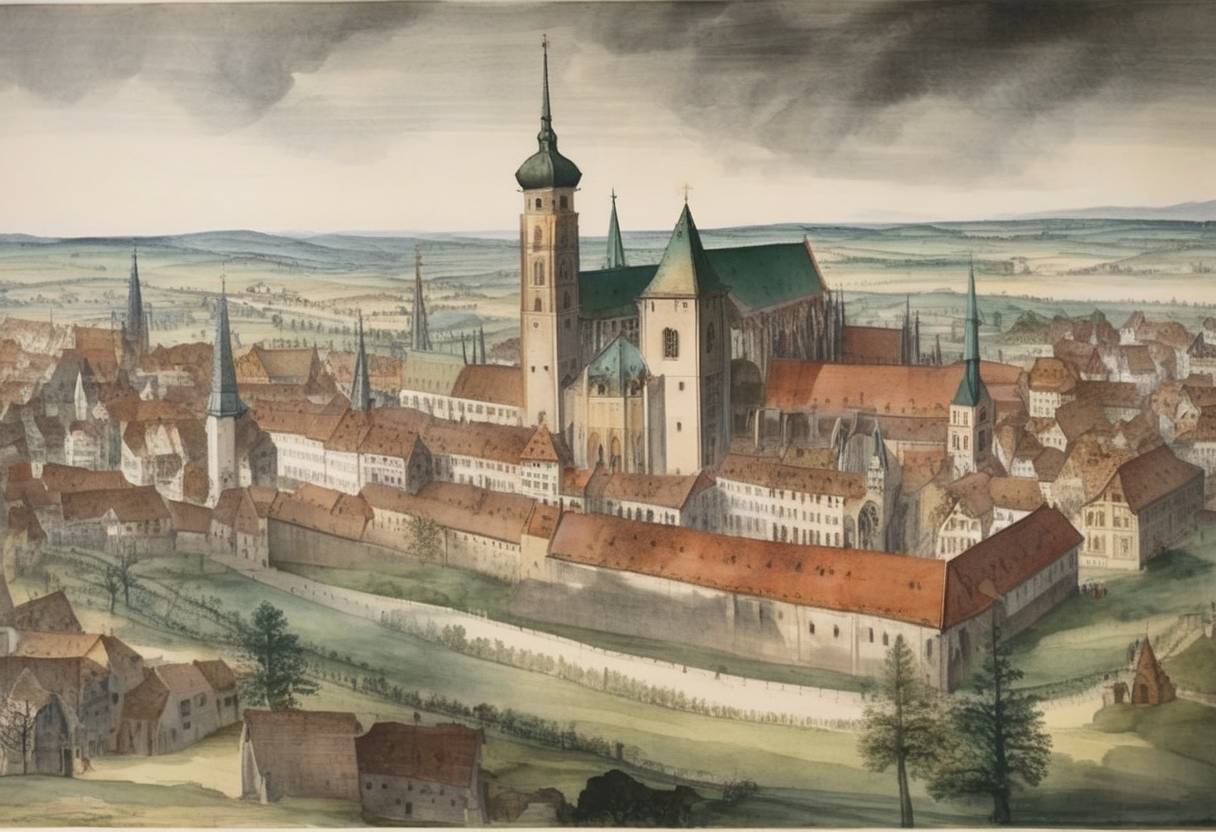
The Peace of Augsburg
On September 25, 1555, the Peace of Augsburg was signed, bringing an end to the ongoing religious conflict between Catholic and Lutheran rulers within the Holy Roman Empire. This landmark agreement was significant for establishing a legal framework for the coexistence of Catholicism and Lutheranism within the empire.
Context
The Reformation, initiated by Martin Luther’s Ninety-Five Theses in 1517, had splintered the religious unity of Europe, particularly within the Holy Roman Empire. As Lutheranism spread, tensions grew between Protestant and Catholic princes, leading to religious and political unrest.
The Holy Roman Emperor Charles V, a staunch Catholic, had initially attempted to suppress the Lutheran movement through the Diet of Worms in 1521, which declared Luther an outlaw. However, unable to quell the growth of Protestantism through force, the empire faced increasing internal strife.
Leading Up to the Treaty
Throughout the 1530s and 1540s, efforts to reconcile religious differences met with limited success. The Schmalkaldic League, an alliance of Protestant princes, formed in 1531 to defend against imperial intervention, exacerbating tensions. The subsequent war between this league and imperial forces, called the Schmalkaldic War, eventually led to a temporary victory for Charles V in 1547.
Despite this military success, the emperor struggled to enforce Catholic uniformity due to internal resistance, geopolitical constraints, and the financial burdens of continuous warfare. With growing pressure, Charles V was compelled to seek a diplomatic solution.
The Agreement
The Peace of Augsburg represented a pragmatic compromise, recognizing the principle of “cuius regio, eius religio” — the ruler of a land determines its religion. This allowed each prince to choose between Catholicism and Lutheranism for his territory, granting legal recognition to Lutheran states and ending decades of religious warfare within the empire.
The treaty also included provisions to protect subjects’ right to emigrate if they disagreed with their ruler’s chosen faith. However, it notably did not recognize Calvinism or other emerging Protestant sects, laying the groundwork for future confessional conflicts.
Aftermath and Significance
The Peace of Augsburg marked a turning point in European religious history. It was one of the first significant legal recognitions of a Protestant faith and allowed for a period of relative peace within the empire. However, its exclusion of other Protestant groups and reliance on the choice of rulers left underlying tensions unresolved.
The treaty’s limitations eventually led to future conflicts, most notably the Thirty Years’ War, which devastated much of Europe from 1618 to 1648. Despite these shortcomings, the Peace of Augsburg was a critical step in the gradual acceptance of religious diversity within Europe, influencing the trajectory of modern religious and political thought.