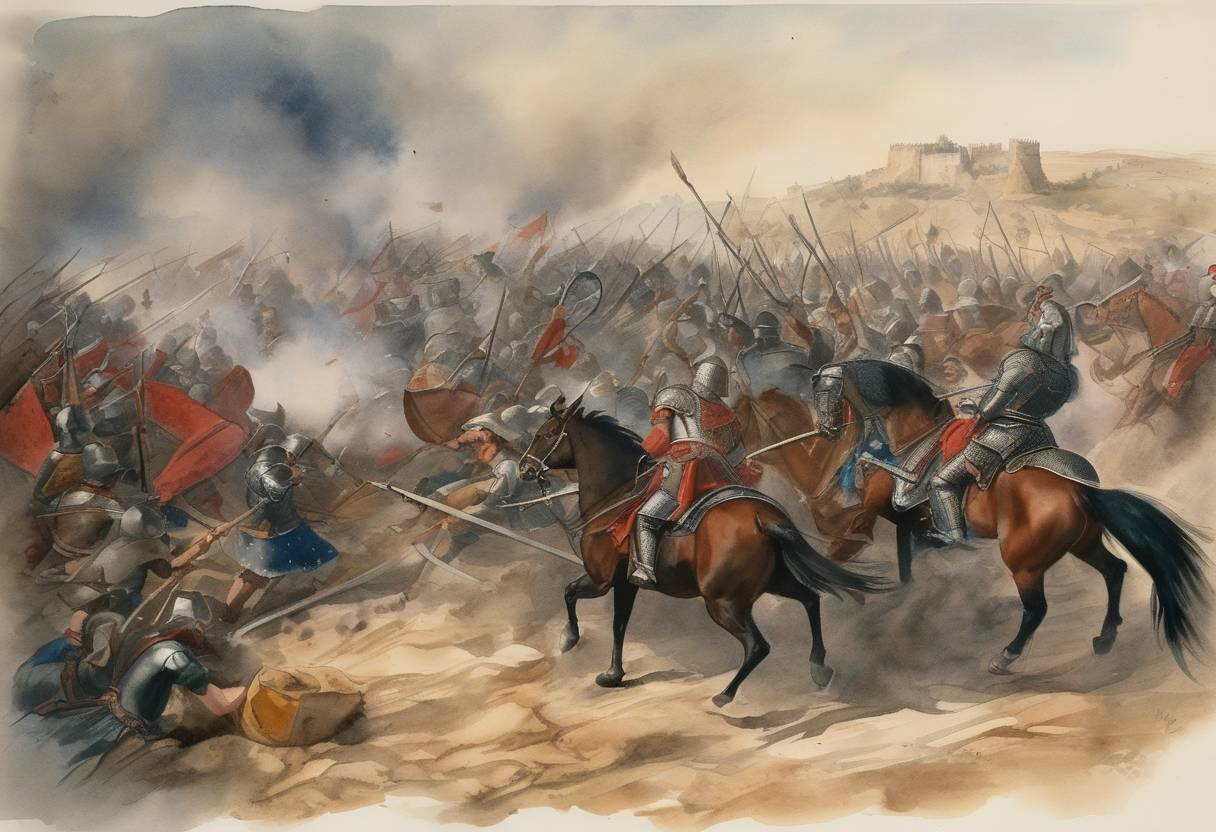
Battle of Nájera (April 3, 1367)
The Battle of Nájera, also known as the Battle of Navarrete, took place on April 3, 1367, in the context of the Castilian Civil War. This conflict was primarily between King Pedro I of Castile, also known as Pedro the Cruel, and his half-brother Henry of Trastámara. The battle was a pivotal moment in the war, as it saw English forces under Edward, the Black Prince, lending crucial support to Pedro of Castile.
Background
- Castilian Civil War Context: The Castilian Civil War was part of a larger series of dynastic struggles across medieval Spain. Pedro I was the legitimate king, but his tyrannical reputation and the support Henry of Trastámara received from France and Aragon created a deep division.
- The English Involvement: In the backdrop of the Hundred Years’ War between England and France, English forces were eager to weaken their French rivals by supporting Pedro, whose victory would also aid English interests on the continent. Pedro pledged vast rewards to the English for their assistance.
The Battle
- Location: The battle took place near Nájera, in present-day La Rioja, which was a strategic site due to its location and the importance of gaining control over the North of Castile.
- Forces:
- The English contingent, led by Edward, the Black Prince, was composed of seasoned soldiers. This included the renowned English longbowmen, who were crucial in past battles during the Hundred Years’ War.
- Pedro’s supporters were mainly his Castilian loyalists.
- Henry of Trastámara’s forces comprised not only Castilian nobles discontent with Pedro’s rule but also French and Aragonese allies.
The Outcome
- Victory for Pedro: The battle concluded with a decisive victory for Pedro of Castile and his English allies. The disciplined English troops played a significant role, particularly with their longbowmen who disrupted Henry’s formations.
- Aftermath: Despite the victory, Pedro failed to consolidate his power effectively. His inability to pay his English allies led to strained relations, and this dissatisfaction was exploited by Henry. By 1369, Henry was able to overthrow Pedro with renewed support.
Historical Significance
The Battle of Nájera is emblematic of the interconnectedness of European conflicts in the medieval period. It demonstrates how the Hundred Years’ War influenced internal disputes within other kingdoms, such as Castile. Although a tactical victory for Pedro, the failure to secure long-term stability illustrates the complexities and shifting alliances of 14th-century European politics.