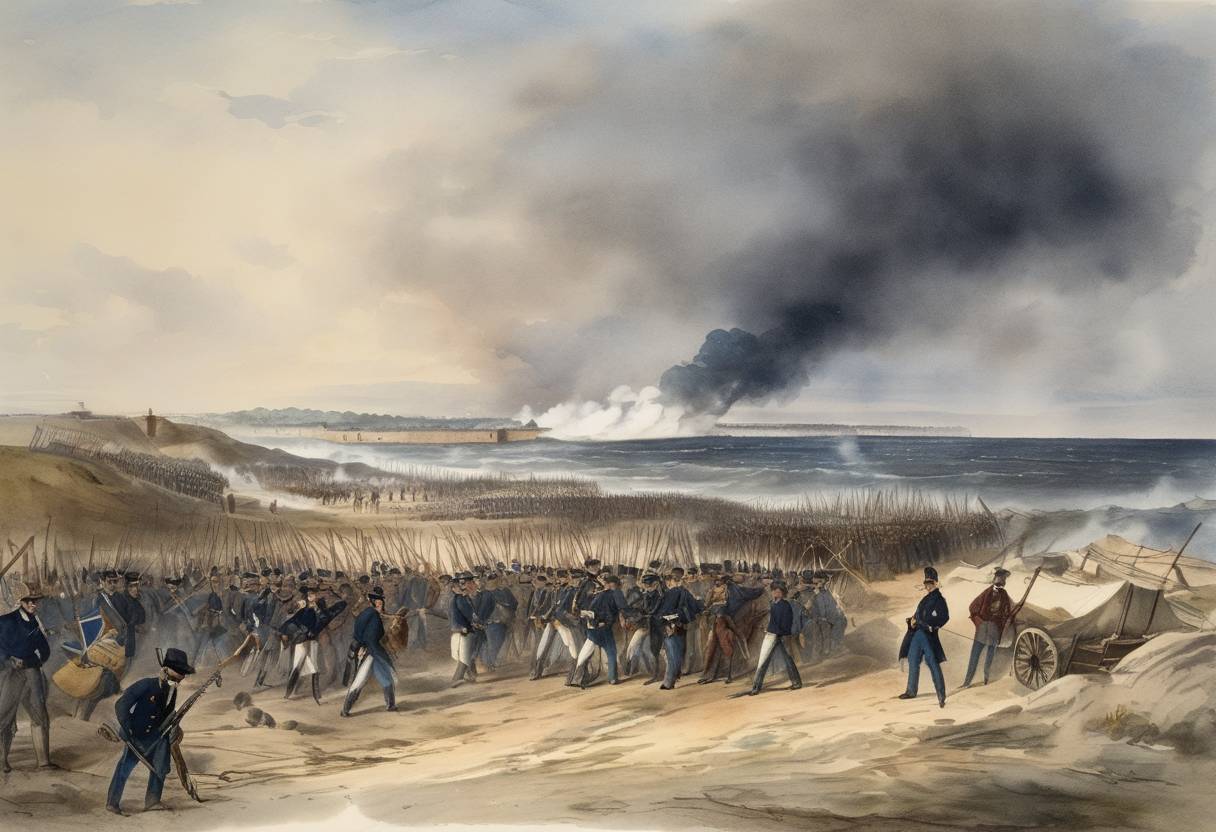
Capture of Fort Wagner - September 6, 1863
On September 6, 1863, during the American Civil War, Union forces achieved a strategic victory with the capture of Fort Wagner, located on Morris Island in South Carolina. This event marked a significant turning point in the Union’s campaign to seize control of Charleston Harbor, one of the key Confederate strongholds along the southern coast.
Context and Background
Fort Wagner was a critical component of the Confederate defense system protecting Charleston. Commanded by seasoned Confederate troops, the fort was situated on the northern part of Morris Island, serving as a formidable barrier to any Union attempt to breach Charleston’s defenses.
Earlier in July 1863, the Union had made two unsuccessful assaults on Fort Wagner, including the well-known attack involving the 54th Massachusetts Volunteer Infantry, one of the first major American military units made up of African American soldiers.
The Evacuation
The Union used determined siege operations and continuous bombardments against Fort Wagner throughout August and into early September. These relentless assaults, combined with the isolation and unsustainable conditions for the Confederate garrison, rendered it increasingly untenable for the defenders to hold their position.
On the night of September 6, under the cover of darkness and strategically planned Union artillery attacks, the Confederate forces quietly evacuated Fort Wagner and the nearby Battery Gregg. They retreated towards the more fortified locations of Charleston. By the morning of September 7, Union forces entered and occupied the abandoned fortifications without resistance.
Strategic Implications
The capture of Fort Wagner allowed Union forces to gain a foothold on Morris Island, bringing them closer to Charleston. It enabled the Union to begin using its heavy artillery against Fort Sumter, which was a psychological blow to the Confederacy and a step towards tightening the noose around Charleston.
Despite its fall, Fort Wagner’s defense served as a testament to the resilience of Confederate troops under adverse conditions. However, its capture was a clear demonstration of the Union’s superior resources and strategy through sustained military pressure and technological advancements such as the use of rifled artillery.
Aftermath
The fall of Fort Wagner did not lead immediately to the fall of Charleston, which remained in Confederate hands until February 1865. However, the capture demonstrated the Union’s determination and capability to conduct sustained siege operations and opened a new chapter in the Union’s military engagements in the South.
The victory also held significant symbolic meaning, showcasing the bravery and contributions of African American soldiers in the 54th Massachusetts and other units, whose roles were instrumental in advancing the Union’s efforts throughout the war.
In summary, the capture of Fort Wagner on September 6, 1863, was a crucial step in the Union’s overarching strategy to reclaim control over key Southern ports and weaken the Confederate war effort through persistent campaigns and resourceful military tactics.