Rudolf II Crowned King of Hungary
1564 · Székesfehérvár, Hungary
Rudolf II was crowned King of Hungary in Székesfehérvár, an important political event in Hungarian history.
December 6, 1060
Béla I of Hungary was crowned as King of Hungary, marking the beginning of his reign after a period of civil war and dynastic conflict in the kingdom.
Székesfehérvár, Hungary | Kingdom of Hungary
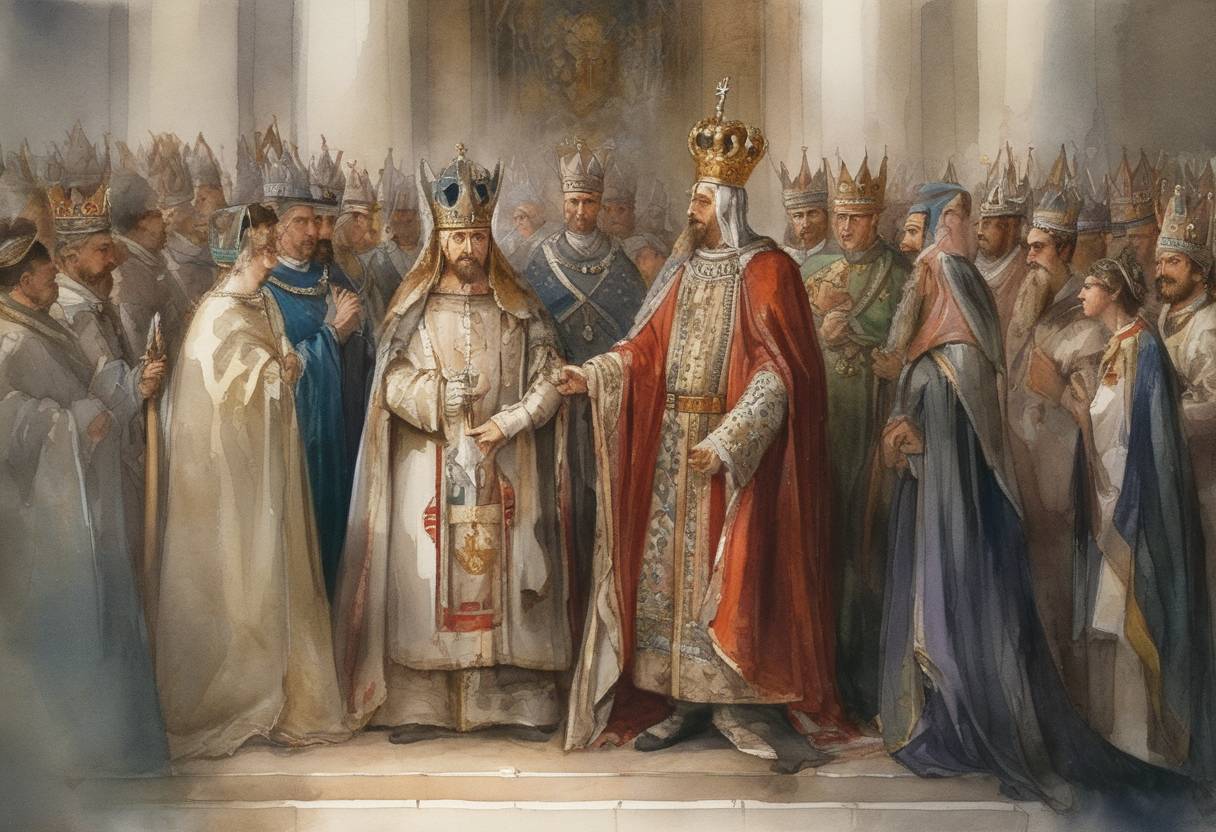
On December 6, 1060, Béla I of Hungary was crowned as King of Hungary, marking the official beginning of his reign. This coronation was a pivotal moment following a turbulent period characterized by civil war and dynastic conflict within the Hungarian kingdom.
The ascent of Béla I to the throne followed a series of disputes within the Árpád dynasty. The kingdom had been under the rule of Béla’s brother, Andrew I, whose favoritism towards his son, Solomon, sparked infighting. Andrew’s intention to secure the throne for Solomon led to Béla, a seasoned warrior and Andrew’s own sibling, contesting for leadership.
The discord culminated in armed conflict between the brothers. Throughout their rivalry, Béla garnered support from various factions discontented with Andrew’s rule, including disaffected nobles and allies from neighboring territories.
Béla’s decisive victory over Andrew in the ensuing battles precipitated Andrew’s demise, reportedly in a confrontation at the Battle of Ménfő. This shift in power dynamics paved the way for Béla to ascend to the throne. Following Andrew’s death, Béla was declared king, and his coronation on December 6, 1060, in Székesfehérvár, symbolized the reunification of the kingdom under his leadership.
Béla’s reign was marked by efforts to consolidate his power while addressing the kingdom’s internal and external challenges. He was faced with the task of reasserting central authority and managing the brewing tensions with the Holy Roman Empire, especially regarding the succession of his potential heirs.
Although he managed to stabilize the kingdom during his reign, Béla’s legacy was complicated by tensions that would eventually resurface after his death, particularly involving the succession of his sons, Géza and Ladislaus.
Béla I’s coronation and reign hold significant importance in Hungarian history, primarily as a testament to the dynastic struggles of the Árpád dynasty during the 11th century. His leadership represents a chapter of internal consolidation that attempted to mend the kingdom’s fractious political landscape after a period of intense familial rivalries. The complexities of his legacy highlighted the fragile balance of power within medieval Hungary, foreshadowing further dynastic tumult in the coming generations.
Source: example.com