Capture of Port Arthur: November 21, 1894
1894 · Port Arthur, China
Port Arthur massacre: Armed forces of Japan captured the Chinese city of Port Arthur (now Lüshun), marking a significant victory during the First Sino-Japanese War.
September 17, 1894
The Sino-Japanese War saw its first major land engagement at the Battle of Pyongyang, resulting in a decisive victory for Japanese forces over Qing China.
Pyongyang, Korea | Japanese Empire, Qing Dynasty
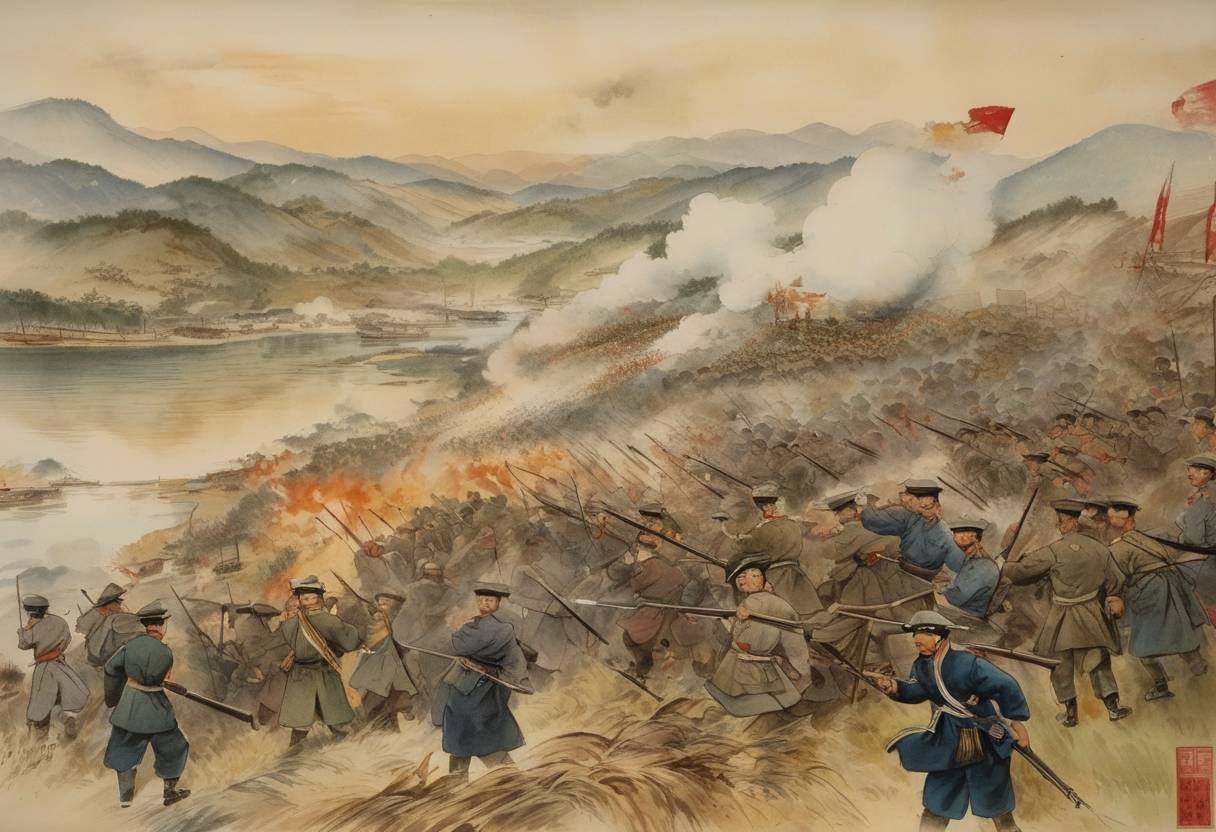
The Battle of Pyongyang, fought on September 17, 1894, marked the first significant land battle of the First Sino-Japanese War. This conflict was primarily between the forces of the Empire of Japan and the Qing Dynasty of China over influence in Korea.
The First Sino-Japanese War erupted due to rising tensions over control and influence in the Korean Peninsula. Both Japan and China had interests in Korea, with each nation attempting to secure its influence in the region. The war symbolized the struggle for dominance in East Asia, as Japan sought to establish itself as a modernized and powerful nation.
The Battle of Pyongyang took place after Japanese forces had already secured several initial victories. On September 15, Japanese forces, led by Major General Nozu Michitsura, moved towards Pyongyang, where a large Qing army had entrenched itself. By September 16, the Japanese had strategically positioned their forces around the city, readying for a coordinated attack.
In the early morning of September 17, Japanese troops launched a multi-front assault on the heavily fortified positions held by approximately 15,000 Qing soldiers under General Zuo Baogui’s command. The Qing troops, despite their numbers, were poorly coordinated and inadequately equipped compared to the modernized Japanese army.
The Japanese forces employed superior tactics and weaponry, resulting in a decisive victory by the end of the day. The Qing suffered significant casualties, with approximately 2,000 soldiers killed and many others captured. The Japanese losses were considerably lighter, numbering around 134 killed and 526 wounded.
The fall of Pyongyang was a significant blow to Qing China, as it lost control of an important strategic position in Korea. The victory boosted Japanese morale and demonstrated the effectiveness of Japan’s modernization efforts in its military forces, setting a precedent for subsequent engagements. The battle was pivotal in establishing Japanese dominance in Korea, eventually leading to Japan’s victory in the war in 1895.
The Battle of Pyongyang and the subsequent war highlighted the waning power of the Qing Dynasty and showcased Japan as an emerging regional power. The conflict had long-lasting effects on East Asian geopolitics, influencing the balance of power and contributing to the eventual downfall of the Qing Dynasty and Japan’s future expansionist ambitions.
Source: www.britannica.com