The Second Battle of Kosovo: October 17, 1448
1448 · Kosovo Polje, Ottoman Empire
The Second Battle of Kosovo began between the Ottoman Empire and a coalition of Hungarian and Wallachian forces, resulting in an Ottoman victory.
June 29, 1444
The Battle of Torvioll took place, where Skanderbeg, the Albanian national hero, defeated the Ottoman forces.
Torvioll, Albania | League of Lezhë
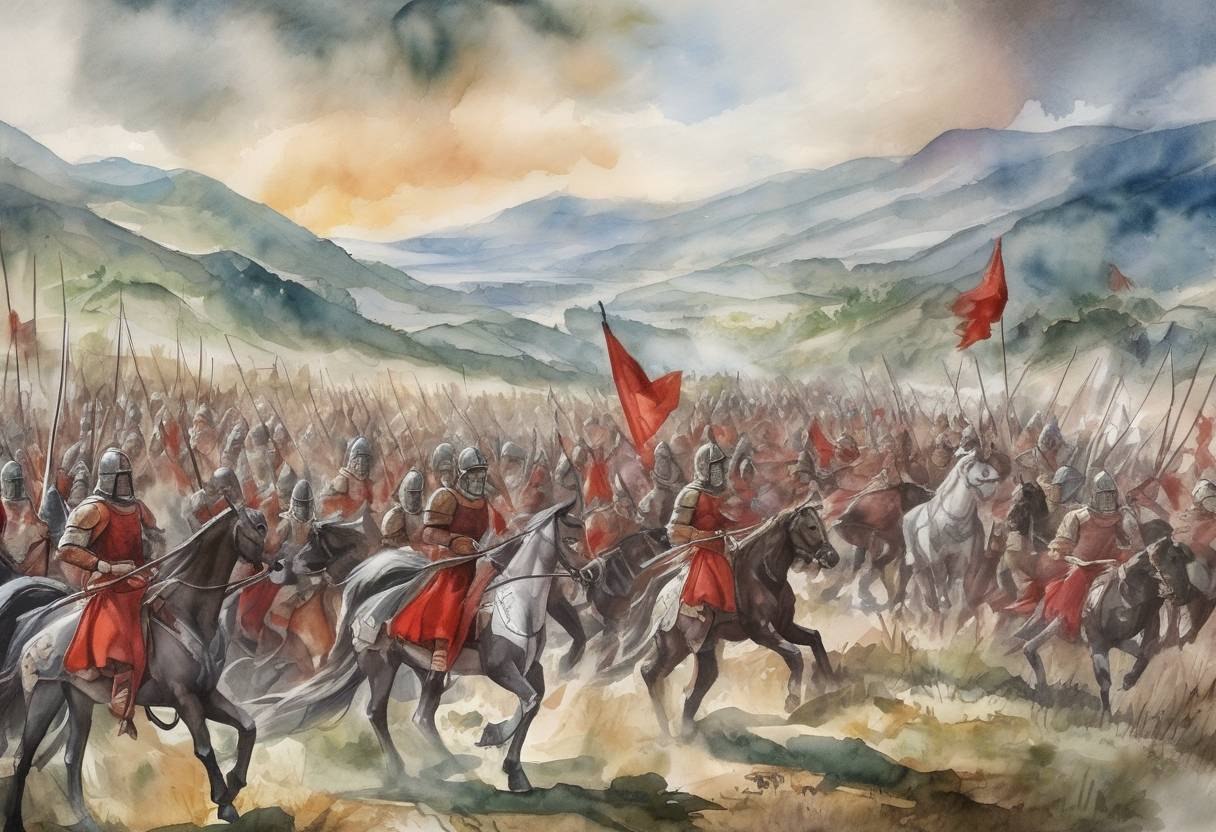
The Battle of Torvioll, fought on June 29, 1444, was a significant military engagement in which the Albanian national hero, Gjergj Kastrioti, known as Skanderbeg, achieved a decisive victory against the Ottoman Empire. This battle marked the beginning of Skanderbeg’s renowned resistance against Ottoman expansion in the Balkans.
In the early 15th century, the Ottoman Empire was expanding its territories into the Balkans, threatening the independence of various principalities, including those in Albania. Gjergj Kastrioti, who had been taken as a hostage by the Ottomans in his youth and converted to Islam, served in the Ottoman military. However, in 1443, he defected and returned to Albania, reclaiming his family’s lands and renouncing Islam to embrace Christianity once again.
Skanderbeg’s return was a rallying point for Albanian resistance. He united various Albanian princes and formed the League of Lezhë in March 1444, a coalition aimed at resisting Ottoman rule.
The Battle of Torvioll took place near the village of Torvioll (modern-day Torvioll, Albania). Skanderbeg’s forces, numbering around 15,000 men, faced an Ottoman army of approximately 25,000 led by Ali Pasha. Despite being outnumbered, Skanderbeg’s strategic acumen and intimate knowledge of Ottoman tactics played a crucial role in the battle.
Terrain Advantage: Skanderbeg chose the battlefield carefully, using the terrain to his advantage. He positioned his troops in a way that forced the Ottomans to attack uphill, which was a significant disadvantage for the Ottoman cavalry.
Feigned Retreat: Skanderbeg employed a feigned retreat, a tactic he had learned during his time with the Ottomans. This maneuver lured the Ottoman forces into a trap, allowing the Albanian forces to encircle and decisively defeat them.
The victory at Torvioll was a morale booster for the Albanian forces and a significant setback for the Ottomans. It demonstrated Skanderbeg’s military prowess and solidified his reputation as a formidable leader. The battle also marked the beginning of a prolonged period of resistance, with Skanderbeg successfully defending Albania against numerous Ottoman campaigns for over two decades.
Skanderbeg’s resistance became a symbol of national pride and unity for Albanians, and he is celebrated as a national hero to this day. The Battle of Torvioll is remembered as a pivotal moment in the struggle for Albanian independence and resistance against Ottoman domination.
Skanderbeg’s resistance delayed Ottoman expansion into Western Europe, providing a buffer that allowed other European powers to prepare for the Ottoman threat. His actions were recognized and supported by various European states, who saw in him a bulwark against the advancing Ottoman Empire.
In summary, the Battle of Torvioll was not just a military victory but a significant event that shaped the course of Albanian history and had lasting implications for the balance of power in the Balkans during the 15th century.
Source: en.wikipedia.org