The 1956 Hong Kong Riots
Background
The 1956 Hong Kong riots were a significant event in the history of Hong Kong, reflecting the deep-seated tensions between pro-Communist and pro-Nationalist factions during a period of intense political rivalry between the People’s Republic of China (PRC) and the Republic of China (ROC). This period was marked by the broader context of the Cold War and the Chinese Civil War’s aftermath, where the PRC, led by the Communist Party, had established control over mainland China, while the ROC government retreated to Taiwan.
The Riots
Date and Location
- Date: The riots erupted on December 6, 1956.
- Location: Hong Kong, a British colony at the time.
Causes
The immediate trigger for the riots was the celebration of the Double Tenth Day, the National Day of the Republic of China, by the pro-Nationalist community in Hong Kong. Tensions were exacerbated by the political climate, with both pro-Communist and pro-Nationalist groups vying for influence among the Chinese population in Hong Kong.
Key Events
- Outbreak: The violence began in the Kowloon area, where pro-Communist groups clashed with pro-Nationalist supporters. The conflict quickly escalated, spreading to other parts of the city.
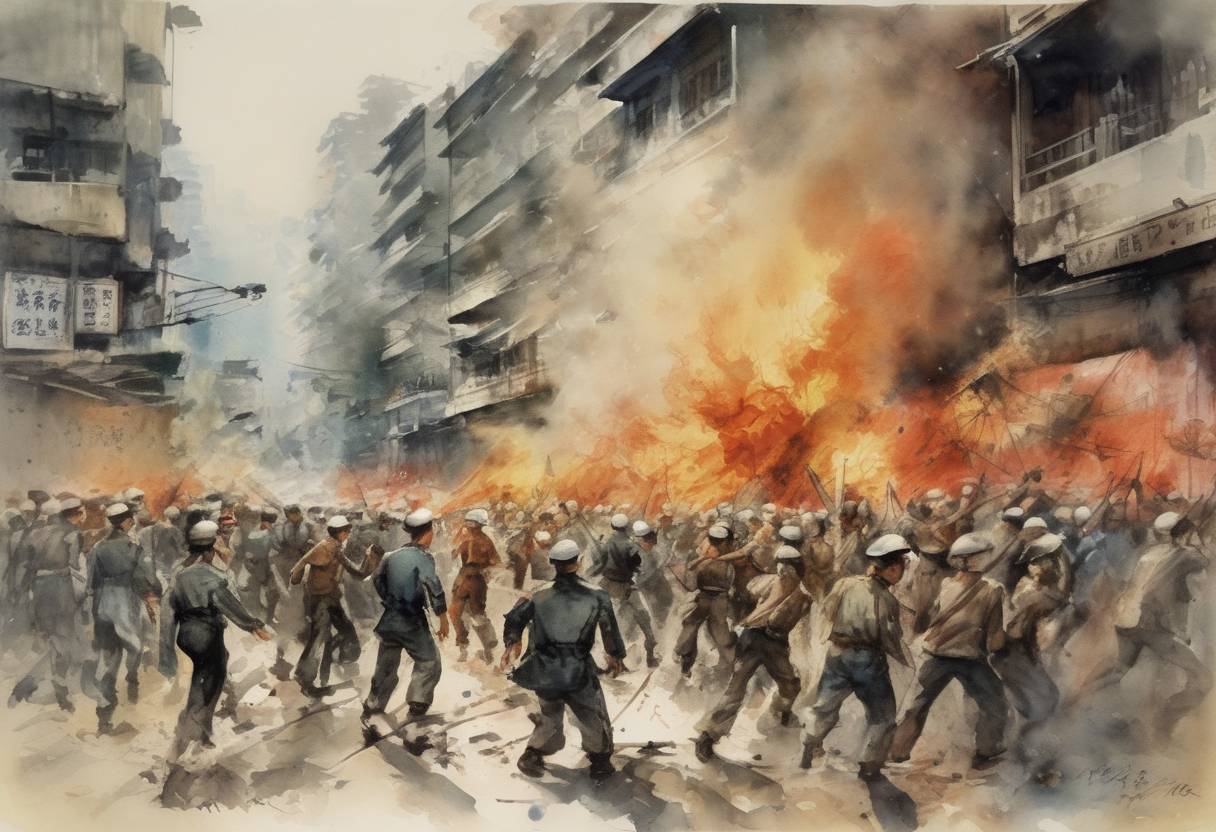
- Nature of the Riots: The riots involved street battles, arson, and looting. Both sides engaged in violent confrontations, leading to significant property damage and chaos in the streets.
- Response: The British colonial government deployed police and military forces to restore order. A curfew was imposed, and numerous arrests were made to quell the unrest.
Consequences
- Casualties and Damage: The riots resulted in several deaths and injuries, along with extensive damage to property.
- Political Impact: The riots highlighted the volatile political environment in Hong Kong and the challenges faced by the colonial government in maintaining order amidst external political influences.
- Long-term Effects: The events of 1956 underscored the deep divisions within the Chinese community in Hong Kong and foreshadowed future tensions that would arise during the 1960s and beyond.
Historical Significance
The 1956 Hong Kong riots were a manifestation of the broader geopolitical struggles of the time, reflecting the ideological divide between communism and nationalism. They served as a reminder of the complex identity and political dynamics within Hong Kong, a city caught between colonial rule and the influences of its Chinese heritage. The riots also demonstrated the challenges faced by the British authorities in managing a diverse and politically charged population, setting the stage for future governance and policy decisions in the colony.