Confirmation of Thurgood Marshall to the U.S. Supreme Court
1967 · Washington, D.C., United States
Thurgood Marshall was confirmed as the first African American Justice of the United States Supreme Court.
October 2, 1967
Thurgood Marshall was sworn in as the first African American Justice of the United States Supreme Court.
Washington, D.C., United States | United States Supreme Court
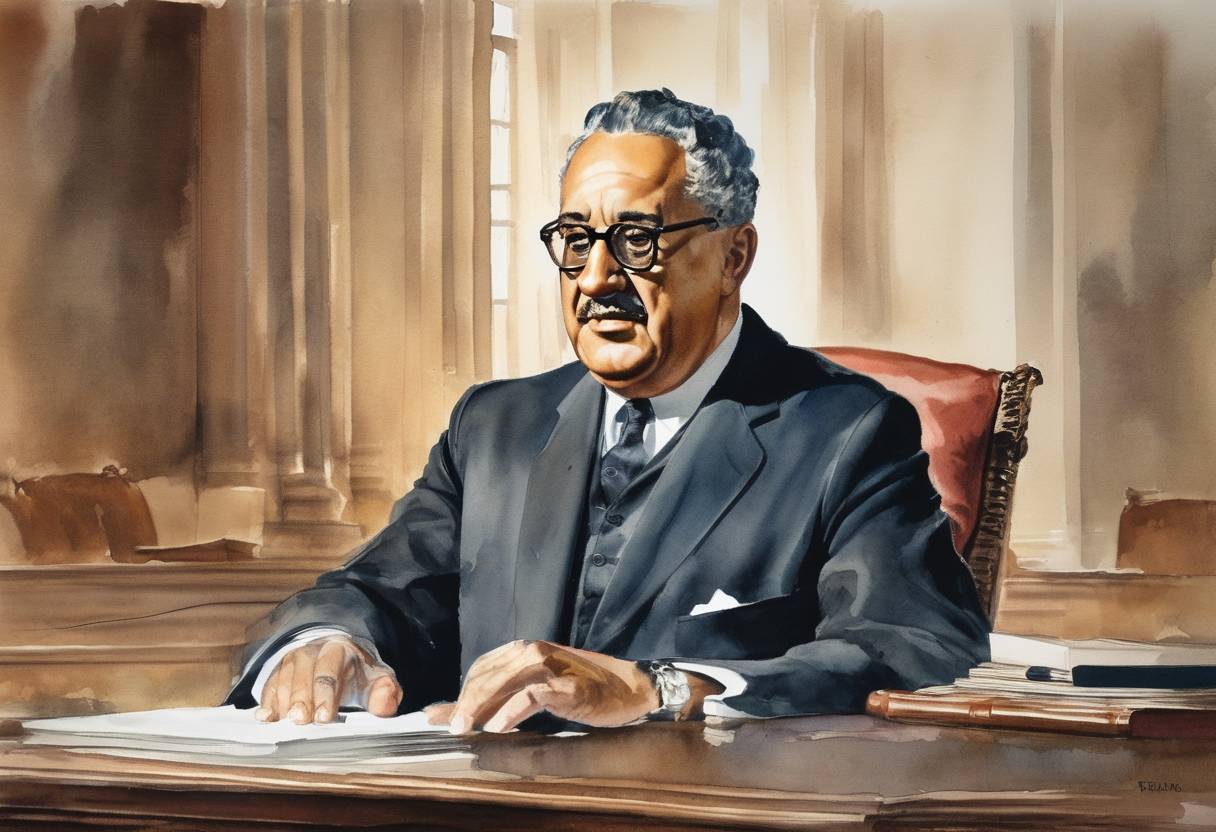
On October 2, 1967, Thurgood Marshall was sworn in as the first African American Justice of the United States Supreme Court, marking a significant milestone in American history and the civil rights movement.
Early Life and Education: Thurgood Marshall was born on July 2, 1908, in Baltimore, Maryland. He attended Lincoln University and later Howard University School of Law, where he graduated first in his class in 1933.
Legal Career: Marshall’s legal career was marked by his work with the NAACP (National Association for the Advancement of Colored People), where he served as the chief counsel. He was instrumental in challenging racial segregation and discrimination through the legal system.
Brown v. Board of Education: One of Marshall’s most notable achievements was his role in the landmark Supreme Court case Brown v. Board of Education of Topeka in 1954. As the lead attorney for the plaintiffs, he successfully argued that racial segregation in public schools was unconstitutional, leading to the Court’s unanimous decision to desegregate schools.
Nomination: President Lyndon B. Johnson nominated Thurgood Marshall to the Supreme Court on June 13, 1967. Johnson’s decision was part of his broader civil rights agenda and commitment to diversity in government.
Confirmation: Marshall’s nomination faced opposition from some Southern senators but was ultimately confirmed by the Senate on August 30, 1967, with a vote of 69-11.
Judicial Impact: During his tenure on the Supreme Court, which lasted until 1991, Marshall was known for his strong stance on individual rights and his opposition to the death penalty. He consistently advocated for the protection of civil liberties and the rights of marginalized groups.
Historical Significance: Marshall’s appointment was a historic moment for the United States, symbolizing progress in the struggle for racial equality and the inclusion of African Americans in the highest levels of government.
Legacy: Thurgood Marshall’s legacy continues to influence the legal landscape and civil rights in America. His work paved the way for future generations of African American lawyers and judges.
Thurgood Marshall’s swearing-in as a Supreme Court Justice remains a pivotal event in American history, reflecting the ongoing journey toward equality and justice for all citizens.
Source: en.wikipedia.org