Hamid Karzai's Inauguration as President of Afghanistan
2004 · Kabul, Afghanistan
Hamid Karzai is inaugurated as the first democratically elected President of Afghanistan after winning the October 2004 presidential election.
January 26, 2004
President Hamid Karzai signs the new constitution of Afghanistan into law, establishing a presidential system of government.
Kabul, Afghanistan | Government of Afghanistan
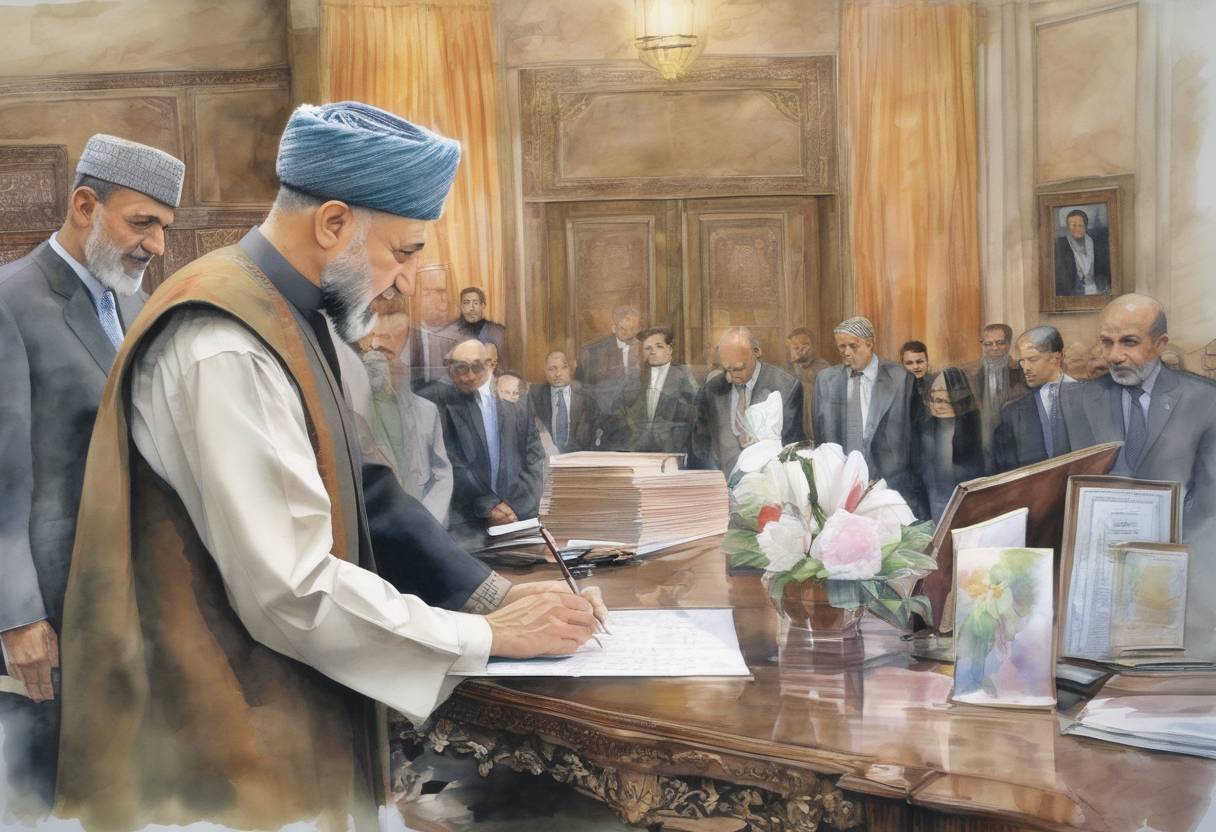
On January 26, 2004, a significant milestone in Afghanistan’s political history was achieved when President Hamid Karzai signed the new Afghan constitution into law. This event marked the establishment of a presidential system of government in Afghanistan, setting the framework for the country’s governance after years of conflict and instability.
Post-Taliban Era: The fall of the Taliban regime in 2001, following the U.S.-led invasion, created a power vacuum and the need for a new political order in Afghanistan. The Bonn Agreement, signed in December 2001, laid the groundwork for the establishment of a transitional government and the drafting of a new constitution.
Constitutional Loya Jirga: The process of drafting the new constitution involved a Constitutional Loya Jirga, a traditional grand assembly, which convened in December 2003. This assembly included representatives from various ethnic, political, and social groups across Afghanistan, reflecting the country’s diverse population.
Presidential System: The constitution established a strong presidential system, with the President serving as both the head of state and government. The President was to be elected by direct vote for a five-year term, with the possibility of re-election for a second term.
Bicameral Legislature: It introduced a bicameral National Assembly, consisting of the House of the People (Wolesi Jirga) and the House of Elders (Meshrano Jirga), to ensure representation and legislative oversight.
Judicial Independence: The constitution provided for an independent judiciary, with the Supreme Court as the highest judicial authority, to uphold the rule of law and protect citizens’ rights.
Rights and Freedoms: It enshrined fundamental rights and freedoms, including freedom of speech, religion, and assembly, and emphasized the equality of all citizens regardless of gender, ethnicity, or religion.
Political Stability: The signing of the constitution was a crucial step towards political stability and the establishment of democratic governance in Afghanistan. It provided a legal framework for the country’s first presidential elections, held later in October 2004, in which Hamid Karzai was elected as the first President under the new constitution.
Challenges and Criticisms: Despite its significance, the implementation of the constitution faced numerous challenges, including ongoing security issues, political factionalism, and the need for effective governance. Critics also pointed out the difficulties in balancing central authority with regional autonomy and addressing the needs of Afghanistan’s diverse population.
Legacy: The 2004 constitution remained a cornerstone of Afghanistan’s political system for many years, although it was subject to amendments and debates over its provisions. It played a pivotal role in shaping the country’s democratic institutions and governance practices.
The signing of the new Afghan constitution on January 26, 2004, was a landmark event in the nation’s history, symbolizing a commitment to democratic principles and the rule of law amidst the challenges of rebuilding a war-torn society.
Source: en.wikipedia.org