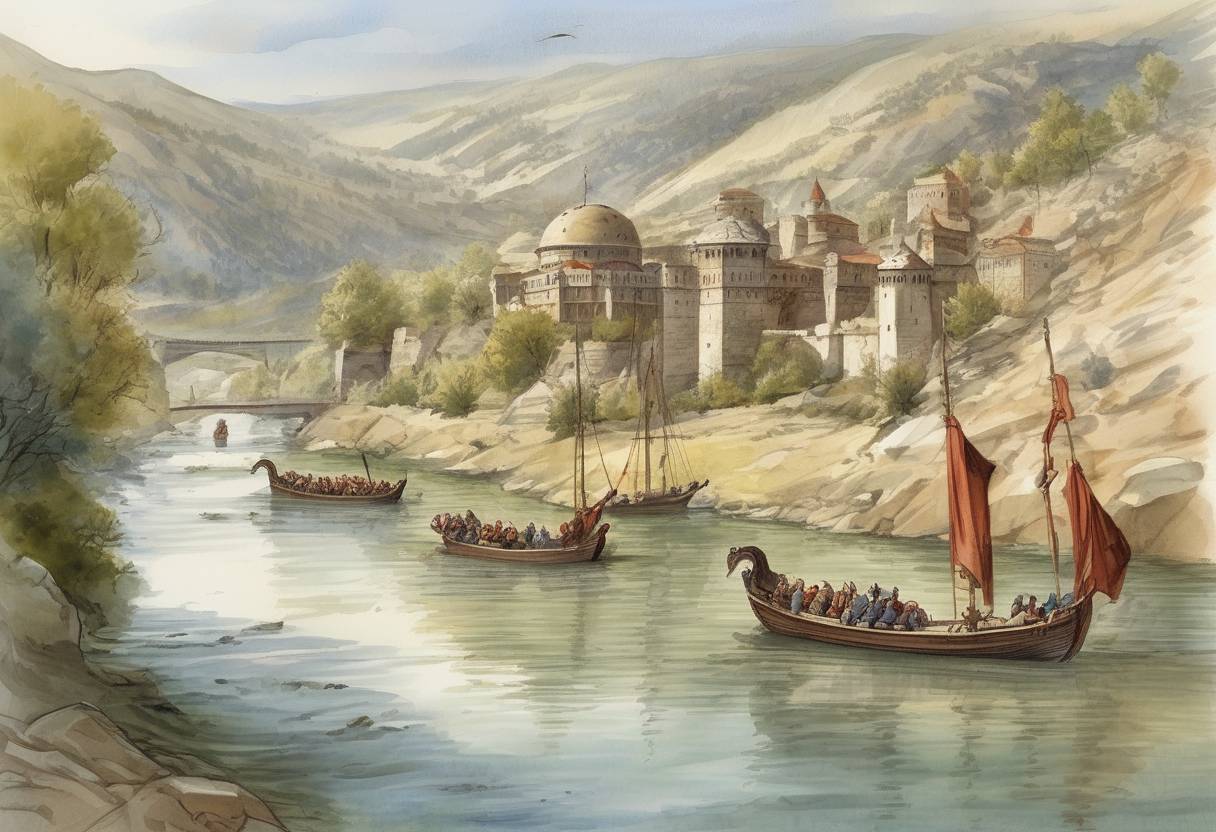
Frederick I Barbarossa: The Drowning in the Saleph River
On June 10, 1190, Frederick I Barbarossa, the Holy Roman Emperor, met an untimely death by drowning in the Saleph River, now known as the Göksu River, in present-day Turkey. This event occurred during the Third Crusade, a significant military campaign aimed at recapturing Jerusalem and other holy sites from Muslim control.
Background
Frederick I, known as Barbarossa due to his red beard, was one of the most powerful and charismatic rulers of the Middle Ages. Born in 1122, he became King of Germany in 1152 and was crowned Holy Roman Emperor in 1155. His reign was marked by efforts to consolidate imperial power and assert dominance over the Italian territories, as well as conflicts with the papacy.
The Third Crusade
The Third Crusade (1189–1192) was launched in response to the capture of Jerusalem by the Muslim leader Saladin in 1187. Frederick Barbarossa, along with other European monarchs like Richard I of England and Philip II of France, took the cross to lead their forces to the Holy Land.
Frederick’s army was one of the largest and most formidable, consisting of tens of thousands of soldiers. The journey to the Holy Land was arduous, requiring the crossing of the Byzantine Empire and Anatolia.
The Drowning Incident
As Frederick’s army traversed through the rugged terrain of Anatolia, they reached the Saleph River. On June 10, 1190, while attempting to cross the river, Frederick, who was reportedly not wearing his armor, was swept away by the strong currents and drowned. His death was a catastrophic blow to the morale of his troops and the overall crusading effort.
Consequences
Disarray Among the Crusaders: Frederick’s death led to chaos and demoralization among his troops. Many soldiers deserted, and the once-mighty army significantly dwindled in size.
Impact on the Crusade: The loss of Frederick, a key leader, weakened the Christian forces. Although Richard I and Philip II continued the crusade, the campaign ultimately failed to achieve its primary objective of recapturing Jerusalem.
Succession and Legacy: Frederick’s son, Henry VI, succeeded him as Holy Roman Emperor. Frederick Barbarossa’s legacy endured, with his reign often idealized in German folklore and history as a symbol of imperial strength and unity.
Historical Significance
Frederick Barbarossa’s death marked a turning point in the Third Crusade, highlighting the challenges of medieval warfare and the difficulties of maintaining a cohesive multinational military campaign. His reign and untimely demise continue to be subjects of historical interest, illustrating the complex interplay of power, religion, and politics in medieval Europe.