The Liberation of Maastricht: September 14, 1944
1944 · Maastricht, Netherlands
The Maastricht Resistance in the Netherlands captures the city of Maastricht from German occupation during World War II.
August 9, 1673
The Siege of Maastricht ends as French forces under Louis XIV capture the city during the Franco-Dutch War.
Maastricht, Netherlands | French Army
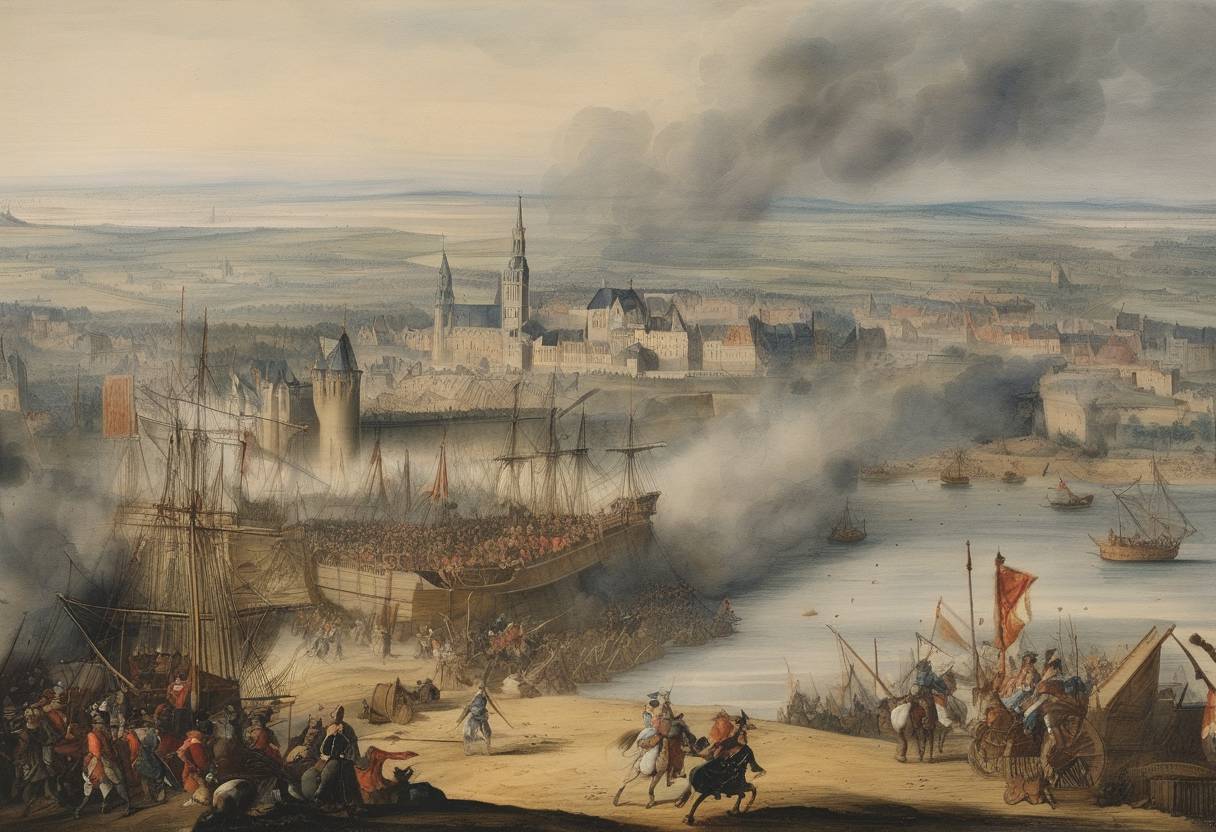
The end of the Siege of Maastricht on August 9, 1673, marked a significant military achievement for French forces during the Franco-Dutch War. Under the command of King Louis XIV, the successful capture of this strategically important city demonstrated the might of France and the effectiveness of its military strategies.
The Franco-Dutch War (1672-1678) was primarily fought between France and the Dutch Republic, with France aiming to expand its territories and weaken Dutch power. France allied with England and the Bishopric of Münster, while the Dutch received support from the Holy Roman Empire, Spain, and several German states. The war was part of Louis XIV’s broader plan to assert French dominance in Europe.
Maastricht, located on the Maas River, was a crucial fortress town in the Dutch defense line, offering control over routes into the heart of the Dutch Republic. Its strategic position made it a prime target for Louis XIV’s campaign.
The siege began on June 13, 1673, when French troops, commanded by Marshal Vauban, one of the most renowned military engineers of the era, surrounded Maastricht. Vauban employed his innovative siege tactics, focusing on trench warfare and precise artillery bombardment to weaken the city’s defenses.
The French forces erected extensive trench networks to protect their soldiers while they advanced towards Maastricht’s fortifications. This method proved effective in diminishing the city’s defensive capabilities. The French also utilized continual bombardment, targeting key structures to create vulnerabilities.
After nearly two months of relentless pressure, the defenders of Maastricht, primarily composed of Dutch and Spanish troops, conceded defeat. On August 9, 1673, the city surrendered to the overwhelming French force. The terms of surrender allowed the defending troops to leave the city with honors of war, a relatively generous condition reflecting the respect for the noble defense mounted by the garrison.
The fall of Maastricht provided France with a strategic foothold in the region, bolstering its position in the ongoing conflict. Louis XIV’s victory at Maastricht was celebrated in France as a demonstration of military prowess, enhancing his reputation and furthering his image as the “Sun King.”
The event also signified the effective use of Vauban’s siege techniques, which would influence military engineering for decades. French dominance continued throughout the war, although the conflict would reach a stalemate in subsequent years, culminating in the Treaty of Nijmegen in 1678, which ended hostilities between the major powers involved.
The Siege of Maastricht is remembered as a significant episode in the Franco-Dutch War, illustrating the complex interplay of military innovation, strategic objectives, and broader geopolitical considerations during the tumultuous 17th century.
Source: en.wikipedia.org