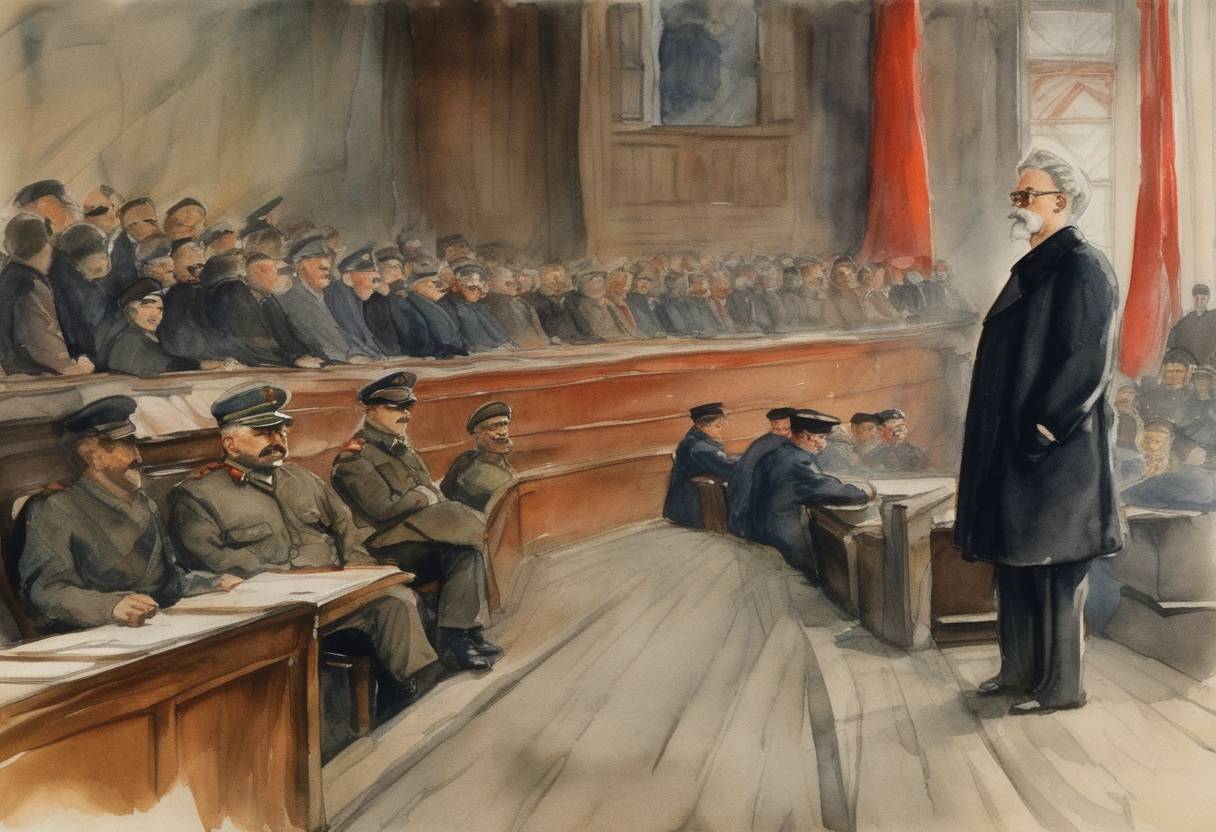
Leon Trotsky’s Dismissal: January 16, 1925
On January 16, 1925, Leon Trotsky was dismissed from his position as the Chairman of the Revolutionary Military Council of the Soviet Union, a pivotal moment in the power struggles that unfolded after Vladimir Lenin’s death. This event marked a significant shift in Soviet politics, as it effectively removed one of the key figures who had been instrumental in the Bolshevik Revolution and the early Soviet military establishment.
Context and Background
Leon Trotsky, a central figure in the October Revolution of 1917, served as the People’s Commissar for Military and Naval Affairs and was a founding leader of the Red Army. During the Russian Civil War (1917-1922), Trotsky’s leadership was crucial to the survival and success of the Bolshevik regime. His strategic military insight and organizational skills earned him a formidable reputation.
However, the death of Lenin in January 1924 triggered a fierce power struggle within the Communist Party. Trotsky, who was perceived as Lenin’s potential successor by some, faced opposition from a coalition led by Joseph Stalin, Grigory Zinoviev, and Lev Kamenev. Stalin, in particular, was gaining influence, partially through his role as General Secretary, which allowed him to build a base of support within the party.
Trotsky’s Dismissal
By the end of 1924, Trotsky’s position was increasingly undermined by Stalin and his allies. The tension between Stalin and Trotsky had deep ideological roots, with Trotsky advocating for “permanent revolution,” a theory that called for an international spread of socialist revolutions, in contrast to Stalin’s focus on “Socialism in One Country.”
Trotsky’s dismissal from the Revolutionary Military Council on January 16, 1925, was not entirely unexpected but signaled a decisive victory for Stalin. It resulted from a series of political maneuvers and character attacks against Trotsky, perpetuated by the ruling faction, which accused him of being divisive and criticized his military strategies and theoretical positions.
Aftermath and Historical Significance
Trotsky’s removal from power was a critical step in consolidating Stalin’s authority, setting in motion events that would eventually lead to Trotsky’s exile from the Soviet Union in 1929. Stalin’s ascent to power marked the beginning of a new era in Soviet politics, characterized by a highly centralized state and the eventual establishment of a totalitarian regime.
The dismissal of Trotsky is regarded as a significant turning point in Soviet history, as it illustrated the shifting dynamics within the Communist Party and the elimination of potential rivals by Stalin. It paved the way for Stalin’s unchallenged leadership and the subsequent purges of the late 1930s, during which many of Stalin’s real and perceived enemies, including former allies, were executed or imprisoned.
Trotsky, living in exile, continued his opposition against Stalinism until his assassination in 1940, ordered by Stalin. His writings and theories remained influential among leftist movements worldwide, though his political influence within the Soviet Union had effectively ended with his dismissal in 1925.