The Treaty of Belgrade: September 18, 1739
1739 · Belgrade, Serbia
The Treaty of Belgrade is signed, ending the Austro-Russian–Turkish War (1735–1739) and establishing peace between the Ottoman Empire and the Habsburg Monarchy.
July 21, 1718
The Treaty of Passarowitz was signed, concluding the Austro-Turkish and Venetian- Turkish Wars of 1716-1718. The treaty marked the end of hostilities between the Ottoman Empire and Austria, with significant territorial changes in favor of Austria.
Požarevac, Serbia | Ottoman Empire, Habsburg Monarchy
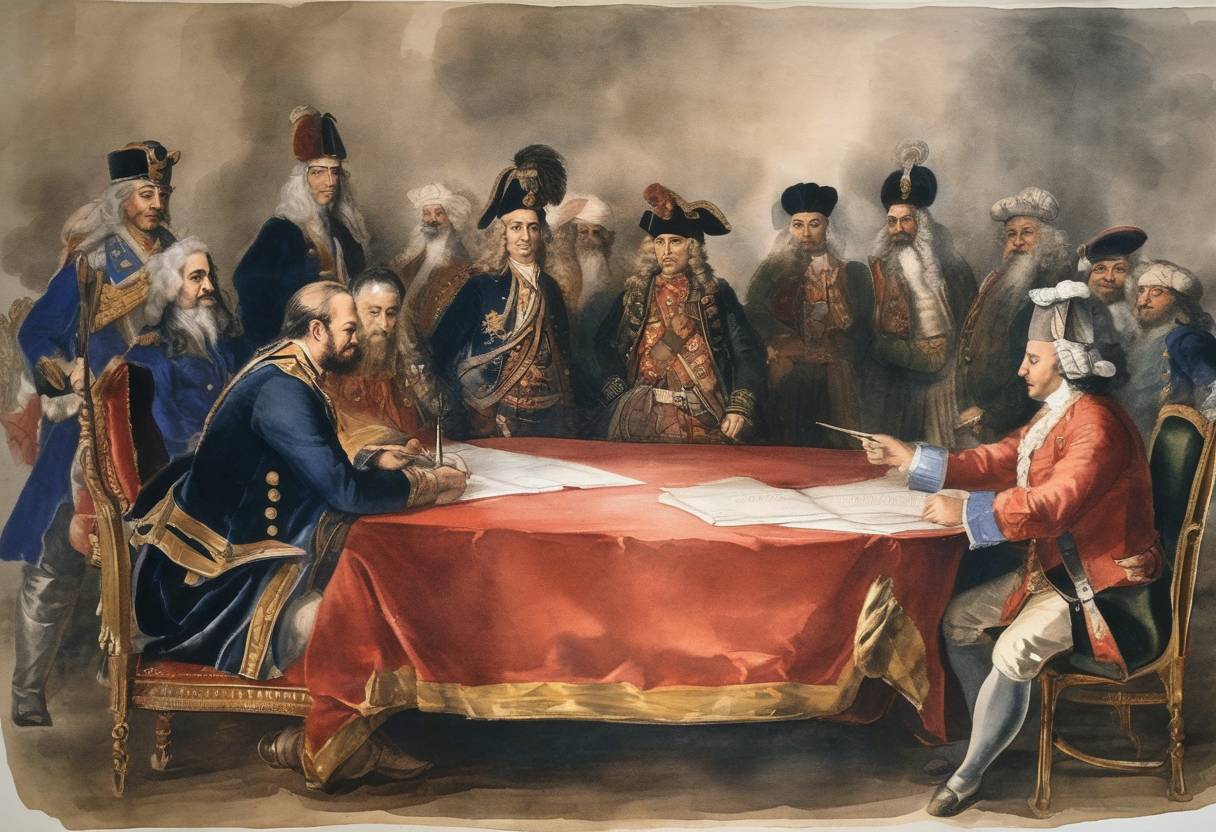
On July 21, 1718, the Treaty of Passarowitz was signed, concluding the Austro-Turkish and Venetian-Turkish Wars that spanned from 1716 to 1718. This treaty marked the cessation of hostilities between the Holy Roman Empire under the rule of the Habsburg Monarchy and the Ottoman Empire, with substantial territorial adjustments in favor of Austria.
The catalyst for the Austro-Turkish War was primarily rooted in the shifting alliances and territorial ambitions in the Balkans and Central Europe. The Ottoman Empire, having once been a dominant force in the region, experienced military setbacks and internal challenges that invited influence and expansion by neighboring powers. The ongoing decline presented Austria, a regional power with significant military resources, a chance to expand its influence and territory in Southeast Europe.
The Venetians, seeking to regain lost territories in the Peloponnese and elsewhere, also engaged the Ottomans. The Austrian military campaigns, particularly under the leadership of Prince Eugene of Savoy, were notably successful. Key victories included the Battle of Petrovaradin in 1716 and the Siege of Belgrade in 1717, both of which solidified Austrian military supremacy in the region.
The Treaty of Passarowitz was negotiated at the Serbian town of Požarevac (known as Passarowitz). The terms reflected Austria’s military victories, resulting in significant territorial gains:
The Treaty of Passarowitz represented a substantial shift in the balance of power in Southeast Europe. It demonstrated the waning influence of the Ottoman Empire, highlighting a period of retrenchment and reform within the empire in response to military and administrative shortcomings exposed by the conflict.
For Austria, the treaty underscored the country’s rise as a significant continental power, strategically expanding its territory and influence. The newfound control over critical waterways and trade routes, as well as fertile lands, contributed to the Habsburg monarchy’s economic and military strength for decades to come.
The Treaty of Passarowitz thus marked a pivotal moment in European and Ottoman history, signaling changes in the dynamics of power and setting the stage for subsequent conflicts and diplomatic interactions in the region.
Source: en.wikipedia.org