The Battle of Vienna: September 12, 1683
1683 · Vienna, Austria
The Battle of Vienna takes place, marking a turning point in the Ottoman-Habsburg wars.
August 6, 1806
The Holy Roman Empire was dissolved following the abdication of Emperor Francis II, marking the end of the centuries-old empire.
Vienna, Austria | Holy Roman Empire
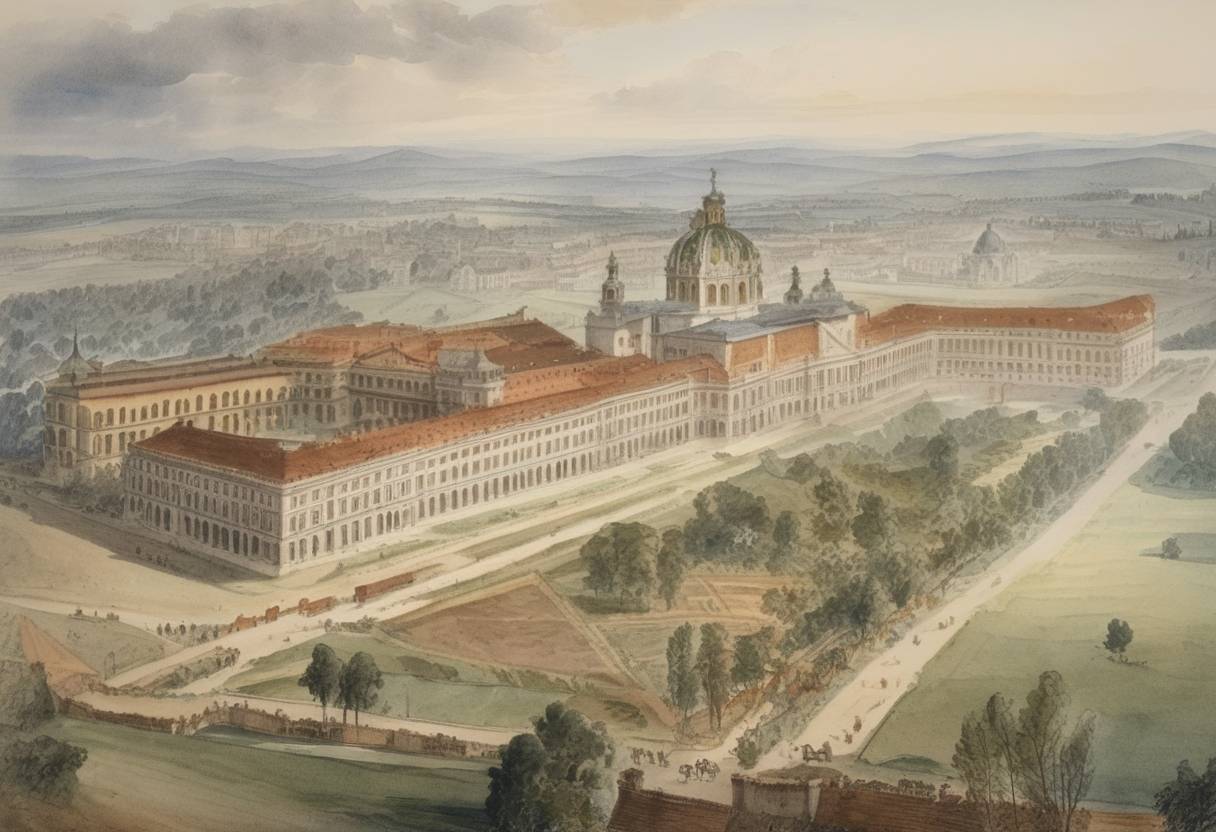
On August 6, 1806, the Holy Roman Empire, a central European empire that existed for over a millennium, was formally dissolved. This event followed the abdication of its last emperor, Francis II, marking the end of a notable era in European history.
The Holy Roman Empire was a complex political entity that traced its foundation back to Charlemagne, crowned as Emperor of the Romans in 800. Although its structure evolved over time, by the late Middle Ages, the empire comprised numerous semi-autonomous territories. It played a pivotal role in European medieval politics and was central to the religious conflicts during the Protestant Reformation.
The immediate context leading to its dissolution was the rise of Napoleon Bonaparte. By the early 19th century, Napoleon’s military campaigns significantly altered the political landscape of Europe. His relentless expansion and the establishment of the Confederation of the Rhine—a league of German states under French influence—undermined the Holy Roman Empire’s cohesion and credibility.
Treaty of Pressburg (1805): Following a decisive defeat at the Battle of Austerlitz, the Treaty of Pressburg forced Austria, the leading state of the Holy Roman Empire, to acknowledge territorial concessions favoring France and its allies.
Formation of the Confederation of the Rhine (July 1806): Napoleon created the Confederation as a buffer against Austria and Prussia, comprising many former Holy Roman Empire states. This alliance was effectively a protectorate under French control and signaled the impending end of the Holy Roman Empire.
Emperor Francis II, acknowledging the empire’s untenability under the prevailing circumstances, abdicated on August 6, 1806. By renouncing his title, he preempted the complete capture or fragmentation of the empire under French pressure. He then adopted the title Francis I of Austria, establishing a new Austrian Empire from the former Habsburg territories.
The dissolution of the Holy Roman Empire had profound implications:
End of the Thousand-Year Reich: The empire’s fall marked the end of an institution that had profoundly shaped Central European history. Its absence left a power vacuum in German-speaking Europe.
Rise of New National Entities: The subsequent decades witnessed the consolidation of national states in Germany and Italy, leading to the unification movements in the mid-19th century.
Napoleonic Influence: The event exemplified Napoleon’s influence and ambitions over Europe, which persisted until his eventual defeat in 1815 at the Battle of Waterloo.
The dissolution of the Holy Roman Empire signified a turning point that led to the modern reshaping of European political borders and laid groundwork for the nation-state structure we recognize today.
Source: www.britannica.com