Juno Spacecraft Enters Orbit Around Jupiter - July 5, 2016
2016 · Jupiter orbit, N/A
The Juno spacecraft, launched by NASA, successfully entered orbit around Jupiter, marking a significant milestone in the study of the gas giant and its moons.
September 21, 2003
The Galileo spacecraft, launched by NASA to study Jupiter and its moons, was intentionally crashed into Jupiter's atmosphere to avoid contaminating any of the planet's moons.
Jupiter, N/A | NASA
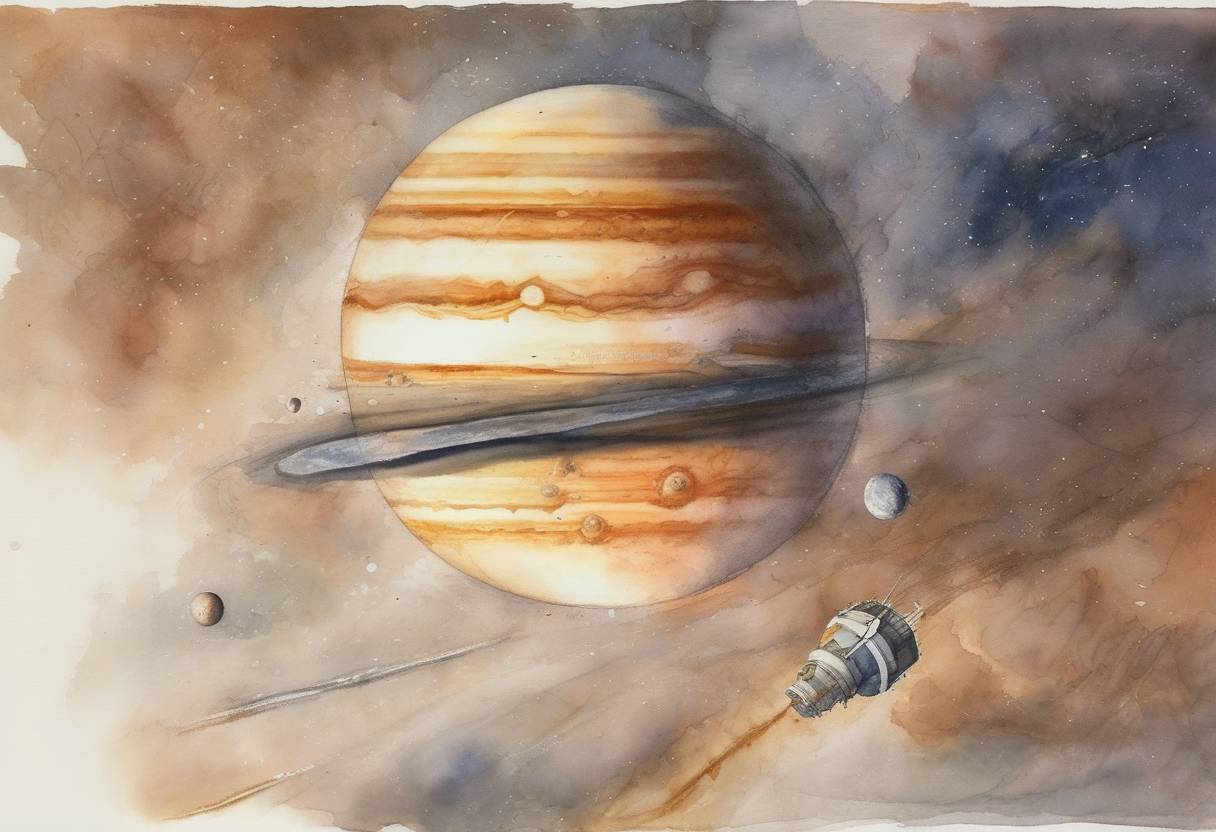
On September 21, 2003, NASA’s Galileo spacecraft concluded its historic mission by intentionally plunging into Jupiter’s atmosphere. This deliberate act was designed to prevent any potential contamination of Jupiter’s moons, particularly Europa, which is believed to harbor a subsurface ocean and possibly conditions suitable for life.
Launched on October 18, 1989, aboard the Space Shuttle Atlantis, Galileo embarked on a complex journey to the Jovian system. Its mission was to study Jupiter, its moons, and its magnetosphere. After a six-year journey, which included gravity-assist flybys of Venus and Earth, Galileo arrived at Jupiter on December 7, 1995.
During its mission, Galileo made several groundbreaking discoveries:
As Galileo’s mission extended beyond its original timeline, concerns grew about the spacecraft’s dwindling fuel reserves. Without the ability to control its trajectory, there was a risk that Galileo could accidentally crash into one of Jupiter’s moons, particularly Europa, and contaminate it with Earth microbes.
To prevent this, NASA decided to send Galileo into Jupiter’s atmosphere, ensuring it would burn up upon entry and eliminate any contamination risk.
On September 21, 2003, after 14 years in space and eight years orbiting Jupiter, Galileo made its final descent. The spacecraft entered Jupiter’s atmosphere at a speed of nearly 108,000 miles per hour (173,000 kilometers per hour). It quickly disintegrated due to the intense heat and pressure, marking the end of a mission that significantly enhanced our understanding of the Jovian system.
Galileo’s mission laid the groundwork for future exploration of Jupiter and its moons. Its findings have been instrumental in shaping subsequent missions, such as the Juno spacecraft, which continues to study Jupiter, and the upcoming Europa Clipper mission, set to further investigate Europa’s habitability.
Galileo’s intentional crash into Jupiter remains a testament to NASA’s commitment to planetary protection and the responsible exploration of our solar system.
Source: solarsystem.nasa.gov