The Soviet Union's Successful ICBM Test on August 26, 1957
1957 · Moscow, Soviet Union
The Soviet Union announced the successful test of an intercontinental ballistic missile (ICBM).
February 13, 1974
Aleksandr Solzhenitsyn, Russian novelist and critic of Soviet totalitarianism, was exiled from the Soviet Union.
Moscow, Soviet Union | Soviet Government
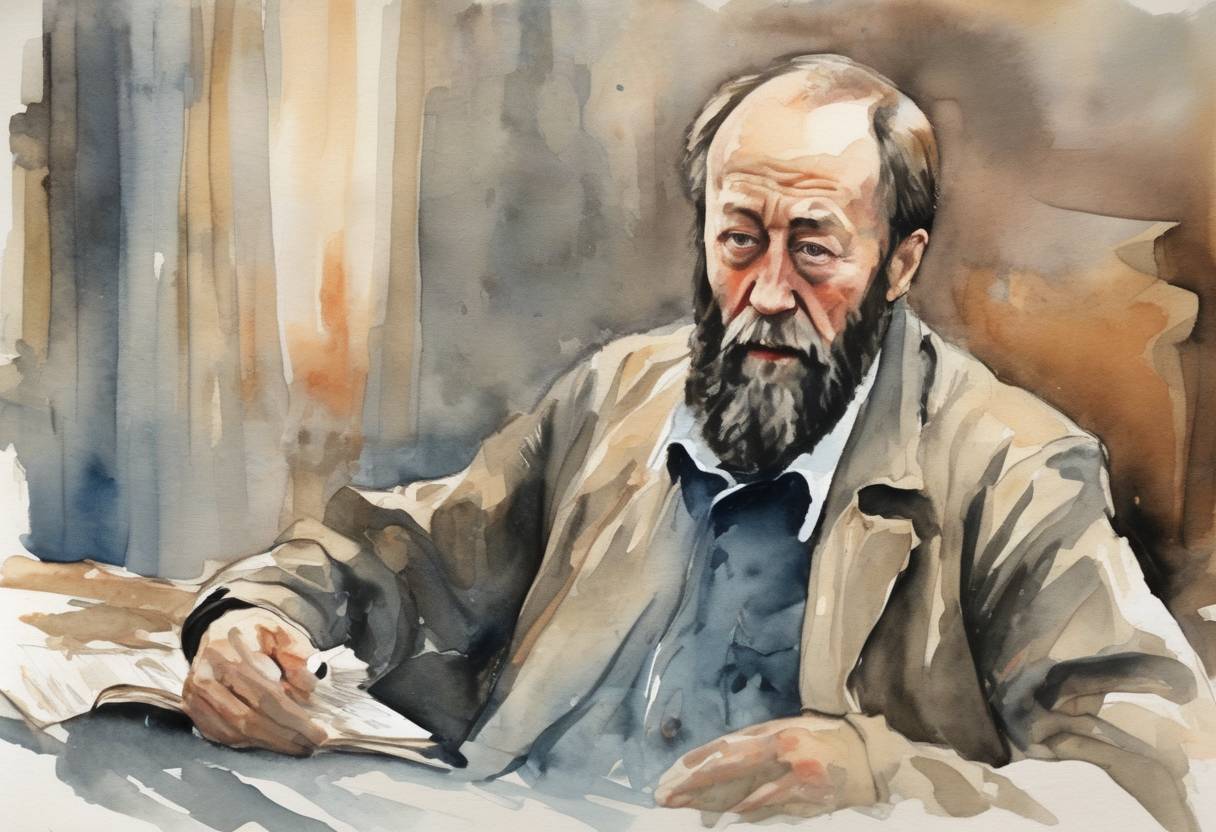
On February 13, 1974, Aleksandr Solzhenitsyn, the renowned Russian novelist and outspoken critic of Soviet totalitarianism, was forcibly exiled from the Soviet Union. This event marked a significant moment in the Cold War era, highlighting the tensions between the Soviet regime and its dissidents.
Aleksandr Solzhenitsyn was born on December 11, 1918, in Kislovodsk, Russia. He served in the Red Army during World War II but was arrested in 1945 for criticizing Joseph Stalin in private correspondence. Solzhenitsyn was sentenced to eight years in a labor camp, followed by internal exile. His experiences in the Gulag system profoundly influenced his writing.
In 1962, Solzhenitsyn gained international fame with the publication of “One Day in the Life of Ivan Denisovich,” a novel that depicted the harsh realities of life in a Soviet labor camp. This work was initially published with the approval of Soviet Premier Nikita Khrushchev, as part of a brief period of de-Stalinization. However, as the political climate shifted, Solzhenitsyn’s works were increasingly censored.
Solzhenitsyn continued to write and publish works that criticized the Soviet regime, including “The First Circle” and “Cancer Ward.” His magnum opus, “The Gulag Archipelago,” was a detailed, multi-volume account of the Soviet forced labor camp system. It was published in the West in 1973, further antagonizing Soviet authorities.
The publication of “The Gulag Archipelago” was a turning point. The Soviet government viewed Solzhenitsyn as a dangerous dissident whose works undermined the state’s authority and international image. In response, the government intensified its efforts to silence him.
On February 12, 1974, Solzhenitsyn was arrested by the KGB. The following day, February 13, he was stripped of his Soviet citizenship and forcibly deported to West Germany. His expulsion was part of a broader Soviet strategy to rid the country of prominent dissidents without creating martyrs.
Solzhenitsyn’s exile drew international attention and condemnation of the Soviet Union’s human rights abuses. He settled in the United States, where he continued to write and speak out against Soviet totalitarianism. His works played a crucial role in raising awareness about the oppressive nature of the Soviet regime and the plight of its political prisoners.
In 1990, as the Soviet Union began to collapse, Solzhenitsyn’s citizenship was restored. He returned to Russia in 1994, where he lived until his death in 2008.
Solzhenitsyn’s exile underscored the power of literature as a tool for political dissent and the lengths to which authoritarian regimes will go to suppress dissenting voices. His legacy endures as a testament to the resilience of the human spirit in the face of oppression.
Source: en.wikipedia.org