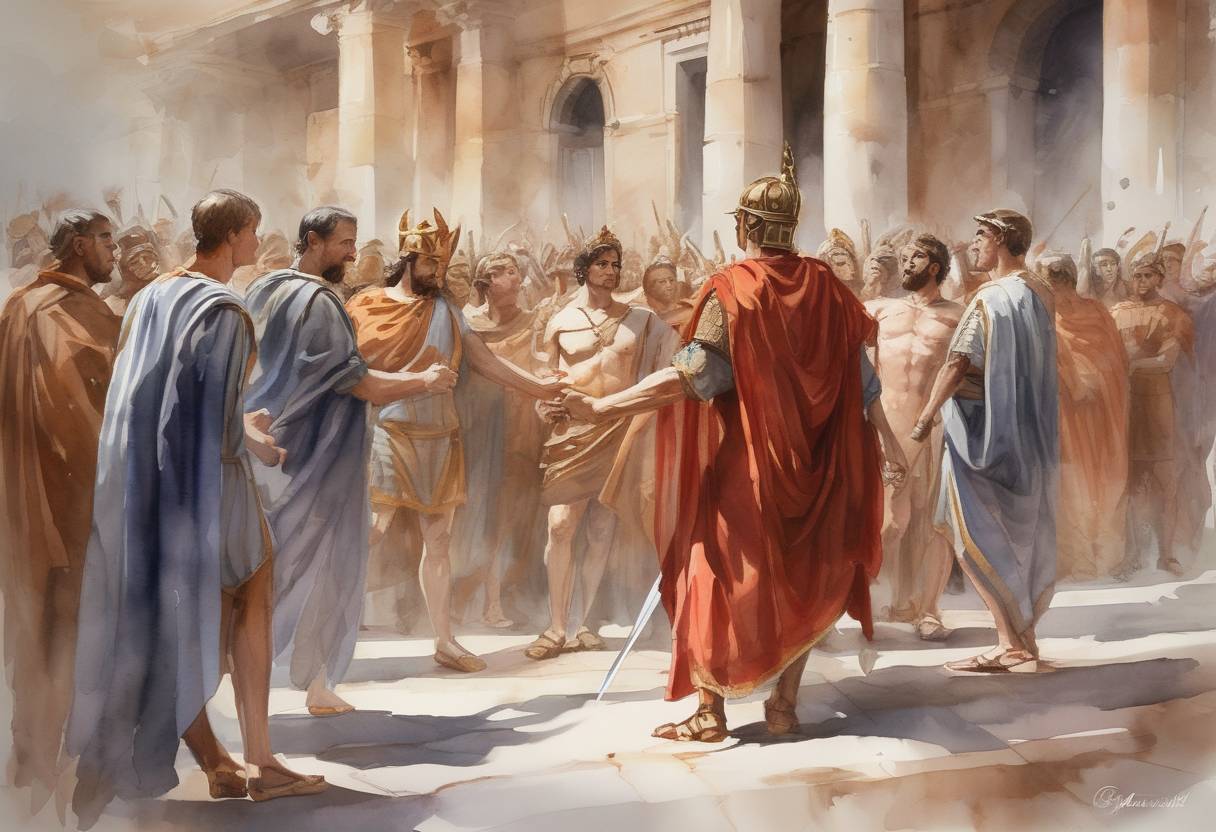
Otho Proclaimed Roman Emperor: January 15, 69 AD
On January 15, 69 AD, Marcus Salvius Otho was proclaimed Roman Emperor following the assassination of his predecessor, Galba. This event marked a pivotal moment in the chaotic Year of the Four Emperors, a period of civil war and political upheaval in the Roman Empire.
Background
The Year of the Four Emperors began with the suicide of Emperor Nero in 68 AD, which left a power vacuum and led to a rapid succession of rulers. Galba, the governor of Hispania Tarraconensis, was declared emperor by his legions and marched on Rome. However, his reign was short-lived, lasting only from June 68 AD to January 69 AD.
Galba’s rule was marked by unpopularity and discontent among the Roman populace and the Praetorian Guard, the elite unit responsible for the emperor’s protection. His decision to not pay the promised donative to the Guard, coupled with his austere and unpopular policies, led to widespread dissatisfaction.
Otho’s Rise to Power
Otho, a former governor of Lusitania and initially a supporter of Galba, became disillusioned with Galba’s leadership. He sought to position himself as a more favorable candidate for the throne. On January 15, 69 AD, Otho orchestrated a coup with the support of the Praetorian Guard. Galba was assassinated in the Roman Forum, along with his chosen successor, Lucius Calpurnius Piso.
Following the assassination, Otho was quickly proclaimed emperor by the Praetorian Guard and the Senate. His ascension was largely due to his ability to capitalize on the discontent with Galba and his promises of financial rewards to the Guard.
Otho’s Brief Reign
Otho’s reign was brief, lasting only until April 69 AD. Despite his initial popularity, he faced immediate challenges from Vitellius, the commander of the legions in Germania, who also claimed the imperial title. This led to a civil war between Otho’s forces and those loyal to Vitellius.
The decisive confrontation occurred at the Battle of Bedriacum in northern Italy. Otho’s forces were defeated, and, in an attempt to prevent further bloodshed, Otho committed suicide on April 16, 69 AD, after only three months as emperor.
Aftermath and Historical Significance
Otho’s death paved the way for Vitellius to become emperor, but his rule was also short-lived, as Vespasian eventually emerged victorious, establishing the Flavian dynasty. The rapid succession of emperors during this period highlighted the instability and volatility of Roman imperial politics.
The events of the Year of the Four Emperors underscored the critical role of military support in determining the legitimacy of Roman emperors and set a precedent for future power struggles within the empire. Otho’s brief reign is remembered as a testament to the tumultuous nature of Roman political life during this era.