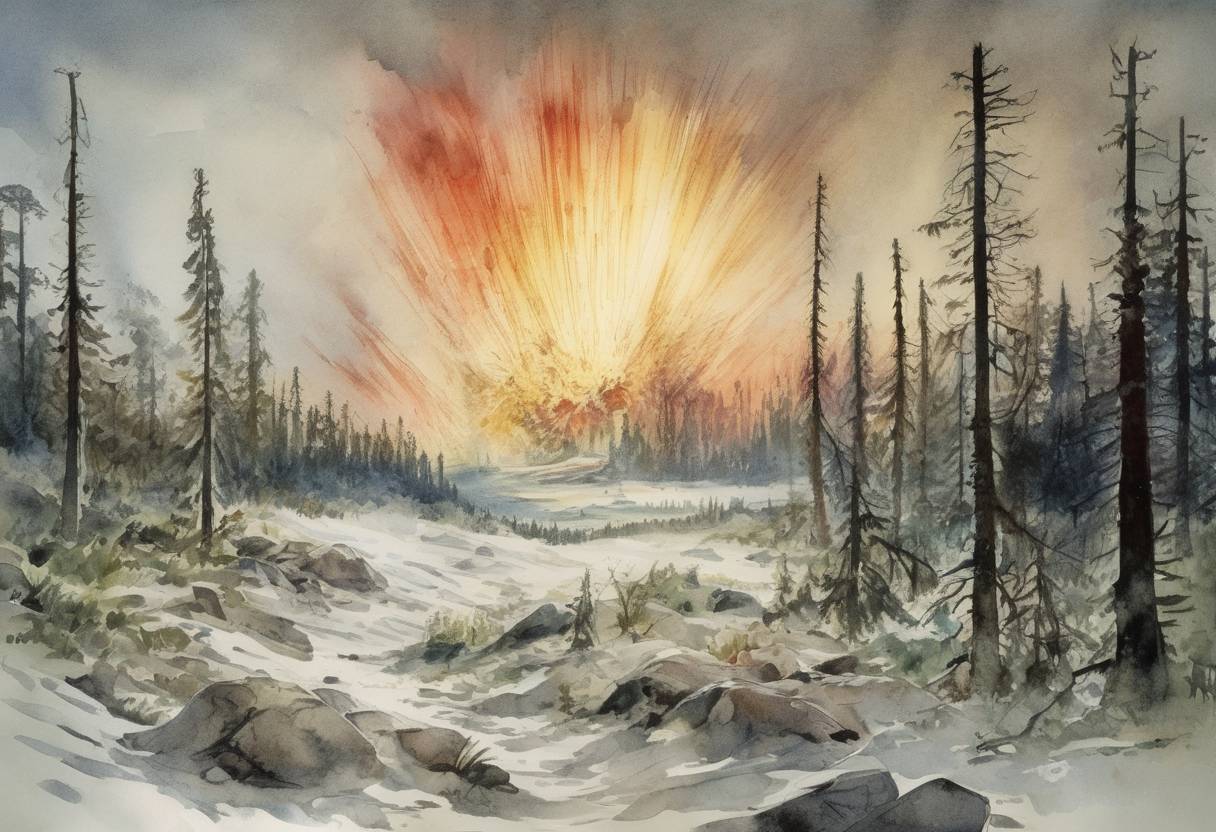
The Tunguska Event: June 30, 1908
The Tunguska event is one of the most significant and mysterious natural events of the 20th century. It occurred on the morning of June 30, 1908, in a remote area of Siberia, Russia, near the Tunguska River. This event is widely believed to have been caused by the airburst of a small comet or asteroid.
Key Details
- Location: The explosion took place over the Eastern Siberian Taiga, near the Podkamennaya Tunguska River in what is now Krasnoyarsk Krai, Russia.
- Impact Area: The explosion flattened an estimated 2,000 square kilometers (approximately 770 square miles) of forest, destroying around 80 million trees.
- Magnitude: The energy released by the explosion is estimated to have been equivalent to 10-15 megatons of TNT, roughly 1,000 times more powerful than the atomic bomb dropped on Hiroshima in 1945.
The Event
On the morning of June 30, 1908, at around 7:17 AM local time, a massive explosion occurred in the sky over the Tunguska region. Witnesses reported seeing a bright, fiery object streaking across the sky, followed by a series of loud explosions. The shockwave from the explosion was felt hundreds of kilometers away, and it knocked people off their feet and shattered windows in nearby settlements.
Scientific Investigation
- Initial Exploration: Due to the remote location and political turmoil in Russia, the first scientific expedition to the site was not conducted until 1927, led by Russian mineralogist Leonid Kulik. Kulik’s team documented the extensive tree damage and collected eyewitness accounts.
- Lack of Crater: Unlike typical meteorite impacts, no crater was found. This led scientists to conclude that the object exploded in the atmosphere, causing an airburst.
- Possible Causes: The prevailing theory is that the event was caused by the airburst of a stony asteroid or comet, approximately 50-60 meters in diameter. The object likely disintegrated at an altitude of 5-10 kilometers (3-6 miles) above the Earth’s surface.
Broader Significance
- Scientific Interest: The Tunguska event has been a subject of extensive scientific study and debate. It has provided valuable insights into the potential hazards posed by near-Earth objects.
- Cultural Impact: The event has captured the public imagination and has been referenced in various works of fiction and popular culture.
- Planetary Defense: The Tunguska event underscores the importance of monitoring and developing strategies to mitigate the threat of asteroid impacts on Earth.
In summary, the Tunguska event remains a fascinating and pivotal moment in the study of cosmic impacts, highlighting both the potential dangers of space objects and the need for continued vigilance in planetary defense efforts.