1914 · Dublin, Ireland
Leopold Bloom's fictional journey in James Joyce's unpublished draft of 'Ulysses' was set on April 28 in this early version of the text.
December 18, 1935
Samuel Beckett, the Irish avant-garde novelist, playwright, and poet known for his play 'Waiting for Godot', publishes his first full-length prose work, 'Murphy'.
Dublin, Ireland | Grove Press
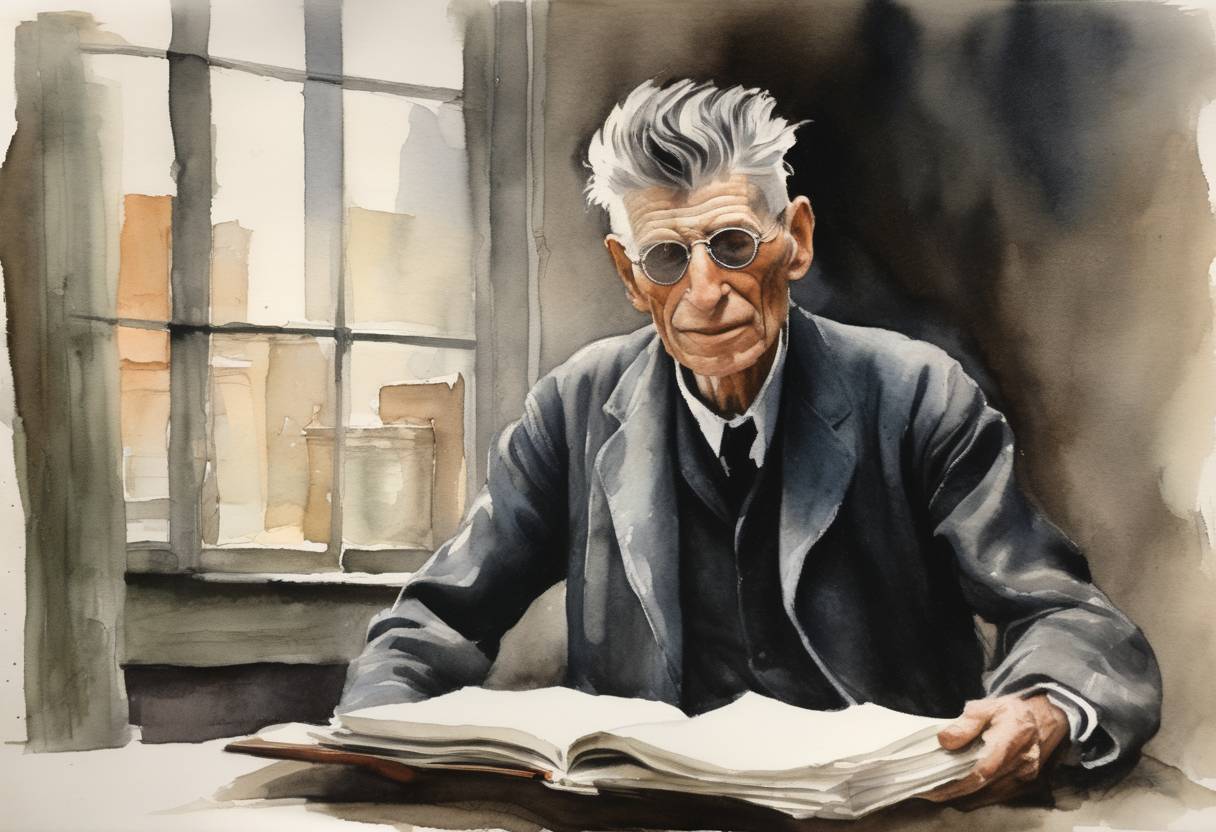
On December 18, 1935, Samuel Beckett, an influential avant-garde Irish novelist, playwright, and poet, published his first full-length prose work, Murphy. This marked a significant achievement in Beckett’s literary career, laying the groundwork for his future explorations of themes such as the absurdity of human existence and the limitations of identity and cognition.
Samuel Beckett was born on April 13, 1906, in Dublin, Ireland. He attended Trinity College, Dublin, where he studied Modern Languages. In 1928, he moved to Paris, where he became acquainted with James Joyce, whose work had a profound influence on Beckett’s own writing style and philosophical outlook.
Murphy is a novel that encapsulates Beckett’s early experimentation with narrative form and existential themes. The story centers around the character Murphy, an Irishman living in London, who seeks a way to reconcile his desire for inertia with the demands of the external world. The novel is characterized by its dark humor, philosophical inquiries, and distinctive prose style.
Beckett’s work in Murphy is notable for its exploration of the mind-body problem, a theme that would recur throughout his oeuvre. The protagonist’s struggle with both the external world and his internal desires is depicted through Beckett’s characteristic wit and a narrative structure that challenges conventional storytelling.
Though Murphy initially achieved limited commercial success, it has since been recognized as a seminal work in Beckett’s bibliography. The novel exemplifies his contribution to modernist literature and prefigures the existential and absurdist motifs that Beckett would famously develop in his later works, such as his groundbreaking play, Waiting for Godot.
Beckett’s innovative approach in Murphy laid the foundation for his post-war writing and significantly influenced 20th-century literature. His exploration of the absurd, the limitations of language, and the human condition continue to resonate with readers and scholars alike.
The publication of Murphy on December 18, 1935, was a pivotal moment in Samuel Beckett’s literary career, signifying the commencement of his profound exploration of existential themes. This work not only established his unique voice in literature but also heralded the emergence of a new narrative form that would challenge and inspire future generations of writers.
Source: www.britannica.com