The Battle of Nieuwpoort: Prelude, May 31, 1600
1600 · Nieuwpoort, Spanish Netherlands
The Battle of Nieuwpoort was in preparation with Maurice of Nassau's Dutch-English army assembling for engagement, significant in the Eighty Years' War.
December 11, 1602
A surprise Spanish attack led by Ambrosio Spinola took place on the fort at Ostend during the Eighty Years' War.
Ostend, Spanish Netherlands
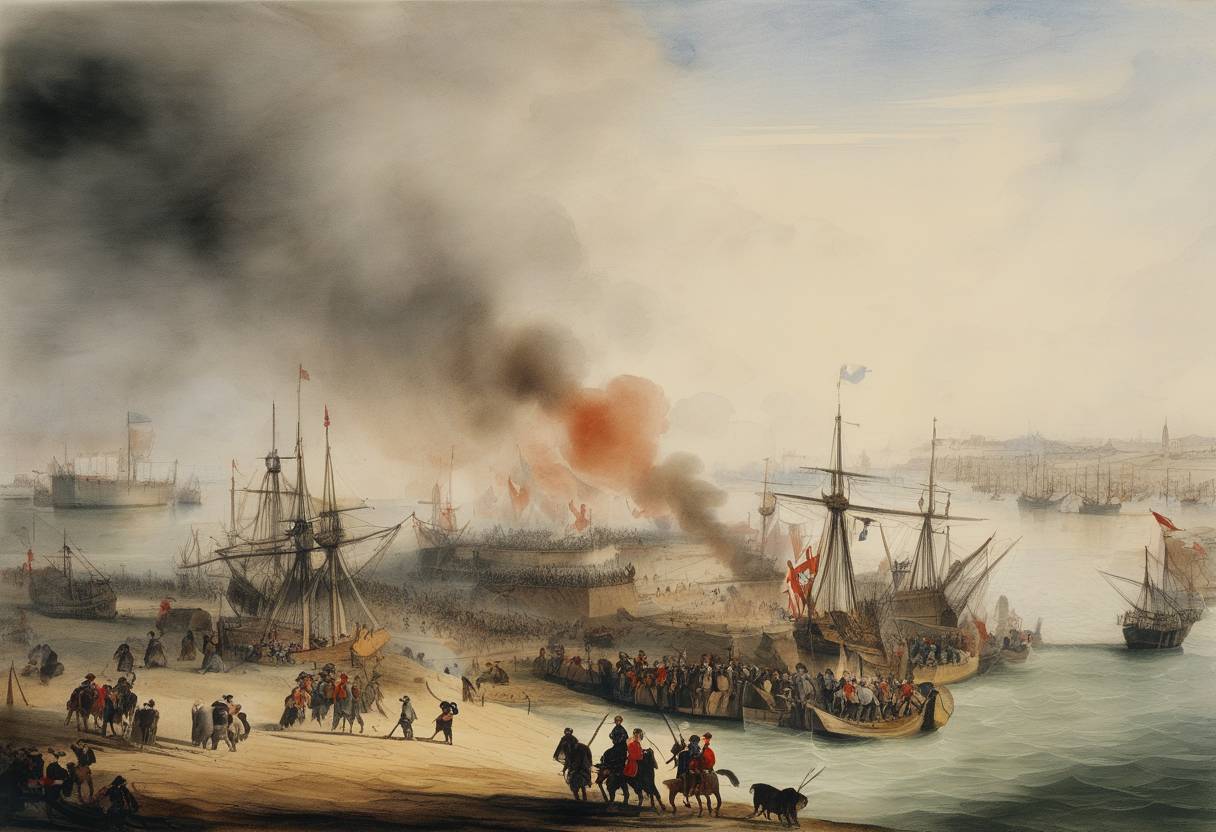
During the Eighty Years’ War, on December 11, 1602, a critical event unfolded in the protracted Siege of Ostend, marking a significant moment in military history.
The Eighty Years’ War (1568–1648) was a prolonged conflict between the Spanish Empire and the rebellious provinces in the Netherlands. The siege of Ostend commenced in 1601 and became one of the war’s lengthiest and most grueling sieges, emblematic of the larger struggle for control over the strategically valuable regions of the Low Countries.
Ambrosio Spinola, a Genoese military leader in the service of Spain, played a pivotal role in reinvigorating Spanish efforts during the siege. By 1602, the Spanish forces were encountering fierce resistance and faced a protracted standoff.
On December 11, 1602, Spinola executed a surprise attack aimed at the strategically significant fort at Ostend. This maneuver was devised to exploit weaknesses in the defenders’ positions and accelerate Spanish advances. Spinola’s unexpected assault demonstrated his tactical acumen, even though immediate gains were limited due to formidable Dutch defenses and inhospitable winter conditions.
Though the fort at Ostend did not fall directly from Spinola’s December offensive, his leadership marked a turning point in the siege’s operational tactics. Spinola’s continued efforts eventually culminated in the surrender of Ostend in 1604 after an exhausting three-year siege. This victory provided Spain with a temporary strategic advantage until the war’s eventual conclusion in 1648, which granted the Dutch independence in the Peace of Westphalia.
Spinola’s campaigns underscored evolving military strategies during the period, highlighting the increasing importance of engineering and fortification in early modern warfare. The siege of Ostend became emblematic of the grim realities of siege warfare, with both sides enduring immense hardships.
Overall, the attack on December 11, 1602, remains a significant example of the tactical innovations and grueling nature of the Eighty Years’ War, reflecting the steadfast Dutch resistance and the relentless Spanish ambition under leaders like Ambrosio Spinola.