Historic Summit on April 28, 2018: North and South Korea
2018 · Panmunjom, Korea
North and South Korea agreed to work towards denuclearization and formally ending the Korean War during a historic summit between leaders Kim Jong-un and Moon Jae-in.
July 22, 1951
The United States issues a cease-fire agreement in Panmunjom during the Korean War.
Panmunjom, Korea | United States
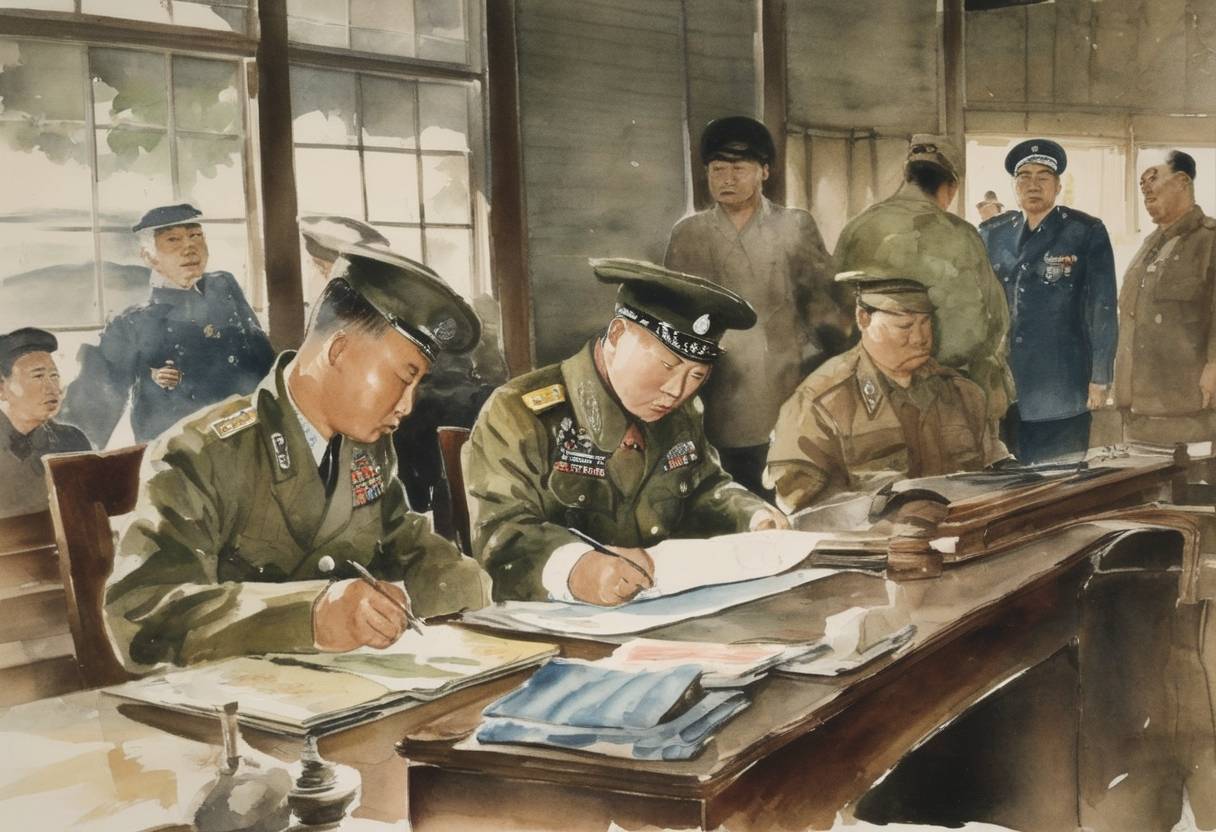
On July 22, 1951, during the Korean War, the United States participated in significant negotiations for a cease-fire agreement at Panmunjom, a village located near the 38th parallel in Korea. This event marked a pivotal moment in efforts to bring an end to hostilities that had been ongoing since June 1950.
The Korean War began on June 25, 1950, when North Korean forces crossed the 38th parallel, invading South Korea. This prompted a United Nations-led coalition, predominantly comprised of United States forces, to intervene on behalf of South Korea. The war saw a series of back-and-forth offensives along the Korean Peninsula, leading to significant casualties and destruction.
By mid-1951, both sides were experiencing war fatigue and massive losses, prompting interest in negotiating an armistice. Preliminary talks began in early July 1951, but reached a problematic phase due to disagreements over several issues, including the demarcation line and the repatriation of prisoners of war.
The discussions on July 22 were part of an ongoing negotiation process that aimed to establish terms for a cease-fire. The location, Panmunjom, was chosen for its neutral positioning between the two warring sides. The cease-fire talks on this date were significant for the fact that they represented a continued commitment from both the United States and North Korea to reach a peaceful resolution, despite existing conflicts over key negotiation points.
Demarcation Line: One of the central issues was determining a mutually acceptable cease-fire line which would later form the basis for the Korean Demilitarized Zone (DMZ).
POW Repatriation: The fate of prisoners of war was another major point of contention. The United Nations Command pushed for voluntary repatriation, which was opposed by the North Korean and Chinese negotiators.
Although the July 22 talks did not immediately result in an agreement, they formed a crucial part of the negotiation process that, after two years of intermittent discussions, led to the Korean Armistice Agreement signed on July 27, 1953. This agreement effectively ceased hostilities but did not result in a peace treaty, meaning that technically, North and South Korea remain at war to this day.
The July 22 negotiations are remembered as a phase in the protracted process aimed at managing the Korean conflict, highlighting the complexities involved in Cold War-era diplomacy and military engagement.
In summary, the discussions held on July 22, 1951, in Panmunjom are notable for their contribution to the broader effort of peaceful negotiation, ultimately leading to the Korean Armistice and the establishment of a framework for military and diplomatic engagement on the Korean Peninsula.
Source: en.wikipedia.org