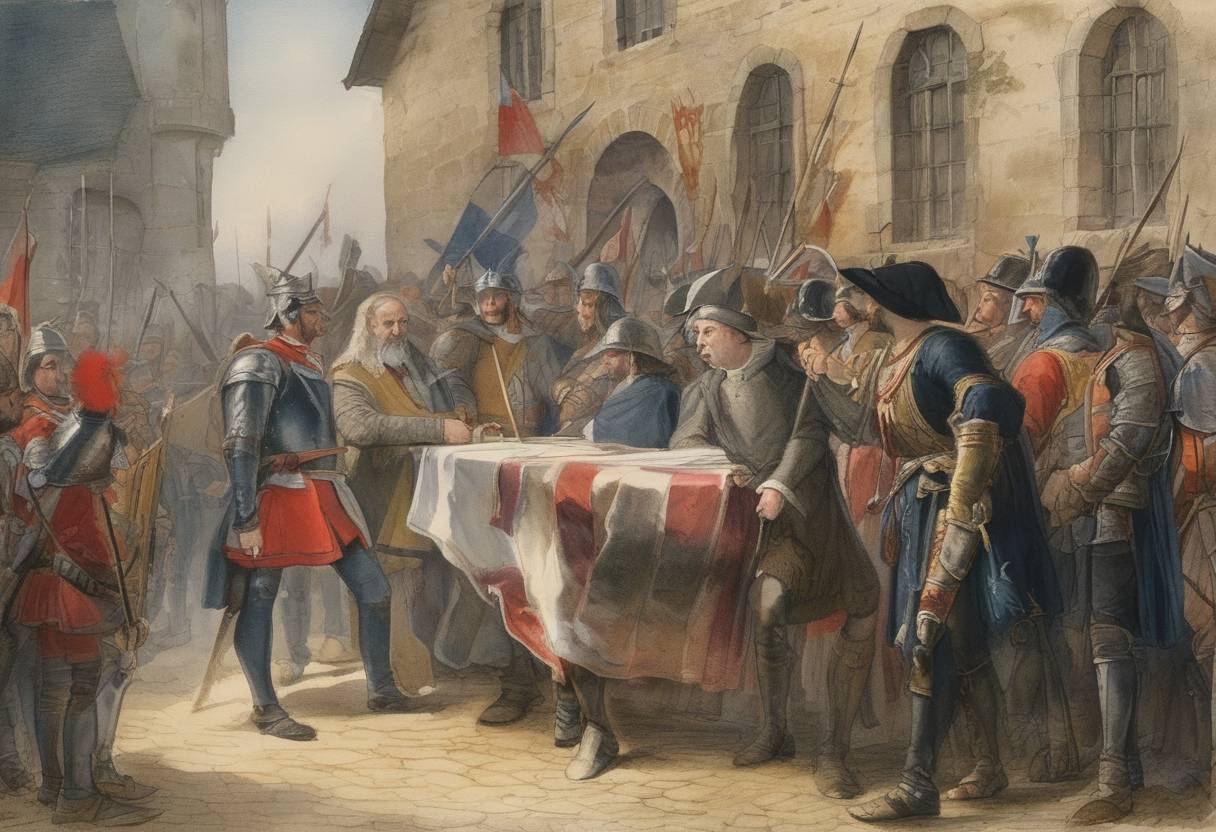
The Treaty of Brétigny - May 8, 1360
The Treaty of Brétigny, ratified on May 8, 1360, marked a significant moment in the Hundred Years’ War between England and France. It temporarily ended hostilities that had been ongoing since 1337, facilitating a period of uneasy peace and altered territorial control. This treaty was a pivotal development in the broader tapestry of medieval European politics.
Background
The Hundred Years’ War began primarily over territorial disputes and claims to the French throne. Edward III of England claimed the French crown through his mother, Isabella of France, challenging the rule of King Philip VI and his successor, John II of France. The conflict saw fluctuating successes for both sides, with intense warfare punctuated by significant battles such as the Battle of Crécy in 1346 and the Battle of Poitiers in 1356.
By 1360, after England’s victory at Poitiers and the capture of King John II, the French were compelled to seek peace terms to stabilize the nation and secure their king’s release.
Key Terms of the Treaty
Territorial Adjustments: England gained substantial territories in France, including the whole of Aquitaine and Calais, and further portions of Brittany, Normandy, and the Angoumois, expanding its foothold in France considerably. These lands were granted in full sovereignty to the English crown, although they necessitated a relinquishment of Edward’s claim to the French throne.
Ransom of the King: A critical part of the treaty was the agreement for the release of King John II of France, who had been a prisoner in London since his capture at Poitiers. A hefty ransom was set at three million écus, a substantial sum for the time, which demonstrated the gravity of the English victory and the resulting leverage.
Ceasefire: The agreement established a temporary cessation of hostilities, presenting an opportunity for both monarchs to recover and consolidate their respective realms after years of warfare.
Aftermath and Significance
The peace brokered by the Treaty of Brétigny ushered in a decade-long period of relative calm known as the “Edwardian Peace.” However, the treaty terms, particularly the financial reparations and territorial losses, were difficult for France to uphold and sowed seeds of resentment and economic strain.
Despite the large territorial gains and formal recognition from France, the peace was fragile. Disputes over the treaty’s execution and its broader implications eventually reignited conflict, leading to continued warfare in 1369. The cycle of conflict and peace that characterized the Hundred Years’ War underscores the complexity of medieval diplomacy and its far-reaching impact on the politics of the time.
The Treaty of Brétigny remains an important example of medieval conflict resolution, illustrating both the potential for and limitations of negotiated peace during an era marked by feudal loyalty and dynastic rivalry.