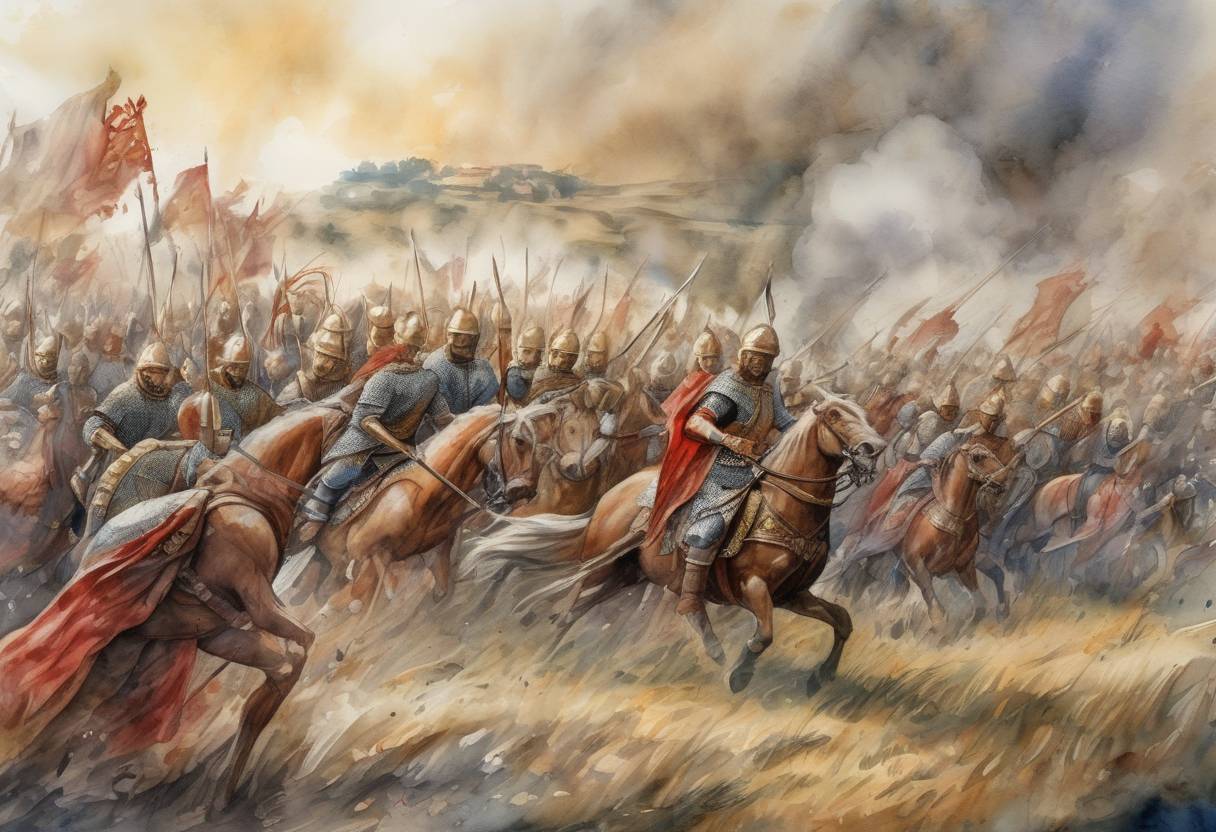
Battle of Toulouse (721)
On June 9, 721, Odo the Great, also known as Eudes, Duke of Aquitaine, achieved a significant victory against the Umayyad forces at the Battle of Toulouse. This battle was a crucial event in the early medieval period, as it marked a decisive halt to the northward expansion of the Moors into the region of Aquitaine in what is now modern-day France.
Context and Background
The Umayyad Expansion: By the early 8th century, the Umayyad Caliphate had rapidly expanded across the Iberian Peninsula, establishing control over much of what is now Spain and Portugal. Their advance into the Frankish territories was part of a broader strategy to extend their influence further into Europe.
Duke Odo of Aquitaine: Odo the Great was the Duke of Aquitaine, a semi-independent duchy in the southwest of the Frankish Kingdom. He was known for his military prowess and political acumen, which were crucial in defending his territories from external threats.
The Battle
Location: The battle took place near the city of Toulouse, a strategic location in the region of Aquitaine.
Forces Involved: The Umayyad forces, led by Al-Samh ibn Malik al-Khawlani, the governor of Al-Andalus, were well-equipped and experienced. In contrast, Odo’s forces were primarily composed of local Aquitanian troops.
Tactics and Outcome: Odo employed a surprise attack strategy, catching the Umayyad forces off guard. His forces launched a sudden assault on the besieging Umayyad army, leading to a decisive victory for the Aquitanians. The Umayyad governor, Al-Samh, was killed in the battle, and the remaining forces retreated.
Aftermath and Significance
Halting the Umayyad Advance: The victory at Toulouse was significant in halting the Umayyad advance into Aquitaine and the broader Frankish territories. It provided a temporary respite from the Muslim expansion in Western Europe.
Odo’s Reputation: The victory bolstered Odo’s reputation as a formidable leader and defender of Christendom. It also strengthened his political position within the Frankish territories.
Long-term Impact: Although the Umayyads would continue to pose a threat to the Frankish realms, the Battle of Toulouse set a precedent for future resistance against their incursions. This resistance would later culminate in the more famous Battle of Tours in 732, led by Charles Martel.
In summary, the Battle of Toulouse was a pivotal moment in the early medieval history of Europe, demonstrating the resilience of local leaders like Odo the Great in the face of external threats and shaping the course of European history by limiting the expansion of the Umayyad Caliphate into Western Europe.