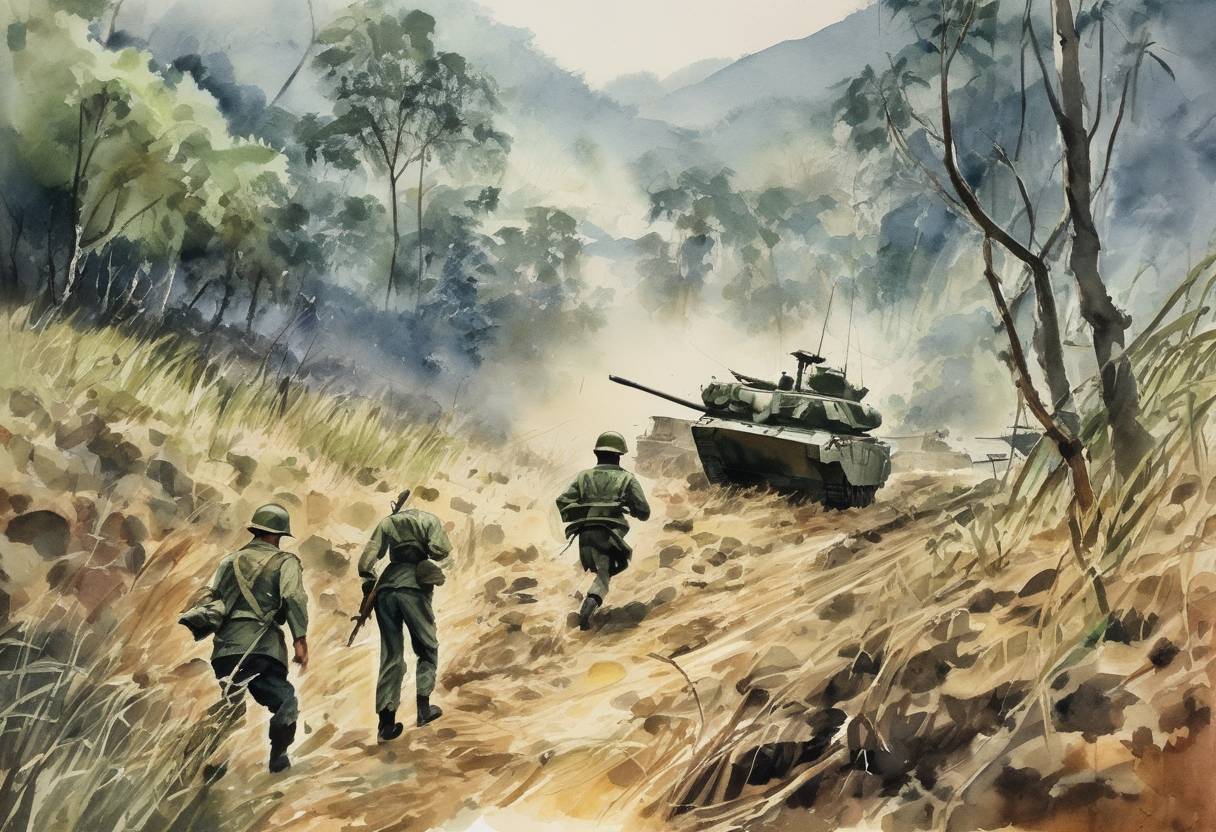
The Battle of Hamburger Hill
Overview
The Battle of Hamburger Hill, officially known as Hill 937, was a significant engagement during the Vietnam War that took place from May 10 to May 20, 1969. This battle was part of Operation Apache Snow, a joint U.S. and South Vietnamese military operation aimed at disrupting North Vietnamese Army (NVA) activities in the A Shau Valley, a strategic area near the border with Laos.
Context
- Location: The A Shau Valley was a critical supply route for the NVA, often referred to as part of the Ho Chi Minh Trail. The valley’s dense jungle and mountainous terrain provided a natural fortress for the NVA.
- Strategic Importance: Hill 937, later dubbed “Hamburger Hill” by U.S. forces due to the intense combat and high casualties, was a key position for controlling the valley.
The Battle
- Forces Involved: The battle involved the 101st Airborne Division of the U.S. Army, supported by South Vietnamese troops, against well-entrenched NVA forces.
- Combat: The fighting was characterized by brutal, close-quarters combat in difficult terrain. The U.S. forces faced heavy resistance from the NVA, who were well-fortified in bunkers and trenches.
- Tactics: The U.S. employed airstrikes, artillery, and infantry assaults in an attempt to dislodge the NVA from their positions. The battle was marked by repeated assaults up the hill, often under intense enemy fire.
Outcome
- Capture of the Hill: After ten days of fierce fighting, U.S. and South Vietnamese forces successfully captured Hill 937 on May 20, 1969.
- Casualties: The battle resulted in significant casualties on both sides, with U.S. forces suffering over 70 killed and hundreds wounded. NVA casualties were estimated to be much higher.
Aftermath and Significance
- Controversy: The battle became controversial due to the high number of casualties and the perception that the hill held little strategic value. The decision to abandon the hill shortly after its capture fueled public and political criticism.
- Impact on U.S. Policy: The intense media coverage and public outcry contributed to growing anti-war sentiment in the United States and influenced military and political leaders to reconsider their strategies in Vietnam.
- Legacy: Hamburger Hill remains a symbol of the Vietnam War’s brutality and the challenges faced by U.S. forces in the conflict. It highlighted the difficulties of fighting a determined enemy in challenging terrain and the complexities of military decision-making during the war.
The Battle of Hamburger Hill is remembered as a testament to the courage and endurance of the soldiers involved, as well as a pivotal moment that shaped perceptions of the Vietnam War both at home and abroad.