René-Robert Cavelier, Sieur de La Salle, and the Claiming of La Louisiane
1682 · Mississippi River Basin, United States
René-Robert Cavelier, Sieur de La Salle, claimed the Mississippi River basin for France, naming it La Louisiane.
May 8, 1541
Hernando de Soto reaches the Mississippi River, becoming the first recorded European to do so.
unknown, United States | Spanish expedition
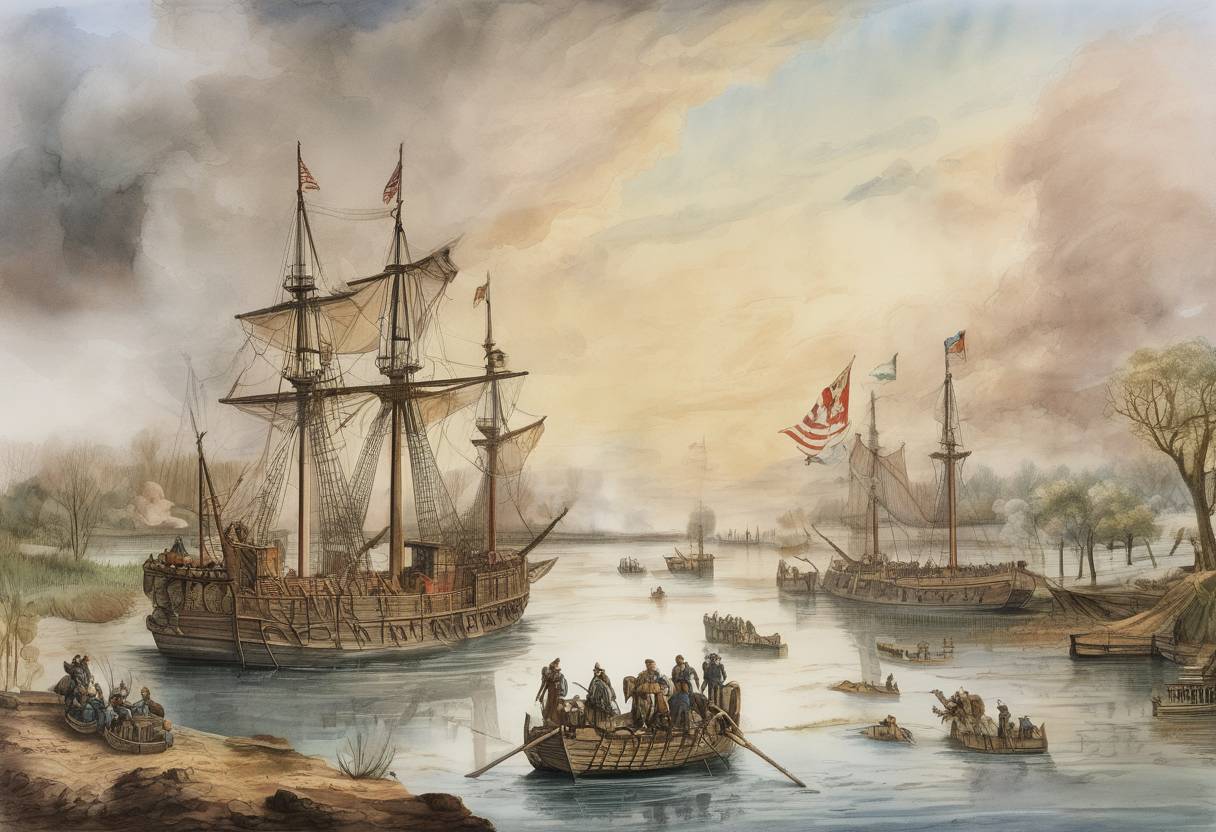
On May 8, 1541, Spanish explorer Hernando de Soto became the first recorded European to reach the Mississippi River. This significant event marked a pivotal moment in the exploration of North America and the expansion of European influence in the New World.
Hernando de Soto was a Spanish conquistador who had previously participated in the conquest of the Inca Empire in Peru alongside Francisco Pizarro. Following his success in South America, de Soto sought to explore and conquer new territories in North America. In 1539, he embarked on an ambitious expedition, landing in present-day Florida with a large contingent of men, horses, and supplies.
De Soto’s expedition was driven by the search for wealth, particularly gold, and the desire to establish Spanish dominance in the region. The journey was arduous, involving difficult terrain, hostile encounters with Indigenous peoples, and the challenges of navigating unfamiliar lands. The expedition traveled through what are now the southeastern United States, including parts of Florida, Georgia, South Carolina, North Carolina, Tennessee, Alabama, and Mississippi.
On May 8, 1541, de Soto and his men reached the banks of the Mississippi River, near present-day Memphis, Tennessee. This was a momentous discovery, as the Mississippi River is one of the largest river systems in the world and a critical geographical feature of North America. De Soto’s crossing of the river marked the first documented instance of a European setting eyes on this mighty waterway.
The discovery of the Mississippi River was a significant milestone in the exploration of North America. It opened up new possibilities for trade, exploration, and eventual settlement by Europeans. However, de Soto’s expedition ultimately failed to find the wealth he sought, and he died in 1542 near the river’s banks. His men, now leaderless, eventually made their way to Mexico.
The encounter with the Mississippi River underscored the vastness and complexity of the North American continent. It also highlighted the interactions between European explorers and Indigenous peoples, which were often marked by conflict and misunderstanding.
De Soto’s journey laid the groundwork for future explorations and contributed to the European understanding of the geography of the New World. The Mississippi River would later become a vital artery for trade and expansion as European powers continued to explore and colonize the continent.
In summary, Hernando de Soto’s reaching of the Mississippi River on May 8, 1541, was a landmark event in the history of exploration, symbolizing the relentless quest for discovery and the profound impact of European exploration on the Americas.
Source: en.wikipedia.org