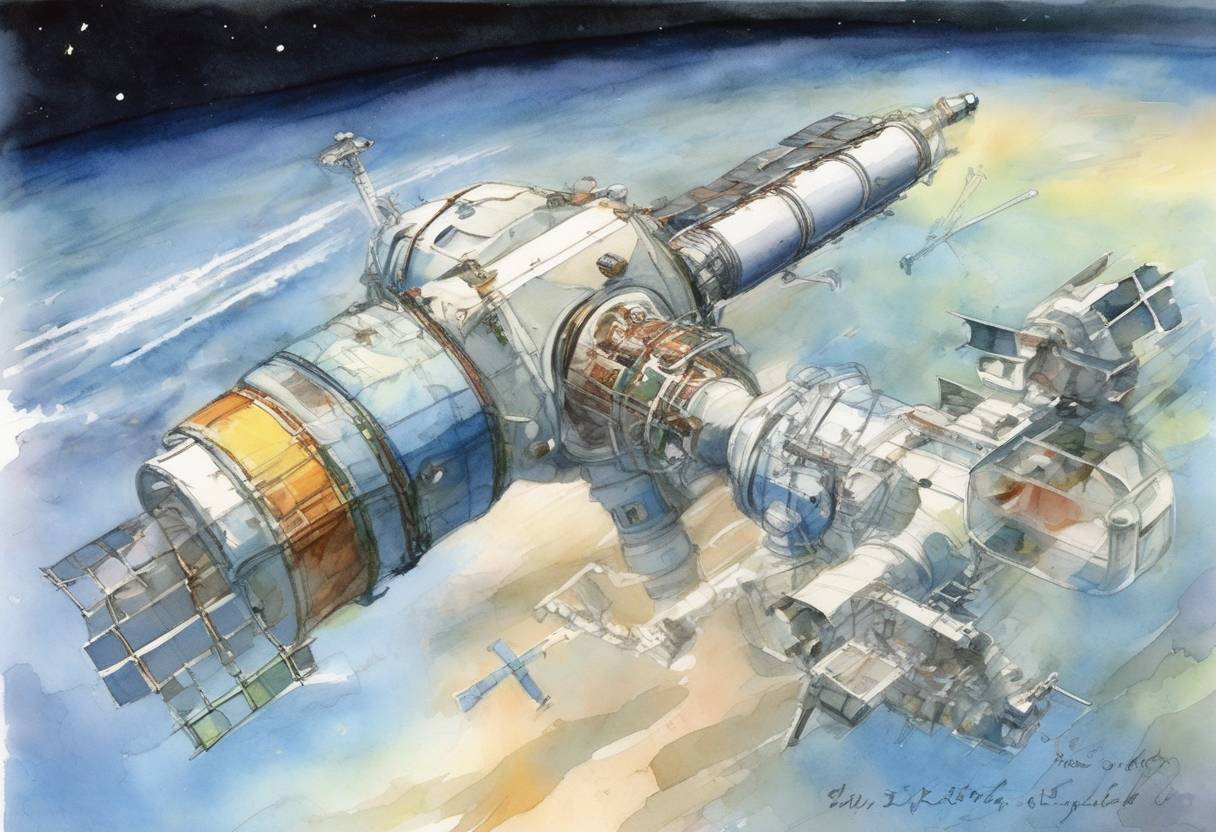
The Re-entry of the Russian Space Station Mir: March 23, 2001
On March 23, 2001, the Russian space station Mir re-entered Earth’s atmosphere and disintegrated over the South Pacific Ocean, marking the end of a significant chapter in space exploration history. This event concluded Mir’s 15-year tenure in orbit, during which it served as a pioneering platform for international cooperation and scientific research in space.
Background and Launch
- Launch Date: Mir was launched by the Soviet Union on February 19, 1986.
- Purpose: Designed as a modular space station, Mir was intended to be a long-term research facility in low Earth orbit, focusing on scientific experiments in microgravity and space technology development.
- Construction: Over the years, Mir was expanded with additional modules, including Kvant-1, Kvant-2, Kristall, Spektr, and Priroda, enhancing its capabilities and living space.
Achievements and Significance
- International Collaboration: Mir was a symbol of international cooperation, hosting astronauts from various countries, including the United States, through the Shuttle-Mir Program in the 1990s.
- Scientific Research: The station facilitated numerous experiments in biology, physics, astronomy, and materials science, contributing valuable data to the scientific community.
- Technological Advancements: Mir’s long-term habitation and modular design provided insights into life support systems, space station construction, and the effects of prolonged spaceflight on the human body.
Challenges and Decline
- Aging Infrastructure: By the late 1990s, Mir’s systems were showing signs of wear, with frequent technical issues and power failures.
- Financial Constraints: The dissolution of the Soviet Union and subsequent economic challenges in Russia led to funding difficulties for maintaining the station.
- Strategic Shift: Russia shifted its focus to the International Space Station (ISS), a collaborative project involving multiple countries, which promised more advanced research opportunities.
Deorbit and Re-entry
- Decision to Deorbit: In 2000, the Russian government decided to deorbit Mir due to its deteriorating condition and the high costs of upkeep.
- Controlled Re-entry: The deorbit operation was carefully planned to ensure Mir’s remnants would fall into a remote area of the South Pacific Ocean, known as the “spacecraft cemetery.”
- Final Moments: On March 23, 2001, Mir re-entered Earth’s atmosphere, breaking apart and largely burning up, with any surviving debris falling harmlessly into the ocean.
Legacy
- Pioneering Spirit: Mir’s legacy lies in its role as a precursor to the ISS, demonstrating the feasibility and benefits of long-term human presence in space.
- Scientific Contributions: The data and experience gained from Mir’s missions continue to inform current and future space exploration endeavors.
- Cultural Impact: Mir remains a symbol of human ingenuity and the spirit of exploration, inspiring generations of scientists, engineers, and space enthusiasts.
The re-entry of Mir marked the end of an era but also paved the way for new beginnings in international space collaboration and exploration.