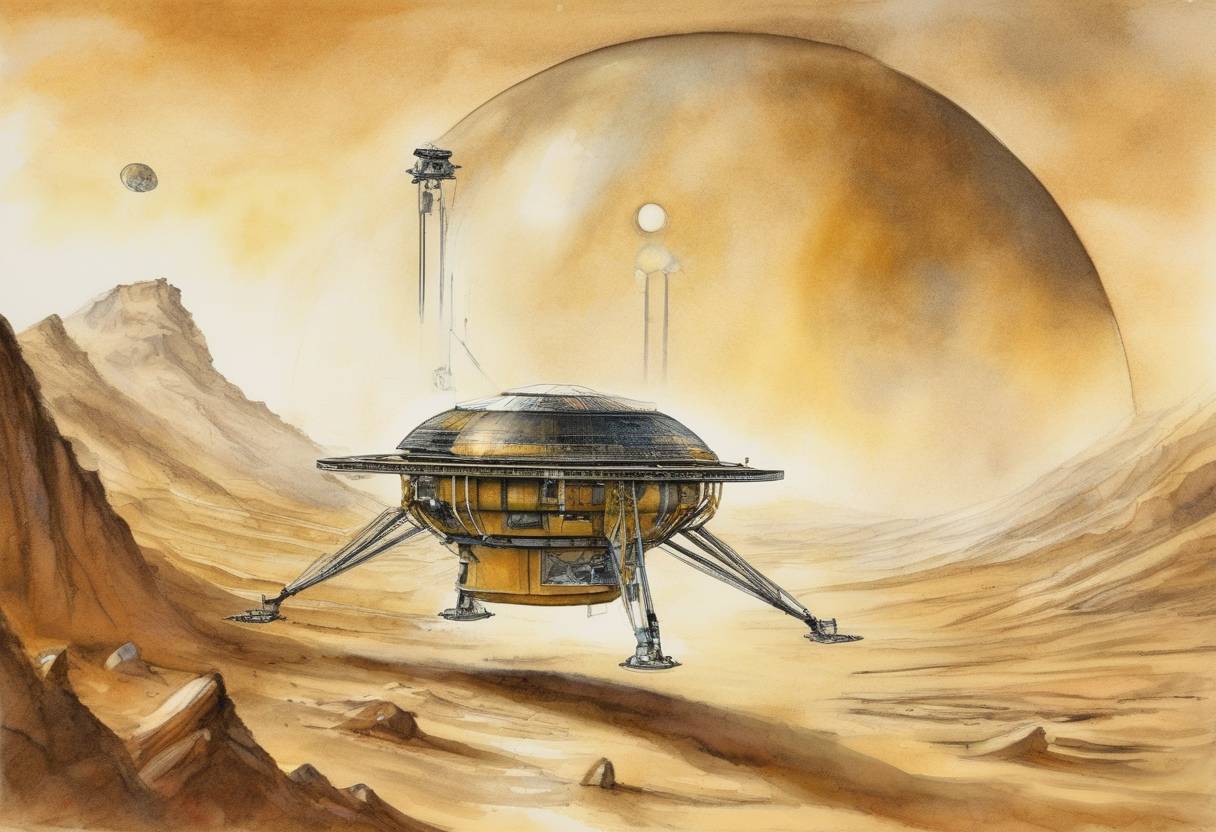
Huygens Probe Lands on Titan: January 14, 2005
On January 14, 2005, the European Space Agency’s (ESA) Huygens probe made history by successfully landing on Titan, Saturn’s largest moon. This event marked the first time a spacecraft landed on a moon in the outer solar system, providing unprecedented insights into Titan’s atmosphere and surface.
Background
The Huygens probe was part of the Cassini-Huygens mission, a collaboration between NASA, ESA, and the Italian Space Agency (ASI). The mission aimed to study Saturn, its rings, and its moons, with a particular focus on Titan due to its dense atmosphere and potential for prebiotic conditions.
- Launch Date: The Cassini-Huygens spacecraft was launched on October 15, 1997.
- Mission Components: The mission consisted of the Cassini orbiter and the Huygens probe. While Cassini was tasked with orbiting Saturn and conducting extensive studies, Huygens was designed to detach and descend onto Titan.
The Descent and Landing
Huygens separated from the Cassini orbiter on December 25, 2004, and began its descent towards Titan on January 14, 2005. The probe’s journey to the surface was a complex process:
- Entry: Huygens entered Titan’s atmosphere at a speed of approximately 20,000 km/h (12,427 mph).
- Deceleration: The probe used a heat shield to withstand the intense heat generated by atmospheric entry.
- Parachute Deployment: After slowing down, Huygens deployed a series of parachutes to further reduce its speed and stabilize its descent.
- Scientific Measurements: During its descent, which lasted about 2.5 hours, Huygens conducted various scientific experiments, collecting data on Titan’s atmospheric composition, temperature, and pressure.
- Surface Landing: Huygens successfully landed on Titan’s surface, transmitting data for about 90 minutes before its batteries were depleted.
Scientific Discoveries
The data collected by Huygens provided groundbreaking insights into Titan:
- Atmosphere: Huygens confirmed that Titan’s atmosphere is primarily composed of nitrogen, with traces of methane and other hydrocarbons.
- Surface: The probe captured images of Titan’s surface, revealing a landscape with river channels, possible lakes, and vast plains, suggesting the presence of liquid methane or ethane.
- Weather Patterns: The findings indicated complex weather patterns, including methane rain, contributing to the moon’s erosion and surface features.
Historical Significance
The successful landing of Huygens on Titan was a monumental achievement in space exploration:
- Technological Milestone: It demonstrated the capability of international collaboration in achieving complex space missions.
- Scientific Impact: The mission significantly advanced our understanding of Titan and its potential for harboring life or prebiotic conditions.
- Inspiration for Future Missions: The success of Huygens paved the way for future missions to explore the outer solar system and its moons.
The Huygens probe’s landing on Titan remains a testament to human curiosity and the pursuit of knowledge beyond our planet, offering a glimpse into the mysteries of the outer solar system.