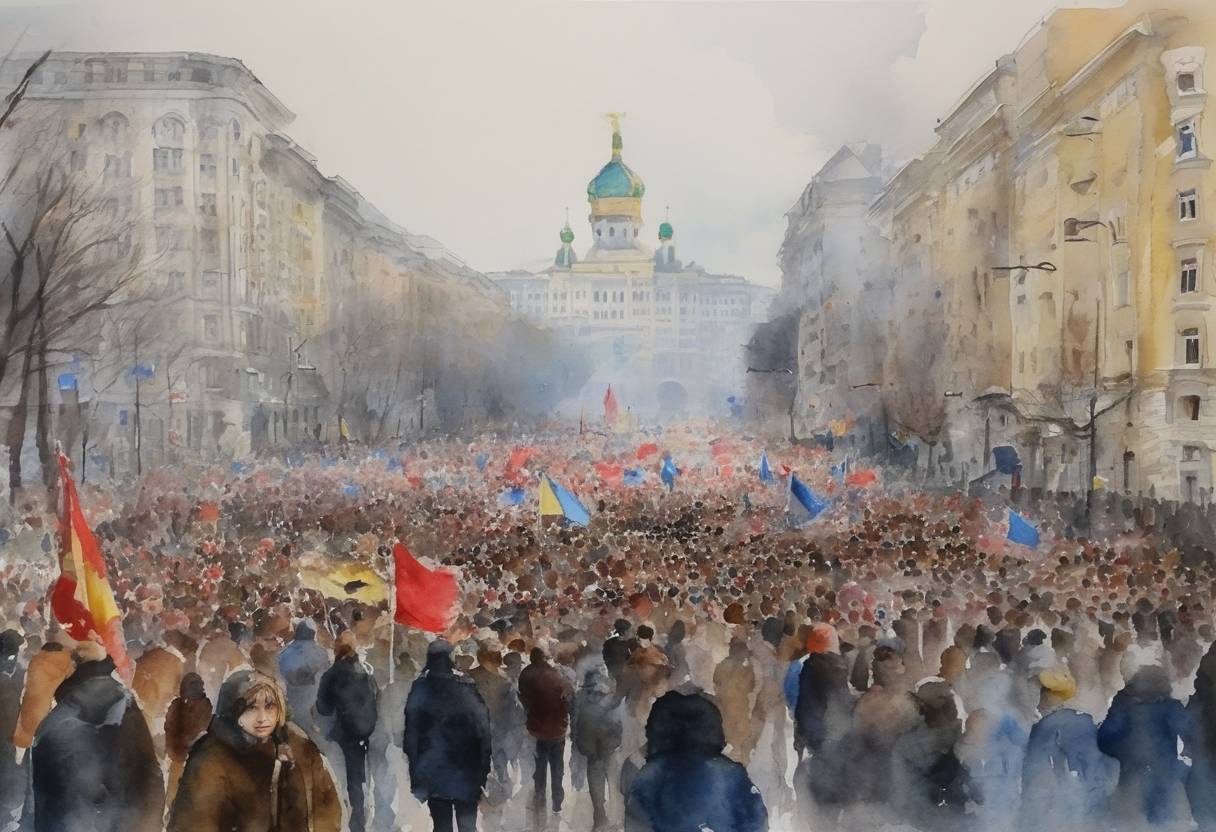
Anti-Government Protests in Ukraine – December 9, 2013
On December 9, 2013, the streets of Kyiv were filled with protestors as anti-government demonstrations continued to swell. The protests were sparked by President Viktor Yanukovych’s decision to halt an association agreement with the European Union, favoring closer ties with Russia instead. This strategic pivot led to widespread dissent, prominently manifesting in the Ukrainian capital.
Background Context
- November 2013 Decision: The unrest began on November 21, 2013, when Yanukovych’s government announced the suspension of the EU association agreement. This announcement diverged from a previously anticipated move towards European integration, which had significant public support.
- Russian Influence: The decision was perceived as a move towards strengthening economic and political relations with Russia, which, under President Vladimir Putin, was offering financial incentives and pressure to keep Ukraine within its sphere of influence.
Key Events of December 9, 2013
- Scale of Protests: On this date, an estimated 800,000 people gathered in Kyiv. The protests were concentrated primarily around Independence Square, commonly known as Maidan Nezalezhnosti.
- Goals of Protestors: Demonstrators were advocating for the resignation of President Yanukovych and calling for new elections, voicing their desire for deeper integration with the European Union. They were also protesting against alleged corruption and the abuse of power by Yanukovych’s government.
- Government Response: The day witnessed heightened tensions as security measures intensified. Law enforcement was deployed in large numbers to manage the crowds, leading to instances of confrontations and attempts to dismantle protester camps.
Broader Historical Significance
- Evolution of Protests: The December 9 protests were part of what became known as the Euromaidan movement. This civic uprising laid the groundwork for substantial political changes in Ukraine.
- Impact: The continued pressure from mass mobilizations eventually led to significant political shifts. By February 2014, Yanukovych was ousted from power, leading to a reformation of Ukraine’s political landscape and a reactivation of the EU association agreement process.
- Long-term Consequences: The events heralded a period of instability in Ukraine, which led to Russia’s annexation of Crimea in 2014 and ongoing conflicts in Eastern Ukraine.
The events of December 9, 2013, were a pivotal moment in Ukraine’s modern history, illustrating the public’s resolute demand for alignment with European values and governance, setting the stage for the profound transformations that followed.