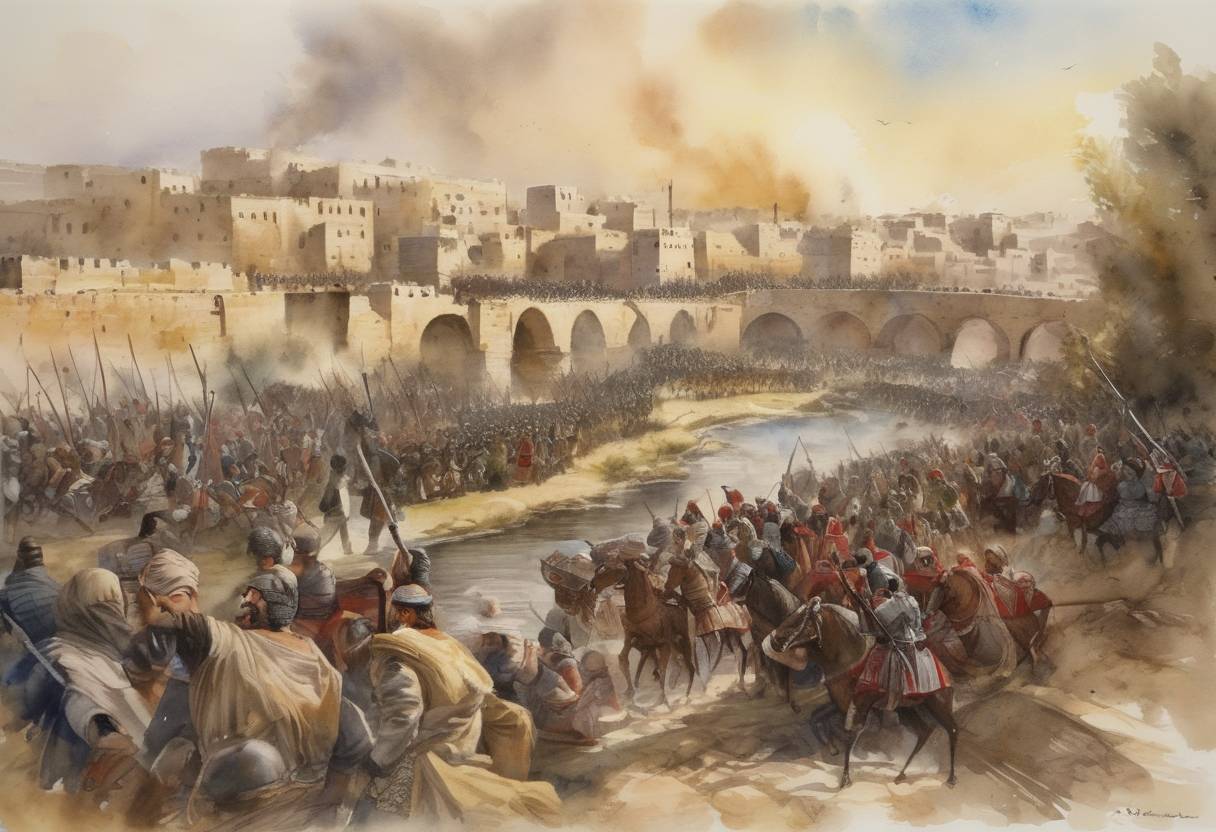
Battle of Yarmouk: A Decisive Victory
On August 20, 636 CE (not September 19, 634), the Rashidun Caliphate achieved a pivotal victory over the Byzantine Empire in the Battle of Yarmouk. This battle, one of the most significant in the early Muslim conquests, dramatically shifted the balance of power in the region and catalyzed Islamic expansion into the Levant.
Context and Prelude
The campaign leading to Yarmouk was part of the broader Arab-Byzantine conflict, which saw the nascent Islamic state expanding under the leadership of the Rashidun Caliphs. The Byzantine Empire, weakened by years of warfare with the Sassanian Empire and internal strife, was now facing the rapidly rising power of the Muslims under the command of the esteemed general Khalid ibn al-Walid.
The Battle
The battle took place over six days near the Yarmouk River, which today forms the border between modern-day Jordan and Syria. Despite being heavily outnumbered, the Muslim forces utilized superior tactics and the inspirational leadership of Khalid ibn al-Walid to outmaneuver and decisively defeat the Byzantine troops. The rugged and unfamiliar terrain further complicated the Byzantine defense, leading to their collapse.
Aftermath and Significance
The outcome of Yarmouk effectively ended Byzantine rule in Syria and opened the way for rapid Muslim expansion across the Levant. This victory not only solidified Islamic control over regions that were deeply intertwined with the Byzantine cultural and religious identity but also established the Rashidun Caliphate as a formidable power in the Middle East. The hastened decline of Byzantine influence underscored the strategic prowess of the Muslim army, further facilitated by Khalid’s dynamic command over his forces.
Legacy
The Battle of Yarmouk is often cited as a textbook example of military strategy and leadership. It represents a turning point in the history of the Middle East, marking the beginning of Islamic dominance in the region and setting the stage for further conquests in Persia, Egypt, and beyond. Khalid ibn al-Walid’s reputation as a military strategist was cemented, earning him the title “The Sword of Allah.”
Conclusion
In historical retrospection, the Battle of Yarmouk underscores the transformational period during the early Islamic expansions and highlights the complex interplay of military tactics, leadership, and the broader geopolitical shifts of the era.