Capture of Calcutta by the British, January 2, 1757
1757 · Calcutta, India
The British army captures the city of Calcutta in India from the Nawab of Bengal after the recapture following the Siege of Calcutta.
September 12, 1798
The Battle of Seringapatam in India marks a British East India Company's significant victory over Tipu Sultan, which led to the eventual fall of Mysore Kingdom.
Seringapatam, India | British East India Company
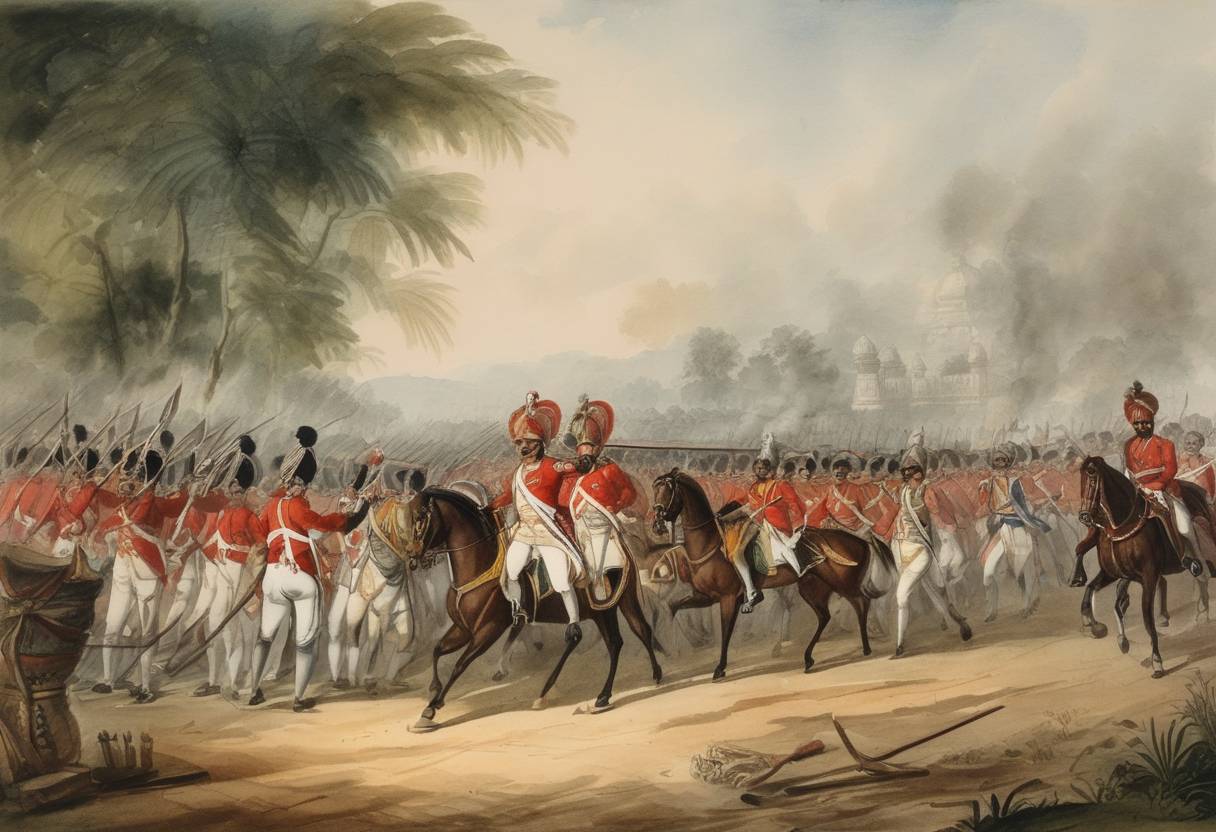
The Battle of Seringapatam, involving the British East India Company and the Mysore Kingdom under Tipu Sultan, actually took place on May 4, 1799, not on September 12, 1798. Therefore, it is important to address the factual details of this event as it fits correctly within the historical timeline.
The Battle of Seringapatam marked the culmination of the Fourth Anglo-Mysore War, a conflict rooted in the broader struggle of European colonial powers, notably Britain and France, for influence in Southern India. Mysore, under the leadership of Tipu Sultan, had been a formidable regional power fiercely resisting British expansion. The British East India Company was determined to subdue Mysore to consolidate its political and economic dominance in the region.
Treaty Violations: Following the Third Anglo-Mysore War, the Treaty of Seringapatam (1792) imposed stringent terms on Mysore, which included territorial concessions and reparations. However, continued disputes and Tipu’s alignment with France against British interests rekindled hostilities.
Diplomatic Maneuverings: The British East India Company, leveraging alliances with the Marathas and the Nizam of Hyderabad, strategically isolated Mysore. The growing threat of a reinvigorated French influence in southern India, due to Tipu Sultan’s diplomatic overtures, further alarmed the British.
Military Mobilization: The British, under the command of General George Harris, assembled a formidable force, setting the stage for a decisive assault on Seringapatam, the capital of Mysore.
Siege and Assault: The British forces laid siege to Seringapatam, employing a combination of artillery bombardments and infantry tactics to breach the city’s defenses. On May 4, a decisive assault was launched, breaching the fort’s walls and entering the city.
Death of Tipu Sultan: The battle concluded with the death of Tipu Sultan, who was found dead while defending his capital. This pivotal moment marked the end of Mysore’s resistance and a significant expansion of British power in southern India.
Dismantlement of Mysore: Following the British victory, the kingdom of Mysore was significantly diminished. The British established a subsidiary alliance, placing a puppet ruler on the throne, effectively making Mysore a princely state under British suzerainty.
End of Franco-Indian Alliances: The defeat weakened French influence in southern India and marked the beginning of unchallenged British dominance in the region.
Legacy of Tipu Sultan: Tipu Sultan’s resistance and modernizing efforts have been pivotal in historical narratives, portraying him as a symbol of defiance against colonial rule.
The Battle of Seringapatam stands as a crucial event in the history of British colonization in India, underscoring the strategic and complex colonial military engagements of the period.
Source: www.bbc.co.uk