Establishment of Hobart as a Penal Colony
1804 · Hobart, Australia
Hobart was established as a penal colony.
January 28, 1788
The British First Fleet, led by Captain Arthur Phillip, established a settlement at Sydney Cove, marking the foundation of Sydney, Australia.
Sydney, Australia | British First Fleet
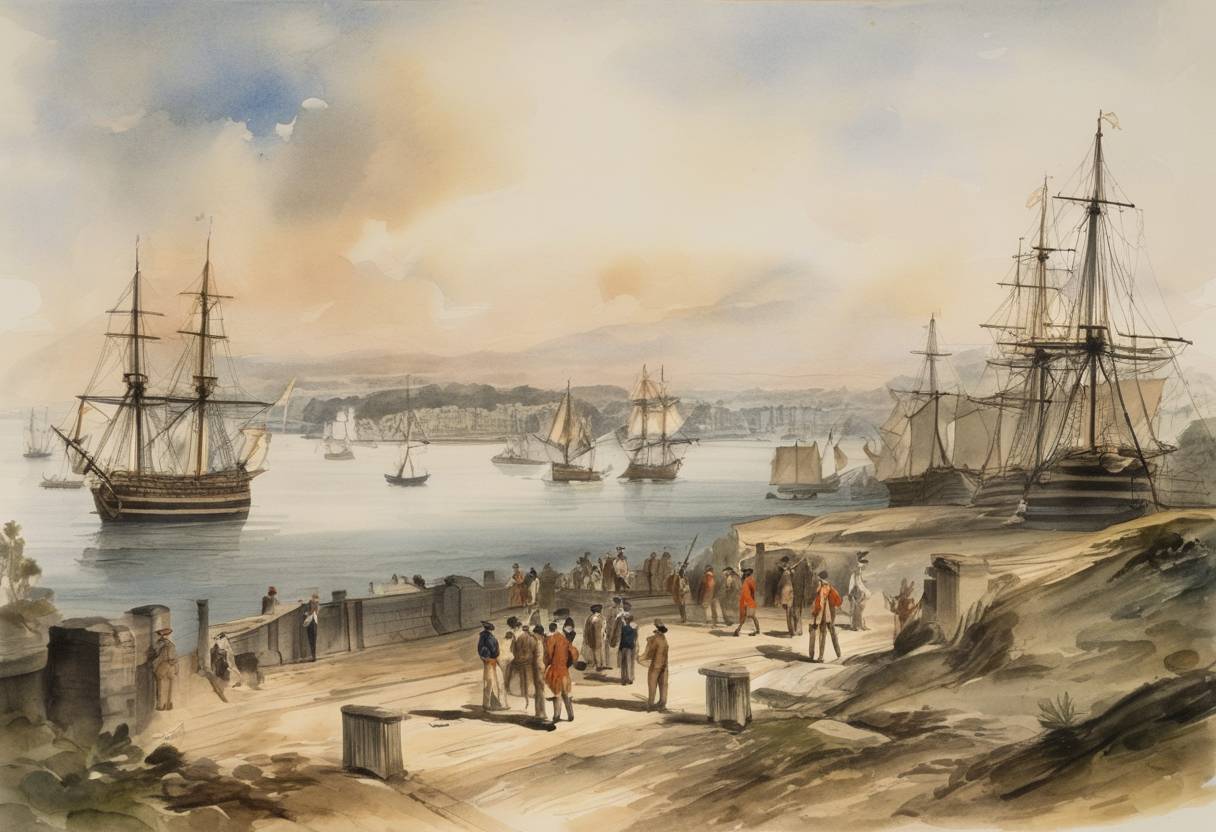
On January 28, 1788, the British First Fleet, commanded by Captain Arthur Phillip, established the first European settlement in Australia at Sydney Cove, marking the foundation of what would become the city of Sydney. This event marked a pivotal moment in Australian history, laying the groundwork for the nation’s colonial development.
The First Fleet consisted of 11 ships, including two naval escorts, six convict transports, and three supply ships, carrying over 1,300 people—comprising sailors, marines, officers, and around 736 convicts. The journey began from Portsmouth, England, on May 13, 1787, and traversed approximately 15,000 miles to reach the eastern coast of Australia.
The decision to establish a penal colony in Australia was driven by Britain’s need to relieve overcrowding in its prisons following the loss of the American colonies. This new colony was intended to provide strategic security and potentially exploit the supposed resources of the unknown southern continent.
Upon arrival in Botany Bay on January 18, 1788, the conditions were found unsuitable for settlement due to inadequate fresh water and poor soil. Consequently, Captain Arthur Phillip sought an alternative location and chose Port Jackson, which he had explored earlier.
On January 26, 1788, Phillip and members of the fleet, including marines and convicts, initially raised the British flag at Port Jackson—an event later celebrated as Australia Day. However, it was on January 28 that the remaining fleet formally relocated from Botany Bay to Sydney Cove, where they landed and began establishing the colony’s infrastructure.
Cultural Impact: The settlement at Sydney Cove signified the beginning of sustained European colonial presence in Australia. This event led to significant cultural and demographic changes, including the displacement and disruption of the Indigenous populations’ way of life.
Economic Development: The establishment of the Sydney Colony initiated the rise of various agricultural and economic activities despite initial challenges and harsh conditions faced by the colonists.
Strategic Importance: The foundation of Sydney became a strategic British naval outpost in the Southern Hemisphere, influencing regional geopolitics.
January 28, 1788, thus stands as a cornerstone date in Australian history and marks the start of the country’s transformation from its Indigenous roots to a British colony and eventually, a modern nation.
Source: www.nma.gov.au