The Battle of Gravelines: July 13, 1558
1558 · Gravelines, France
The Battle of Gravelines took place during the Italian War of 1551–1559, where the Spanish forces defeated the French.
August 10, 1557
On August 10, 1557, at the Battle of St. Quentin, Spanish forces commanded by Emmanuel Philibert, Duke of Savoy, defeated the French army led by Admiral Gaspard de Coligny. The battle was part of the Habsburg-Valois Wars, specifically the Italian War of 1551–1559, and it solidified Habsburg Spanish control over parts of northern France.
St. Quentin, France | Spanish Empire
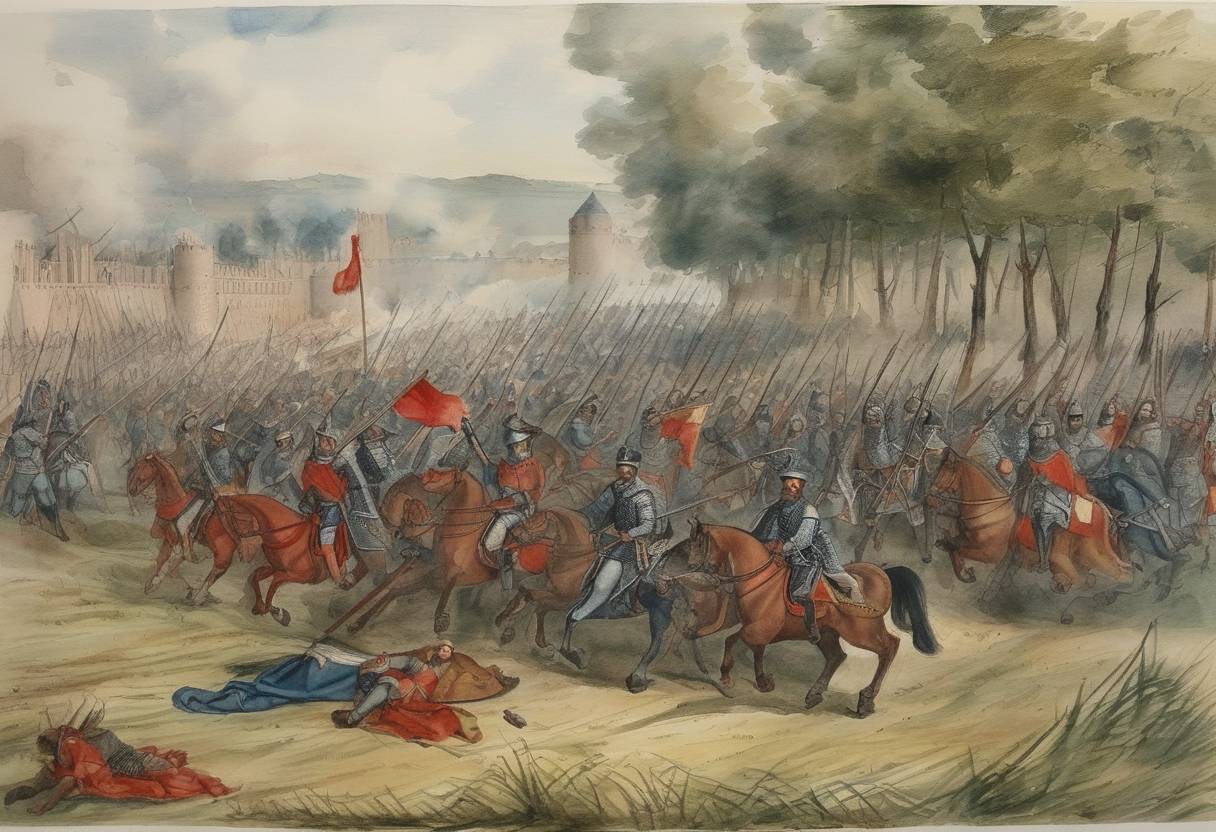
On August 10, 1557, the Battle of St. Quentin marked a crucial engagement in the Habsburg-Valois Wars, particularly during the Italian War of 1551–1559. It was a significant victory for the Spanish-Habsburg forces, led by Emmanuel Philibert, Duke of Savoy, over the French forces commanded by Admiral Gaspard de Coligny.
The Habsburg-Valois Wars were a series of conflicts between the Habsburg Monarchy and the French Valois dynasty, primarily over control of territories in Italy and the Low Countries. By 1557, both powers were vying for dominance in Europe. The intricate web of alliances and enmities set the stage for military confrontations across various fronts, including Northern France, where the Battle of St. Quentin occurred.
Spanish-Habsburg Army: Commanded by Emmanuel Philibert, the Spanish forces were bolstered by English and other allied troops, reflecting the broader coalition against French ambitions. The army had approximately 60,000 soldiers.
French Army: Under the leadership of Admiral Gaspard de Coligny, the French forces were caught off guard due to a shortage of reinforcements and supplies. The French contingent was significantly smaller, with an estimated 30,000 soldiers.
The Spanish forces employed a well-coordinated assault. Emmanuel Philibert, known for his strategic acumen, capitalized on superior artillery and the element of surprise to inflict heavy losses on the French.
The French defenses at St. Quentin were quickly overwhelmed. The decision by Gaspard de Coligny to hold the ground without adequate reinforcement exposed the French flank, leading to a swift breach of their defenses.
The Spanish deployed cavalry effectively, cutting off French retreat and communications, which exacerbated the disarray among the French troops.
Spanish Ascendancy: The victory solidified Spanish control over parts of northern France, establishing Habsburg dominion in the region.
French Losses: The defeat hampered French military morale and resources, further complicating their position in the ongoing wars.
Strategic Repercussions: The fall of St. Quentin paved the way for the Spanish to threaten Paris, though subsequent military engagements and diplomatic negotiations prevented further immediate territorial losses for France.
Diplomatic Negotiations: The protracted conflict eventually led to the Treaty of Cateau-Cambrésis in 1559, ending the Italian Wars, with terms largely favorable to the Habsburgs.
The Battle of St. Quentin stands as a testament to strategic military planning and coalition warfare. It highlighted the shifting power dynamics in Renaissance Europe and emphasized the intricate connections between military conflict and diplomatic realignment.