Polish Counter-Offensive in the Battle of Warsaw
1920 · Warsaw, Poland
Polish forces under Józef Piłsudski launched a counter-offensive during the Battle of Warsaw amidst the Polish-Soviet War.
August 5, 1915
Warsaw is captured by German forces during World War I.
Warsaw, Poland | German army
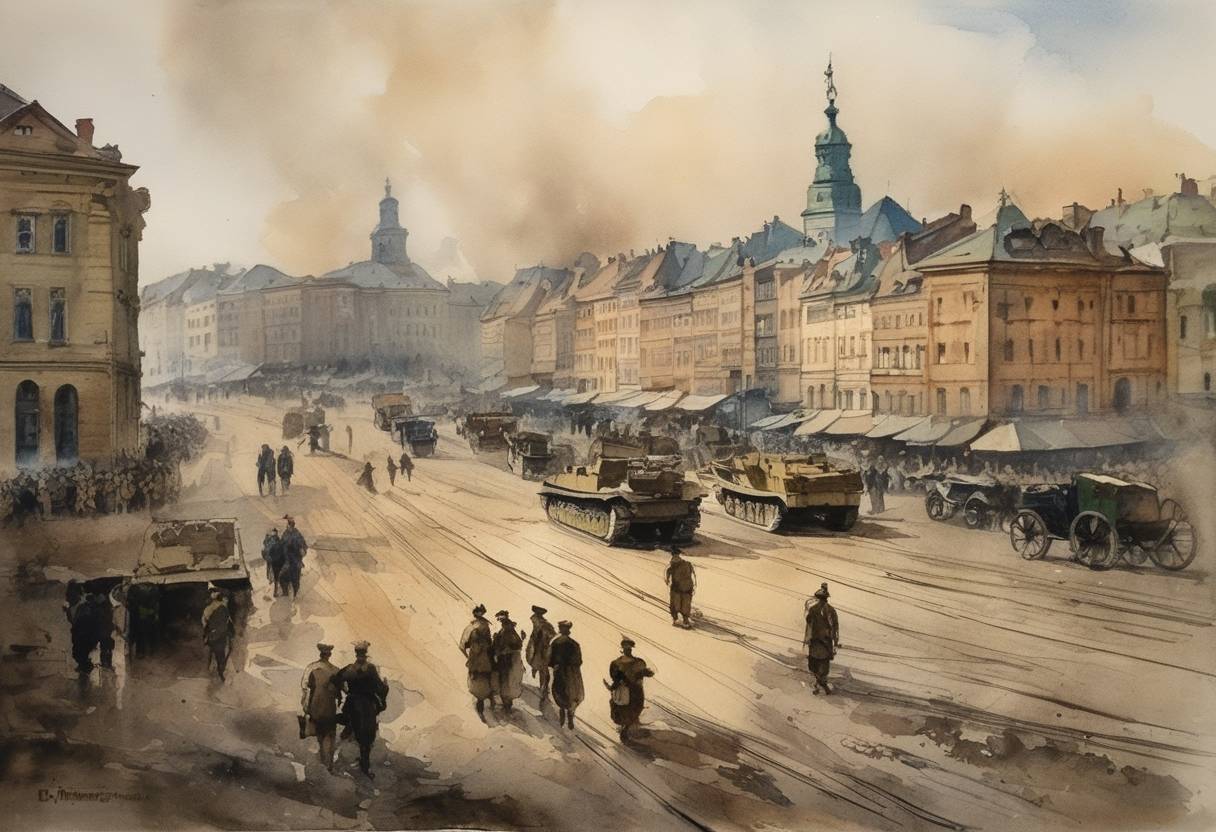
On August 5, 1915, during the First World War, German forces successfully captured Warsaw, the capital of what was then the Congress Kingdom of Poland, part of the Russian Empire. This strategic victory marked a significant advancement in the German Gorlice-Tarnów Offensive and highlighted the shifting tides on the Eastern Front.
The Eastern Front of World War I had been characterized by massive battles and fluctuating front lines. By 1914, the Russian Empire had invaded East Prussia but faced setbacks with defeats at the Battle of Tannenberg and the Masurian Lakes. By early 1915, both the Central Powers and the Russian forces were deeply entrenched along a sizable front.
Initiated in May 1915, the Gorlice-Tarnów Offensive aimed to break through Russian defenses in Galicia. Led by General August von Mackensen, the German and Austro-Hungarian forces executed a highly effective artillery bombardment followed by a successful infantry attack that overwhelmed Russian lines. The victory at Gorlice-Tarnów forced the Russian army into retreat, and it became the catalyst for the ‘Great Retreat’ of 1915.
As part of their broader strategic goals, the Central Powers turned their focus on capturing Warsaw. The city’s location was of both military and symbolic importance, serving as a political center and a major fortress on the Vistula River. German forces, advancing from the southwest, and reinforced by Austro-Hungarian troops, encircled the city, leaving Warsaw vulnerable to a sustained siege.
Following intense fighting and logistical challenges faced by the dwindling Russian defenders, the city fell on August 5, 1915. The capture of Warsaw effectively marked the end of Russian dominance in Poland and was a severe blow to Russian operations on the Eastern Front.
Russian Retreat: The fall of Warsaw precipitated the further retreat of Russian forces across Poland, Lithuania, and Belarus, requiring them to regroup and fortify closer to their internal lines.
Political Implications: The capture had significant implications for Polish territories. It incited hopes among Polish nationalists for greater autonomy or independence, as both the Central Powers and the Allies courted Polish support.
Military Strategy: The successful siege exemplified the effectiveness of combined arms tactics employed by the Central Powers, influencing future military operations on the Eastern Front.
Legacy: This victory contributed to the Central Powers’ advantageous position by the end of 1915, demonstrating the vulnerabilities of the Russian military apparatus, which led to further German advances in Eastern Europe.
The capture of Warsaw is a point of examination in the strategic realignments during World War I and serves as an example of the interactions between military strategy and political geography during the conflict.
Source: en.wikipedia.org