The Coronation of Queen Elizabeth II
1953 · London, United Kingdom
Queen Elizabeth II is crowned in Westminster Abbey, London, marking the beginning of her reign.
July 18, 1841
Coronation of the 15th British monarch, King Edward VII's mother, Queen Victoria, took place.
London, United Kingdom | British Monarchy
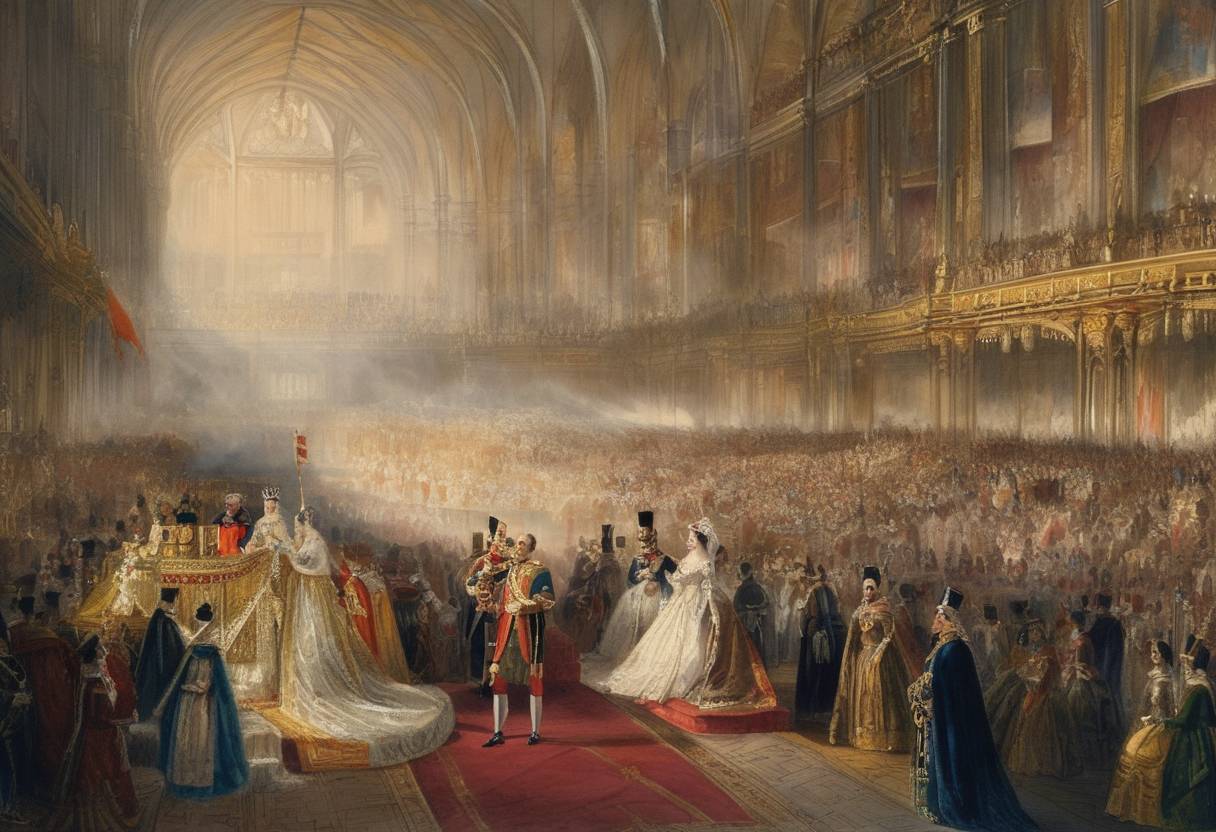
Queen Victoria’s coronation took place on June 28, 1838, at Westminster Abbey in London. She became queen on June 20, 1837, following the death of her uncle, King William IV. Queen Victoria was a member of the House of Hanover and was crowned when she was just 18 years old.
Victoria’s accession marked significant transitions, both politically and culturally. Her reign, known as the Victorian Era, was characterized by great industrial, cultural, political, scientific, and military changes in the United Kingdom. By the time of her coronation, the British Empire was expanding rapidly, and Victoria’s leadership symbolized a period of progress and transformation.
The coronation ceremony followed traditional protocols of the British monarchy, involving a complex pageant at Westminster Abbey. Approximately 400,000 visitors came to London for the occasion. Various aspects of the ceremony included her entry into the abbey dressed in a state robe of crimson velvet, her anointment by the Archbishop of Canterbury, and the crowning itself.
Queen Victoria’s reign lasted until her death in 1901, making her the second-longest reigning British monarch after Queen Elizabeth II. Her coronation set the stage for what would become an era of British global dominance and significant internal transformation, with lasting impacts on British society and the world.
Queen Victoria’s oldest son, King Edward VII, would later ascend to the throne in 1901 following her death, serving as the monarch heralding the subsequent Edwardian Era. His royal upbringing and the values impressed upon him during Victoria’s reign influenced his approach to kingship and foreign policy.
Victoria’s long and storied reign is remembered not only for her extensive influence but also as a time of pivotal change in British and world history.
Source: www.britannica.com