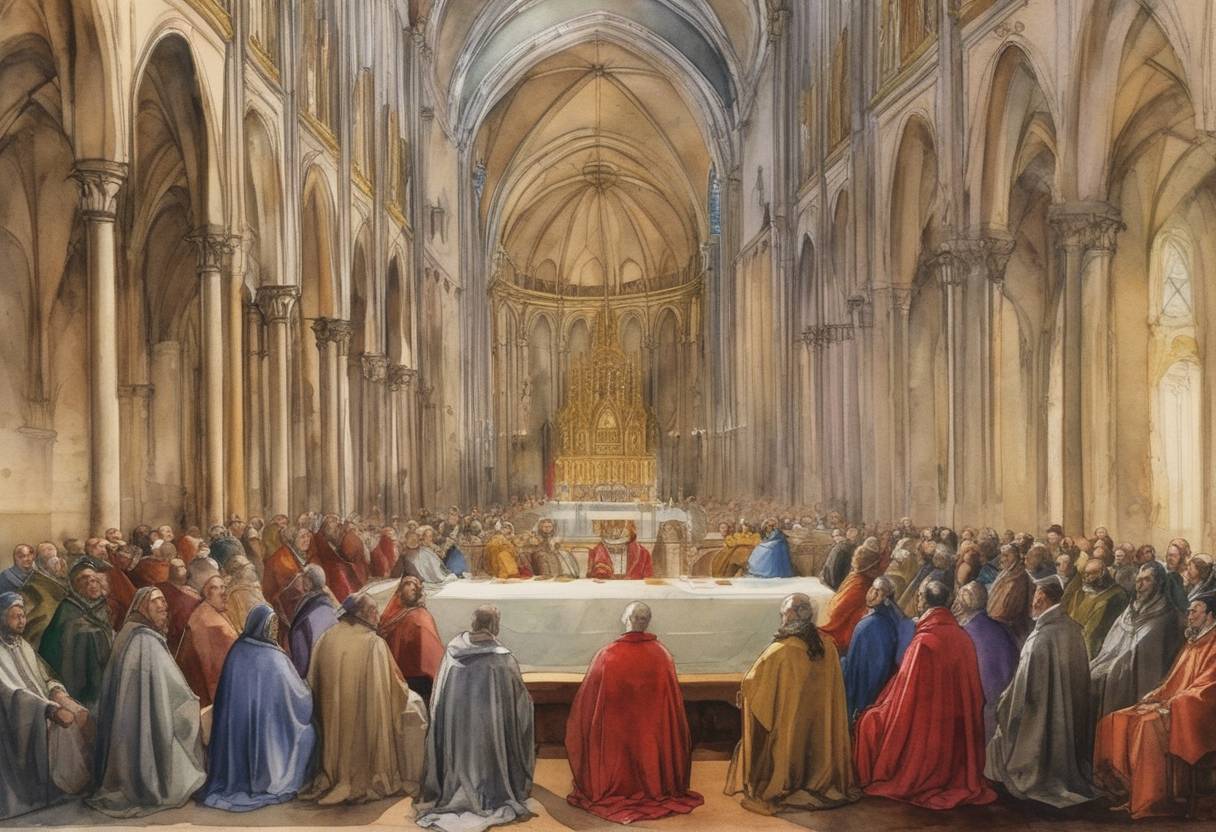
The Second Council of Lyon: May 7, 1274
The Second Council of Lyon, a significant ecumenical council of the Catholic Church, was convened by Pope Gregory X on May 7, 1274. Held at the Cathedral of St. John in Lyon, France, it marked the 14th such council and had dual aims: instituting church reform and addressing the long-standing East-West Schism.
Background
The division between the Eastern Orthodox and Western Catholic Churches, known as the East-West Schism, had been a major issue since the schism intensified in 1054. The primary causes were theological differences, ecclesiastical politics, and linguistic/territorial disputes. Attempts at reconciliation occurred periodically but with little success until this council.
Key Objectives
Reunion with the Eastern Church: Pope Gregory X sought to bridge divisions, inviting numerous Greek (Eastern) representatives to discuss potential reunification, symbolizing a major ecclesiastical rapprochement.
Church Reform: The council aimed to address issues of clerical discipline and church administration, aspiring to enhance ecclesiastical governance amid growing secular influence.
Preparation for Crusades: An additional agenda was strategizing support for another crusade to recapture the Holy Land from Muslim control, reflecting the prevailing georeligious dynamics.
Proceedings
Over 300 bishops and many other church dignitaries attended, including representatives from the Byzantine Emperor Michael VIII Palaiologos, indicating a serious diplomatic effort toward East-West ecclesiastical harmony.
A declaration of faith was crafted combining Western and Eastern theological perspectives, prominently the addition of the “Filioque” clause concerning the Holy Trinity, a major point of contention.
Outcomes
Temporary Reunification: The agreements reached at Lyon led to a brief reunion between the Western and Eastern churches. However, this unity proved unsustainable due to persistent theological and political tensions back in the Byzantine Empire, leading to its eventual collapse in subsequent decades.
Church Reform: The council also promulgated numerous decrees aimed at ecclesiastical reform, addressing clergy corruption, and reinforcing papal authority.
Historical Significance
The Second Council of Lyon exemplified both the aspiration for Christian unity and the complexities involved in mass reformations within the medieval church. Although its efforts for reunion were ultimately unsuccessful, it remained a notable attempt at bridging ecclesiastical divides and establishing precedent for future engagements between the East and West. It is often studied as a historical milestone in church diplomacy and reformative zeal.