Capture of Calcutta by the British, January 2, 1757
1757 · Calcutta, India
The British army captures the city of Calcutta in India from the Nawab of Bengal after the recapture following the Siege of Calcutta.
January 9, 1760
Afghan leader Ahmad Shah Durrani defeats the Marathas in the Third Battle of Panipat.
Panipat, India | Durrani Empire
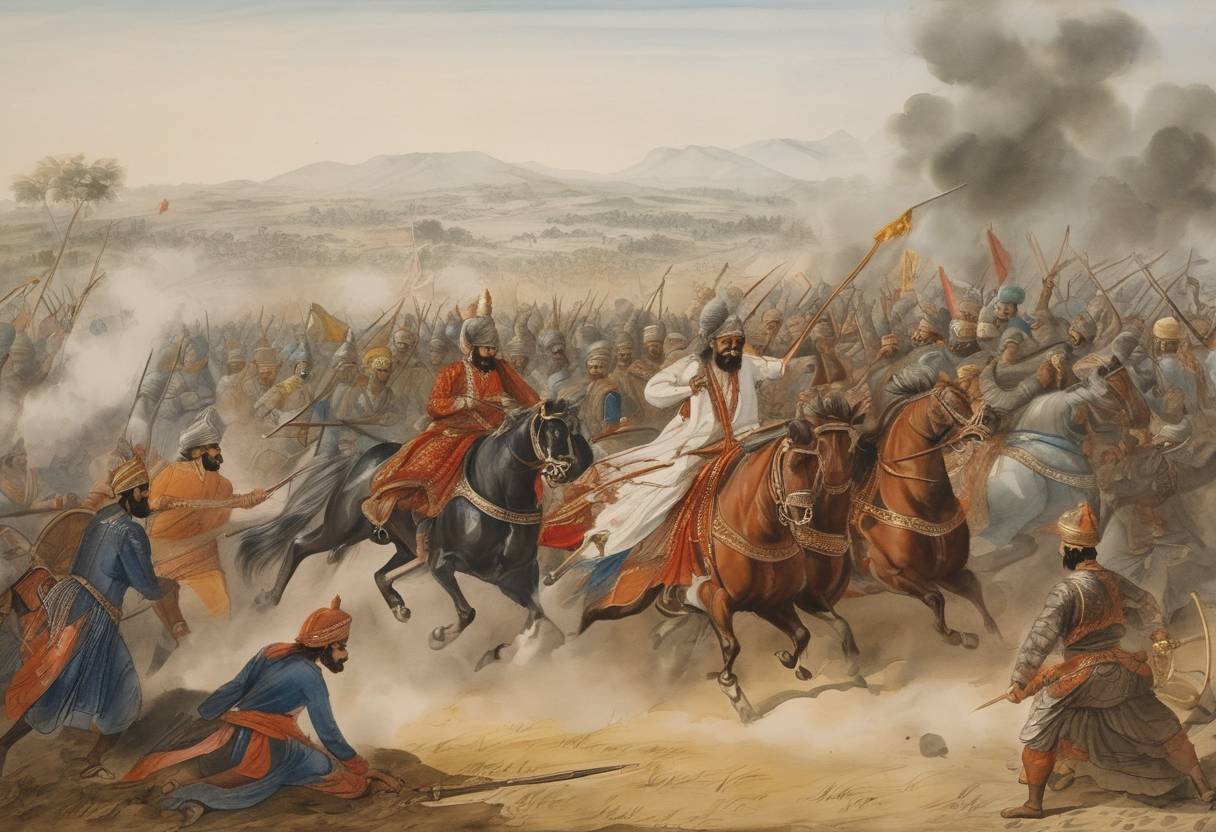
The Third Battle of Panipat took place on January 14, 1761, near the town of Panipat, in present-day Haryana, India. The battle was among the largest and bloodiest fought in the 18th century on the Indian subcontinent.
In the mid-18th century, the Indian subcontinent was a fragmented landscape with competing regional powers. The Marathas, emerging from western India, had expanded substantially and controlled several regions across the subcontinent. Ahmad Shah Durrani had repeatedly invaded northern India, seeking to reunify the Mughal territories under his influence after recognizing the instability in the Mughal Empire.
The Marathas sought to extend their empire further north, into territories affected by Durrani’s campaigns. This expansion was part of a broader strategy to become the predominant power in the northern Indian landscape. Recognizing the threat, Ahmad Shah Durrani formed an alliance with various local rulers opposed to Maratha expansion, such as the Rohilla Afghans, and orchestrated a coordinated strategy to challenge Maratha advances.
The Maratha forces, comprising over 100,000 troops, included infantry, cavalry, and artillery units, while Durrani’s forces, slightly larger, were well-versed in rapid cavalry warfare and strategically utilized artillery. The brutal combat included multiple waves of aggressive charges against fortifications, combined with intricate tactical maneuvers.
The battle resulted in a decisive victory for Ahmad Shah Durrani. The Maratha forces suffered heavy casualties, with estimates of up to 70,000 to 100,000 killed, significantly weakening the Maratha confederation’s hold in the north. The outcome sapped Maratha military strength and paved the way for subsequent British expansion, with the British East India Company capitalizing on the power vacuum and instability further south.
Ahmad Shah Durrani’s victory reasserted Afghan influence in the region but also marked the last major aim for territorial expansion on the Indian subcontinent due to logistical and resource constraints. The Marathas eventually refocused their efforts on rebuilding and consolidating power in central and southern India, leading to eventual resurgences. The battle is often cited as a turning point that opened paths for colonial intervention that shaped the history and politics of the subcontinent for decades to follow.
Source: en.wikipedia.org