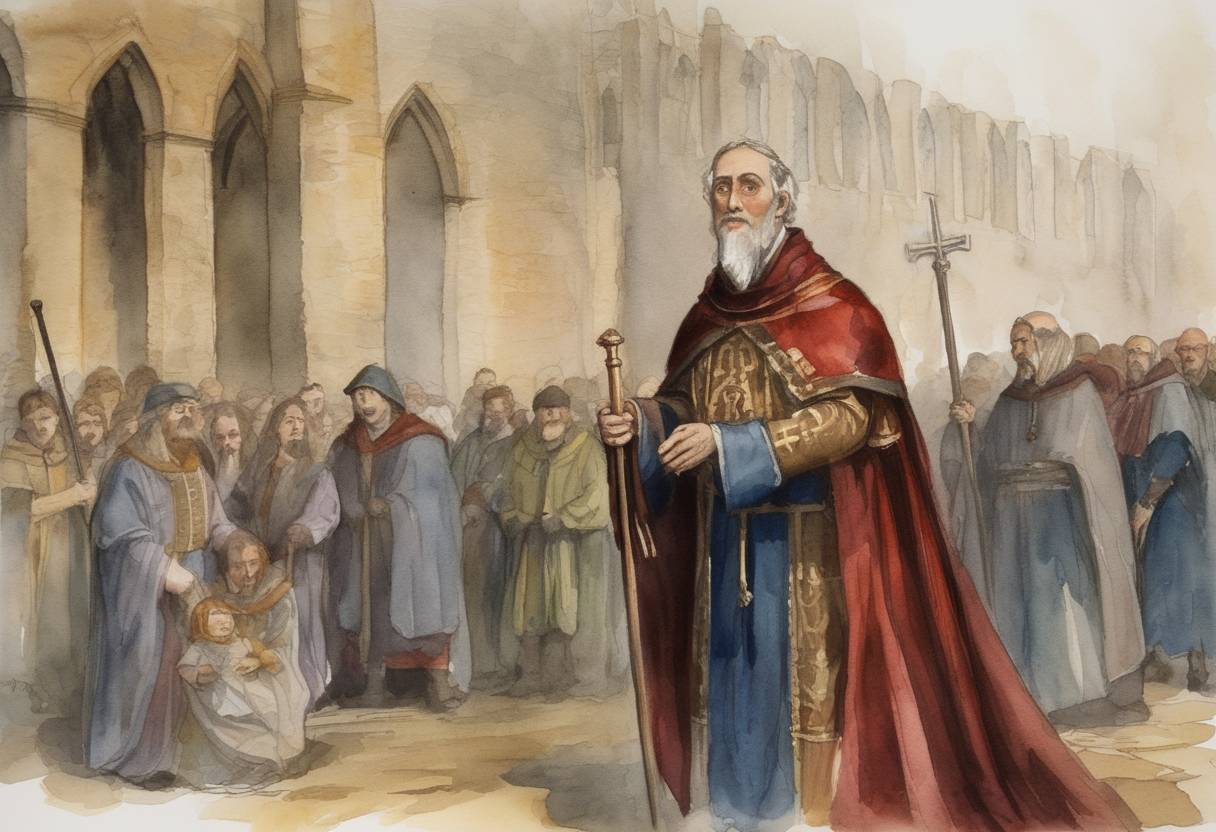
The Martyrdom of Ælfheah on April 19, 1012
On April 19, 1012, Ælfheah, the Archbishop of Canterbury, met a tragic end at the hands of Viking raiders in Greenwich. Born around 953, Ælfheah was a revered ecclesiastical leader noted for his piety and commitment to the church. His death is often remembered as an act of martyrdom and steadfast faith.
Background
In the early 11th century, England was under frequent attack from Viking invaders, particularly the Danes, who often demanded tribute, known as Danegeld, to spare towns from being looted. During one of these raids, Ælfheah was captured by the marauding forces.
Capture and Refusal of Ransom
Following his capture, Ælfheah was imprisoned and the Vikings demanded a substantial ransom for his release. Despite the dire circumstances, Ælfheah refused to allow his followers or the church to collect or pay the ransom. He believed that succumbing to the demands of the Vikings would further impoverish his already beleaguered people and contradicted Christian values of charity and sacrifice.
Martyrdom
His refusal enraged his captors, leading to a brutal outcome. On April 19, 1012, after enduring several months of captivity, Ælfheah was executed by the Vikings in Greenwich. According to several contemporary sources, including the Anglo-Saxon Chronicle, he was struck down and killed amidst a chaotic scene where the Vikings reportedly pelted him with ox bones and other debris.
Legacy and Canonization
Ælfheah’s martyrdom quickly made him a venerated figure within the Christian community. His sacrifice was seen as the epitome of spiritual steadfastness against pagan barbarism. In 1078, he was canonized as a saint by Pope Gregory VII, and his feast day continues to be observed by the Roman Catholic Church, the Eastern Orthodox Church, and the Anglican Communion.
Historical Significance
The event underlined the severity of the Viking threat during that period and highlighted the cultural and religious tensions between the invading Norse pagans and the Christian English populace. Ælfheah’s story has been remembered as a symbol of moral fortitude and commitment to spiritual principles, inspiring many in the medieval Christian world and beyond.