1371 · Menzhyk, Ukraine
The Battle of Menzhyk took place during the Galicia–Volhynia Wars, a conflict involving the Kingdom of Poland and the Grand Duchy of Lithuania against the Kingdom of Galicia–Volhynia.
January 22, 1371
The Battle of Baesweiler, a conflict between forces led by Wenceslaus I, Duke of Luxembourg, and William II, Duke of Jülich, commences near Baesweiler, present-day Germany.
Baesweiler, Holy Roman Empire (now Germany) | Luxembourgian forces and Jülich forces
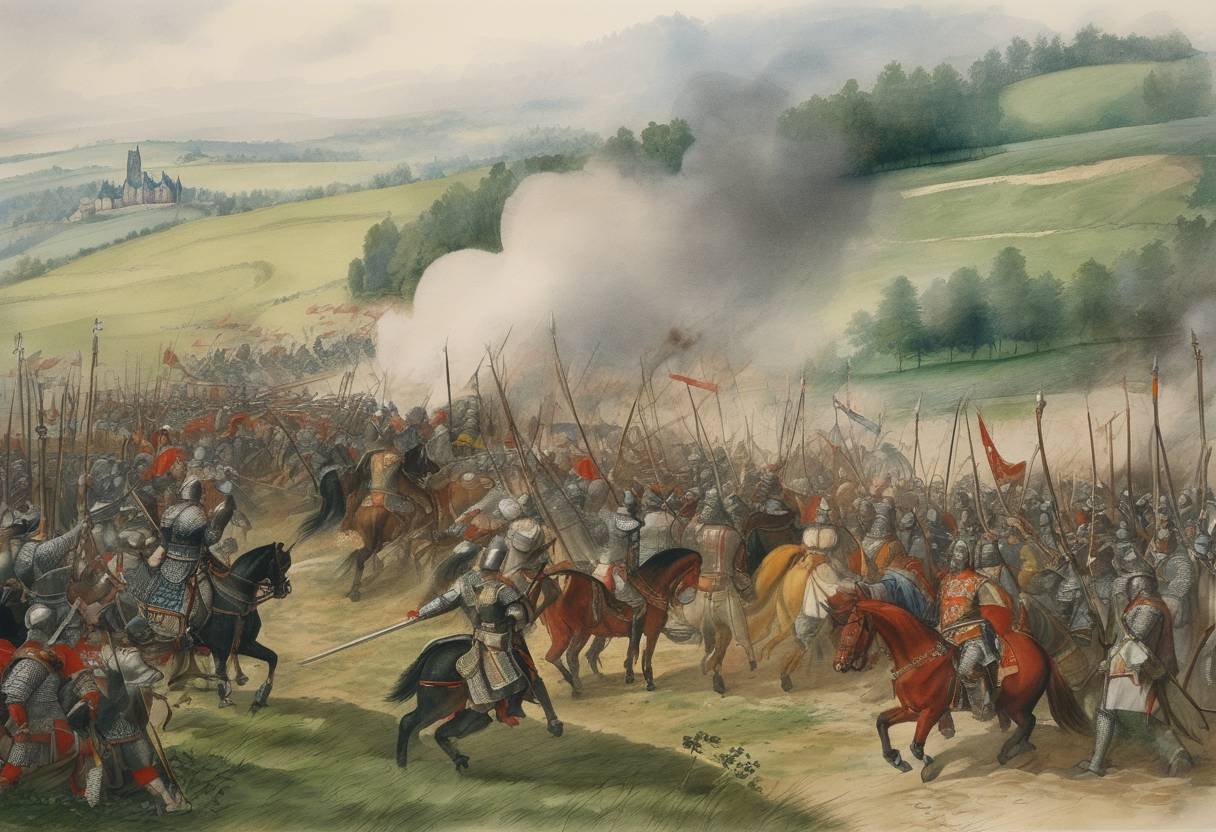
The Battle of Baesweiler took place on January 22, 1371, near the town of Baesweiler in what is today Germany. This conflict was part of the ongoing power struggles among the nobility of the Holy Roman Empire during the late 14th century. The battle was primarily fought between the forces of Wenceslaus I, Duke of Luxembourg, and his rival William II, Duke of Jülich.
The political landscape of the Holy Roman Empire during the late 1300s was marked by territorial disputes and the ambitions of local lords and dukes. The Duchy of Luxembourg, under the rule of Wenceslaus I, was a significant player in these regional power dynamics. Wenceslaus sought to expand his influence, leading to tensions with neighboring territories such as the Duchy of Jülich.
William II, the Duke of Jülich, had his own territorial ambitions and was keen on defending and potentially expanding his territory against Luxembourgian encroachment. The tension between these two ambitious nobles resulted in the escalation of hostilities, culminating in the battle at Baesweiler.
Details of the Battle of Baesweiler itself are limited, but it is known to have been a hard-fought engagement. The armies clashed near the town, with both sides bringing substantial forces typical of feudal levies of the period, including knights, archers, and foot soldiers.
The terrain of Baesweiler, like much of the region, was relatively flat, favoring cavalry maneuvers. This allowed both parties to utilize their knights effectively, leading to fierce mounted combat, which was a hallmark of medieval warfare.
The battle did not bring about a decisive victory for either side. It instead resulted in significant casualties and demonstrated the volatility of the political situation in the region. The inconclusive nature of the battle meant that hostilities continued in varying forms, and no lasting peace was achieved directly from the conflict.
In broader terms, the battle further contributed to the fragmentation and internal conflicts that characterized the Holy Roman Empire during this period. The ambitions of local nobles like Wenceslaus I and William II continued to shape the regional politics of what is now part of modern Germany and Belgium.
The Battle of Baesweiler serves as a reflection of the feudal conflicts and power struggles prevalent in medieval Europe. It illustrates the complex web of alliances and rivalries between the numerous principalities, duchies, and kingdoms within the Holy Roman Empire. These conflicts would continue until the gradual unification and centralization processes in the later centuries reduced the power of localized feudal lords.
The power dynamics at play during the battle are indicative of the broader shifts occurring in the political landscape of Europe as noble families sought to expand their realms and influence amidst the shifting allegiances and rivalries typical of the era.
Source: en.wikipedia.org