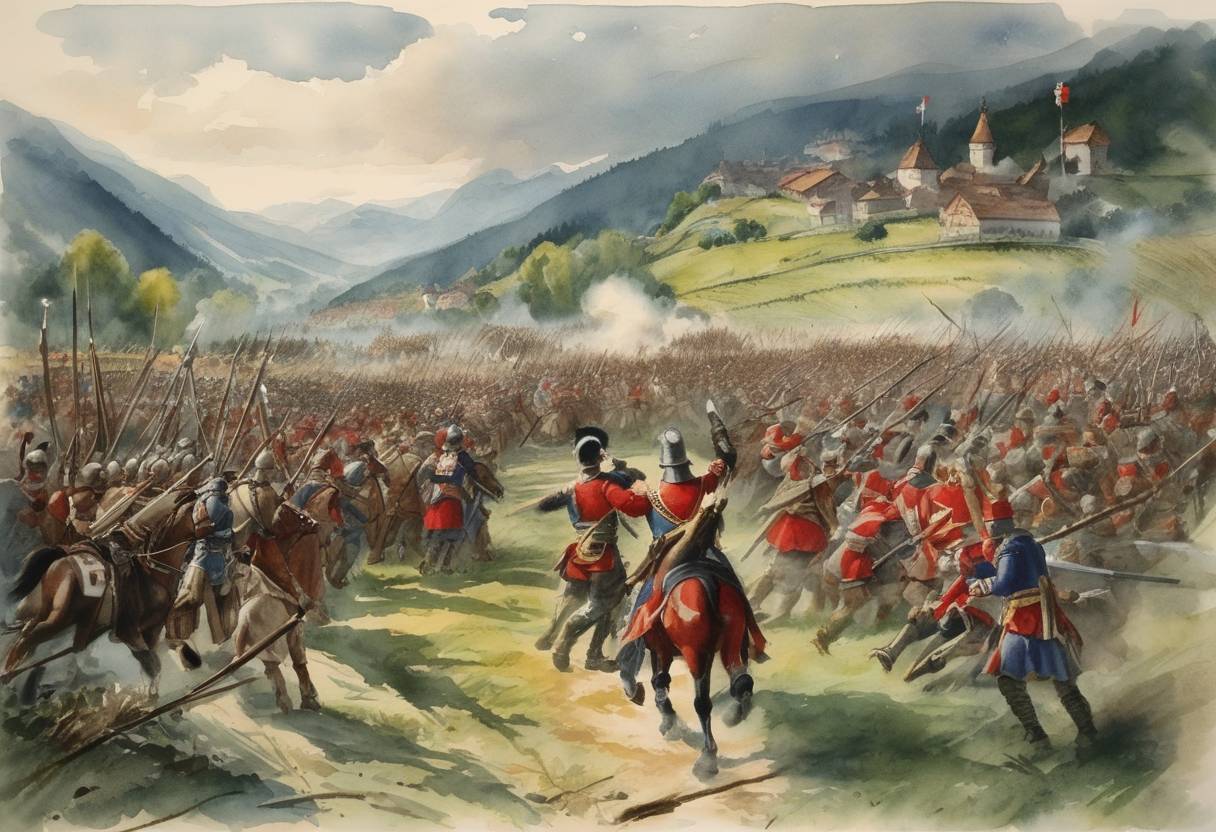
The Battle of Morgarten: November 11, 1315
The Battle of Morgarten, fought on November 11, 1315, marked a significant turning point in Swiss history as forces of the Swiss Confederation secured a crucial victory against the Austrian Habsburg army. This battle is often regarded as a pivotal moment in the formation of Swiss national identity, as it fortified Swiss unity and set the stage for further developments towards independence.
Context and Prelude
The conflict arose from rising tensions between the Swiss Confederation, which consisted of the cantons of Uri, Schwyz, and Unterwalden, and the expanding ambitions of the Habsburg dynasty, then a dominant force in Central Europe. The Swiss cantons sought autonomy and freedom from external domination, while the Habsburgs aimed to exert control over the strategically significant alpine passes.
In 1314, a contested election for the title of Holy Roman Emperor exacerbated tensions. The Swiss supported Louis IV of Bavaria, while the Habsburgs backed Frederick the Fair. This political divergence fueled hostilities that would culminate in conflict.
The Battle
On the morning of November 11, 1315, Duke Leopold I of Austria led a Habsburg army, reportedly numbering between 3,000 to 5,000 men, through the narrow Morgarten Pass. Their goal was to suppress the rebellious Swiss cantons and reassert Habsburg authority. The Swiss forces, composed of approximately 1,500 men, predominantly from Schwyz, utilized the terrain to their advantage.
The Swiss meticulously planned their defense, positioning themselves on high ground overlooking the pass. As the Austrians advanced, the Swiss launched a surprise attack, rolling boulders and logs down the slopes, causing chaos and disarray among the Habsburg ranks. The narrowness of the pass compounded the difficulties for the Austrian forces, who struggled to organize a cohesive defensive response.
Aftermath and Significance
The Swiss victory at Morgarten established a lasting legacy. The success not only emboldened the Swiss Confederation but also showcased the effectiveness of unconventional warfare tactics against larger and better-equipped armies. This triumph instilled a strong sense of unity and identity among the Swiss cantons.
In the wake of Morgarten, the Confederation solidified its collective agreements, laying foundations that would eventually evolve into the formation of modern Switzerland. Furthermore, the defeat signaled to the Habsburgs and other European powers that Swiss aspirations for independence were formidable and not easily quashed.
The Battle of Morgarten is commemorated as a defining episode in Swiss history, symbolizing the resolve and capability of the Swiss people to defend their liberty and autonomy against external pressure.