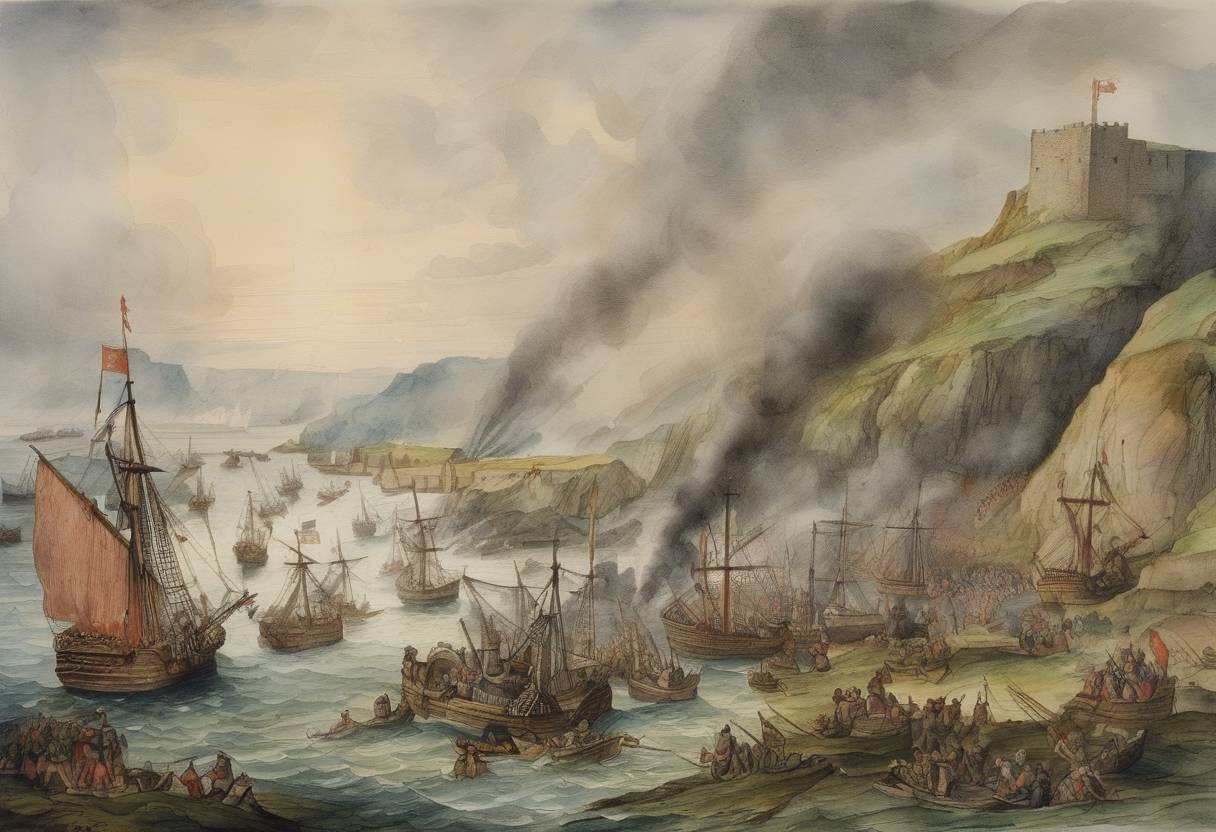
The Raid of Rathlin Island: July 7, 1575
The Raid of Rathlin Island took place on July 7, 1575, during the turbulent period of the Irish Confederate Wars. This brutal attack was part of the ongoing struggle between English forces and Gaelic clans in Ireland.
Background
Rathlin Island, situated off the north coast of Ireland in County Antrim, was centrally involved in the MacDonnell clan’s power dynamics, a Scottish family with significant influence in the region. At that time, the MacDonnells were under siege by English forces attempting to assert control over Irish territories.
Tensions had escalated due to the strategic alliances among Irish and Scottish clans and their refusal to submit to English rule. Rathlin Island was a strategic location for the MacDonnells, used both as a refuge and a point to assert their dominion.
The Attack
On the day of the raid, English troops commanded by Sir John Norris, an English military officer, launched an assault on Rathlin Island. The force was supported by Sir Francis Drake’s naval fleet, which provided essential logistical and tactical support, highlighting the well-organized effort behind the attack.
The English forces, determined to eliminate the MacDonnell influence from the region, brutally massacred around 600 people, including women and children. This ruthless attack extended beyond the combatant members of the clan, aiming to break the social and familial structures of the MacDonnells.
Historical Significance
The Raid of Rathlin Island is remembered as a grim episode in the history of the English conquest of Ireland. It exemplified the harsh tactics employed by English forces to suppress Irish and Scottish collaboration and maintain control over contested regions.
This massacre unambiguously discouraged further resistance, paving the way for the English to consolidate power. It also contributed to embedding deep-seated animosities that would influence Irish-English relations in subsequent generations, serving as a poignant illustration of the brutal measures used during the campaign for dominance in Ireland.
Aftermath
The outcome of the raid left a lasting scar on the cultural memory of the MacDonnell clan and the broader Gaelic communities. The English forces viewed the operation as a strategic victory that significantly diminished the resistance capabilities of the MacDonnells, although at a significant moral and humanitarian cost.
Rathlin Island’s raid remains a potent symbol of the violent conflicts that characterized the era, reflecting broader patterns of colonization and military aggression. The incident continues to be studied for insights into the period’s socio-political dynamics and the harsh reality of territorial disputes.