Publication of Isaac Newton's *Philosophiæ Naturalis Principia Mathematica*
1687 · London, England
Isaac Newton's 'Philosophiæ Naturalis Principia Mathematica' was published, laying the groundwork for classical mechanics.
August 12, 1687
The first performance of Isaac Newton's Principia Mathematica is made at a meeting of the Royal Society.
London, Kingdom of England | Royal Society
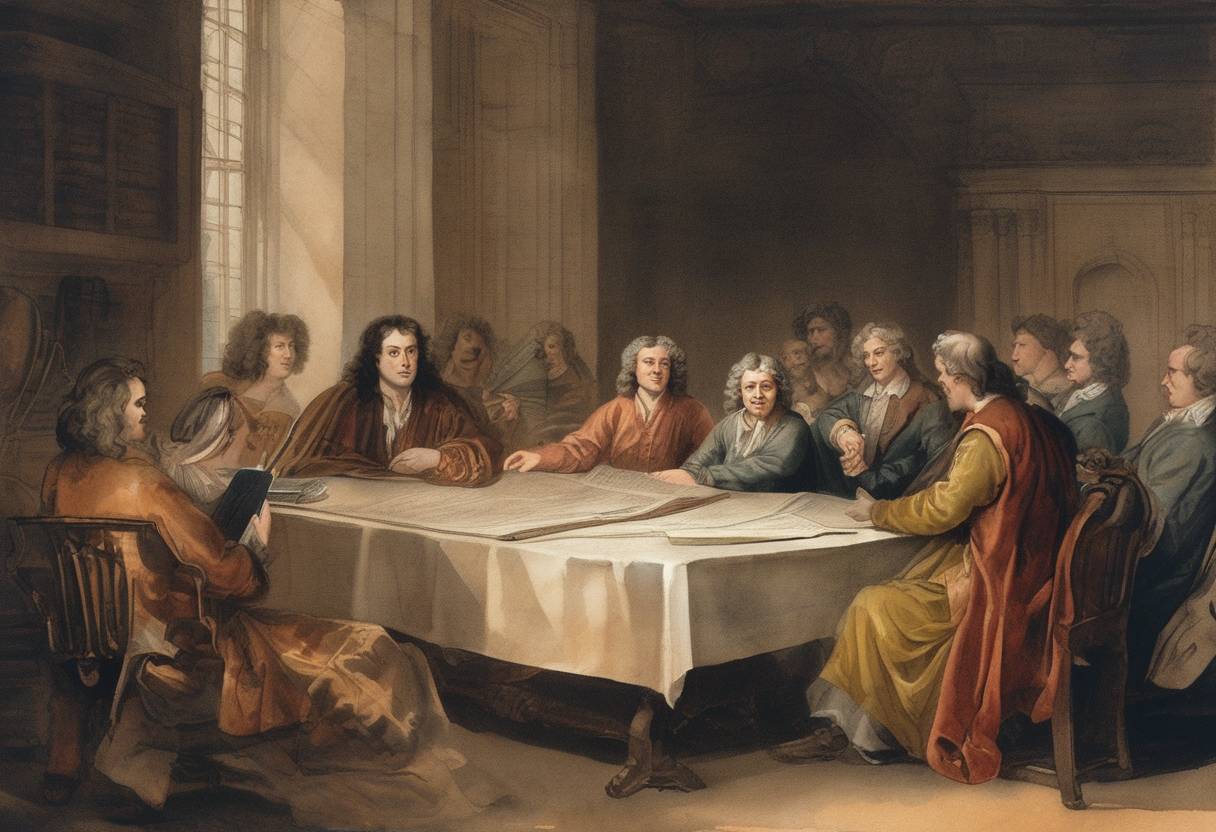
On August 12, 1687, a pivotal moment in the history of science took place when Isaac Newton’s seminal work, Philosophiæ Naturalis Principia Mathematica (often simply referred to as the Principia), was presented to the Royal Society in London. This momentous work laid the foundational principles of classical mechanics and astronomy, marking a significant turning point in the scientific revolution.
Newton’s Principia emerged from a series of advances in understanding motion and gravity. Before its publication, the prevailing astronomical model was dominated by the works of Kepler and Copernicus, alongside the experimental mechanics of Galileo. The Principia synthesized these ideas with Newton’s own groundbreaking understanding of gravitational force.
The presentation of Principia to the Royal Society was a crucial endorsement from one of the most respected scientific institutions of that era. The Society, founded in 1660, was an assembly of England’s most prominent scientific minds and served as a key platform for the formal recognition and dissemination of scientific knowledge. Although the specific format and details of the presentation itself at the Royal Society on August 12, 1687, are less documented, it marked the official acceptance and endorsement of the work, following its publication earlier that year.
Principia Mathematica is structured in three books:
The principles outlined by Newton provided a comprehensive explanation for the motion of planets and laid a basis for physics that persisted until the advent of relativity and quantum mechanics.
The implications of the Principia were profound. It not only transformed scientific inquiry by providing a clear method based on mathematical principles and empirical observation, but it also had a lasting influence on philosophy, pushing forward the Age of Enlightenment. Newton’s work substantiated the application of reason and observation to uncover universal laws, influencing subsequent scientists like Albert Einstein.
In summary, the presentation of Principia Mathematica to the Royal Society on August 12, 1687, was more than just a scholarly event; it was a pivotal moment that left an indelible mark on the progress of human understanding, altering the trajectory of scientific thought for generations to come.
Source: en.wikipedia.org