The Egyptian Revolution of 2011: February 3rd Events
2011 · Cairo, Egypt
The Egyptian Revolution of 2011 continues as protesters gather in Tahrir Square, demanding the resignation of President Hosni Mubarak.
July 23, 1952
The Free Officers Movement headed by Mohammed Naguib and Gamal Abdel Nasser stages a military coup in Egypt, overthrowing King Farouk and marking the beginning of the Egyptian Revolution of 1952.
Cairo, Egypt | Free Officers Movement
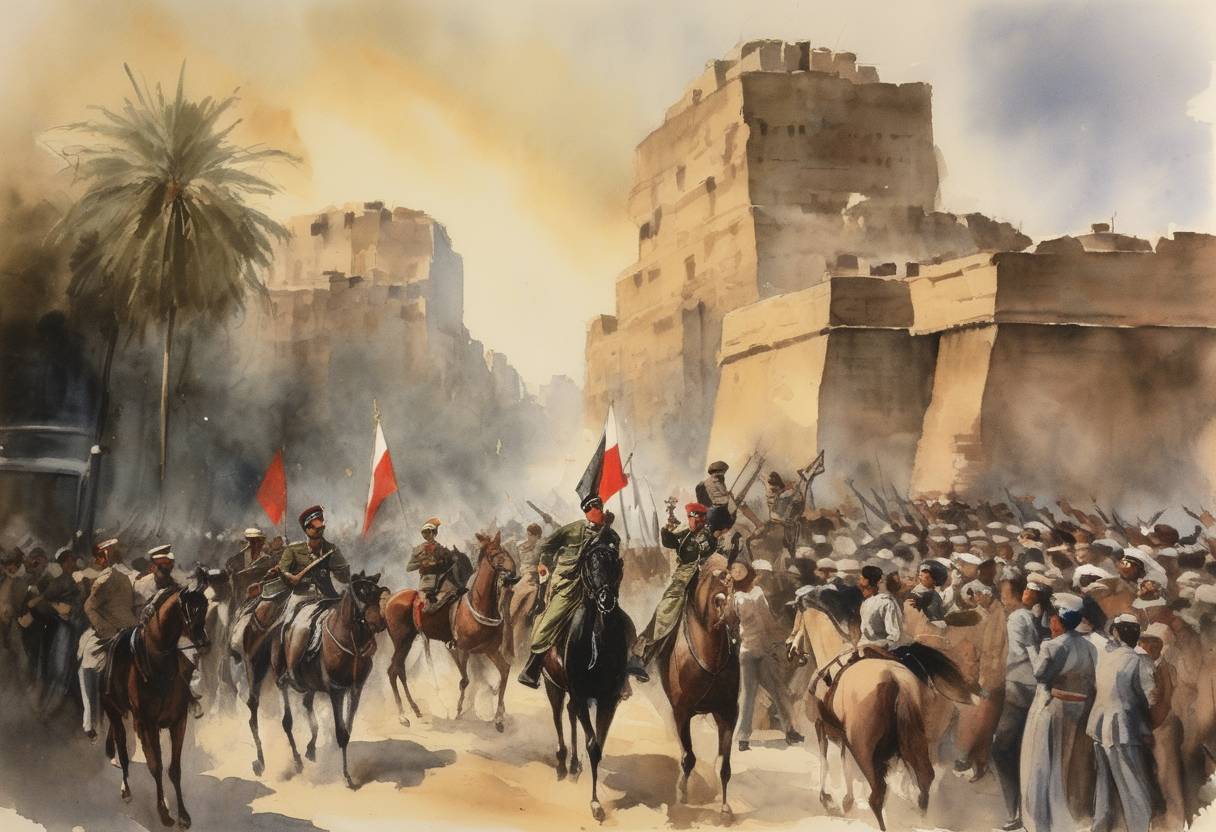
On July 23, 1952, a pivotal event in modern Egyptian history unfolded as the Free Officers Movement executed a military coup, leading to the overthrow of King Farouk. This event marked the beginning of the Egyptian Revolution of 1952, radically altering the course of Egypt’s political landscape.
The Free Officers Movement was a clandestine group of junior military officers in the Egyptian army. It was founded by a group of disillusioned Egyptians who sought to overthrow the monarchy, end British occupation, and address widespread corruption and social inequality. The key figures in this movement were Mohammed Naguib and Gamal Abdel Nasser, who rapidly rose to prominence for their leadership capabilities and vision for a new Egypt.
In the early hours of July 23, 1952, the Free Officers, led by Nasser, initiated a military coup in Cairo. They swiftly gained control of key government and military installations, exploiting the element of surprise and the popularity of their movement among both civilians and the military rank-and-file. The coup was executed smoothly, and within hours, King Farouk, who was seen as a puppet of foreign powers and corrupt, was forced to abdicate. He eventually went into exile in Italy.
Mohammed Naguib: A senior military officer respected among peers and rank-and-file soldiers, he initially became the face of the movement due to his seniority and public appeal. Naguib was installed as the first President of Egypt but was later sidelined by Nasser.
Gamal Abdel Nasser: The mastermind behind the Free Officers Movement, Nasser rose to power after the coup, eventually becoming the second President of Egypt. His influence was instrumental in shaping Egypt into a republic and was a leading voice in Arab nationalism.
The coup led to the abolition of the Egyptian monarchy and the establishment of a republic in 1953. This event also initiated widespread social reforms in areas such as land distribution, education, and women’s rights. The successful overthrow of the monarchy ended British influence in the region and inspired numerous anticolonial movements across the Arab world and Africa.
The revolution instituted a nationalistic narrative that set the tone for Nasser’s subsequent policies and his stature as a leader in the Arab world. It repositioned Egypt as a key player in the non-aligned movement during the Cold War, significantly impacting regional geopolitics.
The Egyptian Revolution of 1952 not only transformed Egypt internally but also had far-reaching consequences across the Middle East and Africa. It symbolized the sweeping changes post-colonial states were undergoing and reverberated through the corridors of power in regions under colonial influence. The revolution’s leaders, especially Nasser, became iconic figures, shaping the discourse on independence and national sovereignty.
The success of the Free Officers Movement’s coup is regarded as a significant turning point in not only Egyptian history but in the rise of military-led governments in the Middle East.
Source: en.wikipedia.org