The First Major Wagon Train Departs for Oregon
1843 · Elm Grove, United States
The first major wagon train headed for the Northwestern United States on the Oregon Trail departs from Elm Grove, Missouri.
November 4, 1841
The first wagon train arrived in California via the Emigrant Trail, marking a significant milestone in the westward expansion of the United States.
Sacramento, United States
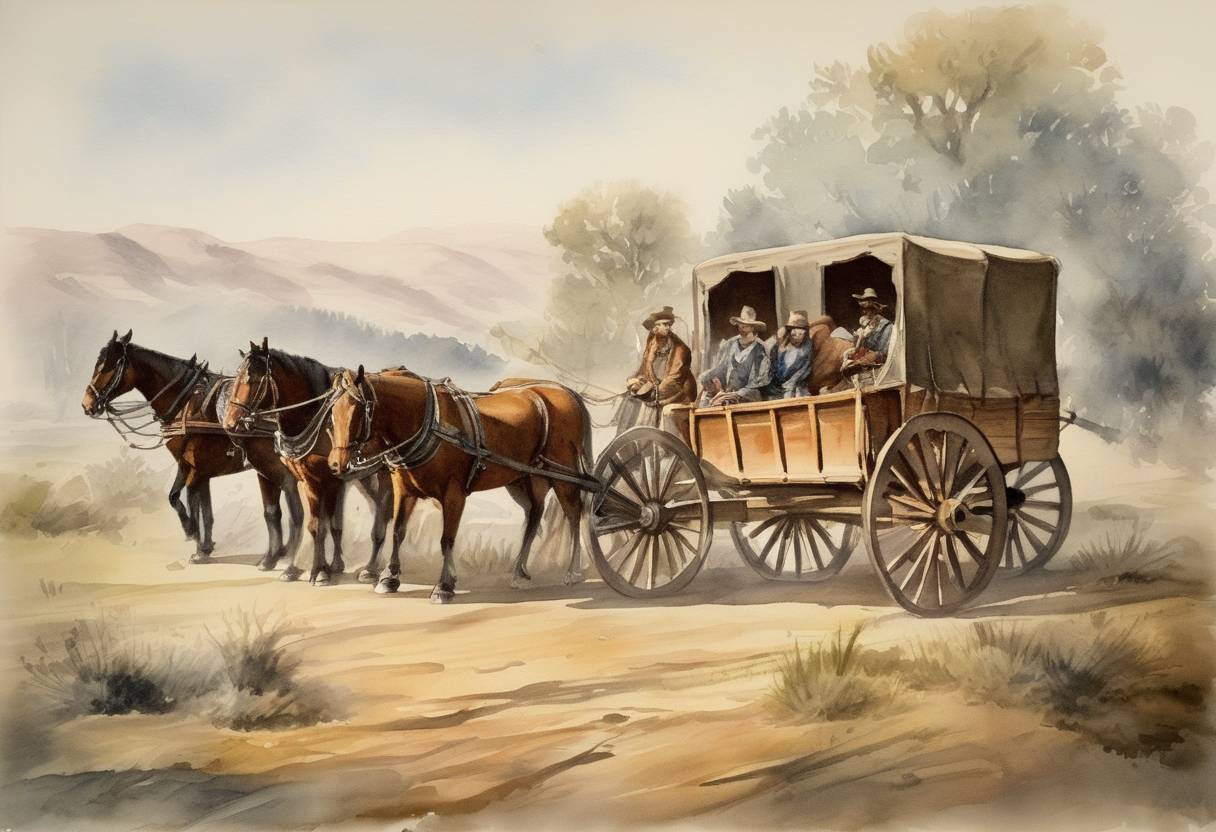
On November 4, 1841, the first wagon train successfully arrived in California via the Emigrant Trail, marking a pivotal moment in the westward expansion of the United States. This journey was part of a broader movement of American settlers migrating westward, driven by opportunities for land and wealth, and the concept of Manifest Destiny.
The Emigrant Trail, also known as the California Trail, was a major overland emigrant route across the western United States used by pioneers traveling to California in the mid-19th century. This trail branched off from the Oregon Trail and was instrumental in the California Gold Rush of 1849, facilitating the influx of settlers seeking new opportunities.
The wagon train that arrived on November 4, 1841, was part of the Bartleson-Bidwell Party. Comprising 69 men, women, and children, this group was led by John Bartleson and John Bidwell. They embarked on their journey from Missouri in May 1841, initially following the established path of the Oregon Trail before branching off towards California.
The journey was fraught with challenges. Lacking detailed maps and prior experience, the group had to make decisions about which paths to take as they approached the uncharted territory west of the Great Basin. The terrain was rugged, supplies were limited, and the travelers faced harsh weather conditions.
Moreover, the party was not unanimous in their decision to head to California. Initially, their plan included both California and Oregon as potential destinations. This indecision led to divisions, and part of the group split to continue on to Oregon.
Those who persisted in the journey to California finally arrived at Sutter’s Fort, near present-day Sacramento, on November 4, 1841. Their successful arrival was a testament to human will and tenacity and demonstrated the viability of overland travel to California.
The arrival of this first wagon train set a precedent that encouraged subsequent groups to make the westward journey, ultimately facilitating the large-scale migration known as “The Great Migration” in the 1840s. The California Trail became a critical path of this migration wave, leading to increased settlement and the eventual statehood of California in 1850.
This event played a crucial role in shaping the demographic and cultural landscape of the region. It marked the beginning of large-scale settlements in California and contributed to the development of the western United States. The successful use of the Emigrant Trail illustrated the potential for expanding American territories across the continent, an idea central to the concept of Manifest Destiny.
Ultimately, the arrival of the Bartleson-Bidwell Party on November 4, 1841, was more than just a successful journey; it was a harbinger of the transformative changes that would sweep through the American West in the ensuing decades.
Source: www.history.com