The Siege of Vienna Begins - September 1, 1529
1529 · Vienna, Austria
The Siege of Vienna begins as the Ottoman Empire, led by Suleiman the Magnificent, attempts to capture Vienna, Austria.
June 1, 1485
Matthias Corvinus, King of Hungary, captured Vienna, a significant event in the Austro-Hungarian history.
Vienna, Austria | Kingdom of Hungary
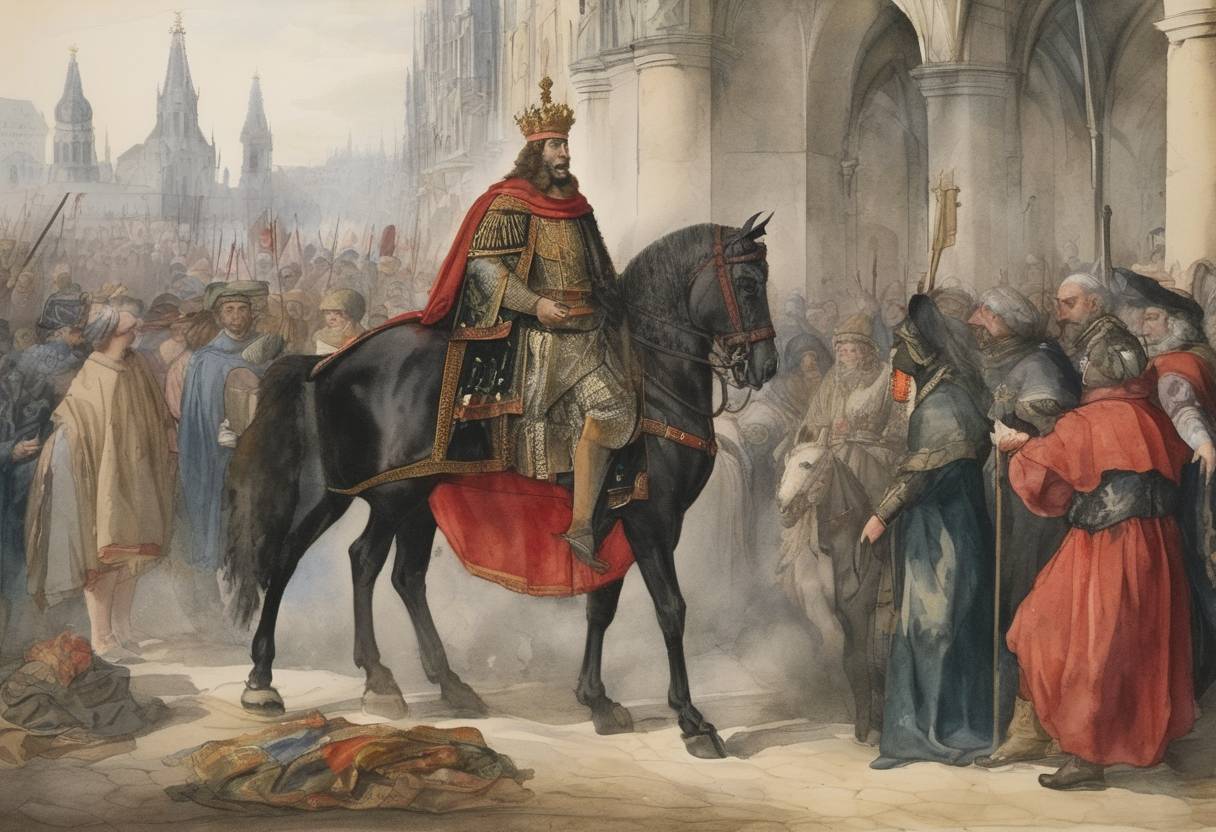
On June 1, 1485, Matthias Corvinus, King of Hungary, achieved a significant military and political victory by capturing the city of Vienna. This event marked a pivotal moment in Austro-Hungarian history and showcased the extensive territorial ambitions of King Matthias.
Matthias Corvinus, ascending to the Hungarian throne in 1458, was known for his efforts to centralize power and reform the kingdom of Hungary. His reign was characterized by military campaigns aimed at strengthening Hungarian influence throughout Central Europe. The capture of Vienna occurred during an ongoing conflict with Frederick III, Holy Roman Emperor, over control and influence in the region.
Matthias’s focus on Vienna was part of a larger campaign against Frederick III. The siege of Vienna began in 1485 after a series of successful expansions by Matthias into Austrian territories. His forces were well-prepared and demonstrated advanced military strategy, including the effective use of artillery, which was crucial for breaching fortified city defenses.
The siege culminated on June 1, 1485, when Matthias’s forces finally captured the city. This victory allowed Matthias to occupy Vienna, subsequently establishing it as a secondary capital of his Hungarian dominions. This was a strategic stronghold that strengthened his position against the Holy Roman Empire.
Matthias’s occupation of Vienna challenged the authority of the Habsburgs and extended Hungarian influence into the heart of the Holy Roman Empire. The subsequent period of Hungarian administration brought about changes that influenced urban and cultural development. However, his death in 1490 initiated a power vacuum, and Vienna eventually returned to Habsburg control.
The capture of Vienna by Matthias Corvinus underscored the volatility of Central Europe in the late 15th century. It highlighted the contest for dominance between emerging nation-states and the established imperial powers. Additionally, Matthias’s rule in Vienna left a lasting impact on the city’s structure and governance.
In broader terms, this event demonstrated the shifting political landscape of Europe on the eve of the Renaissance, characterized by ambitious leaders seeking to extend their influence through military conquest and complex diplomatic maneuvers.
Source: en.wikipedia.org