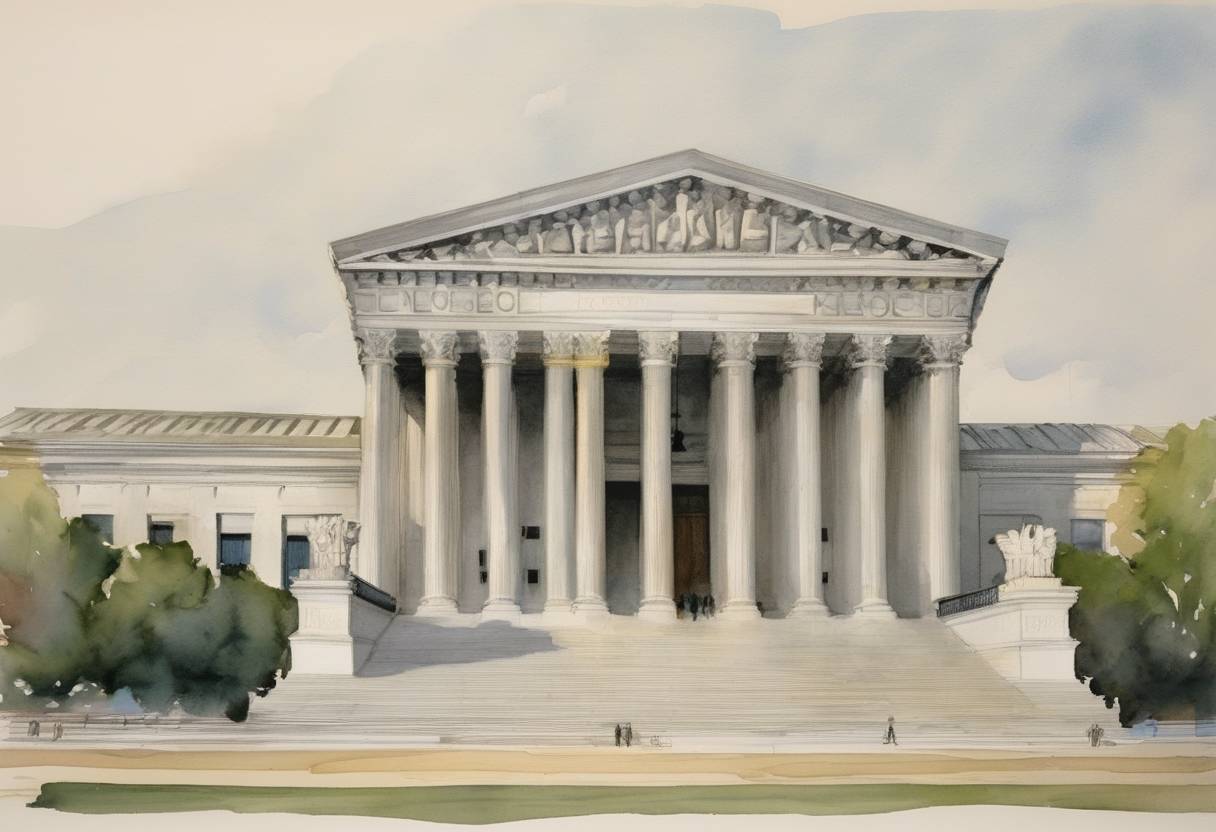
Wesberry v. Sanders: Landmark Decision on Congressional Districts
On February 17, 1964, the Supreme Court of the United States delivered a significant ruling in the case of Wesberry v. Sanders, establishing a critical precedent in the realm of electoral law. This decision mandated that congressional districts must have roughly equal populations, firmly upholding the constitutional principle of “one person, one vote.”
Context and Background
Before Wesberry v. Sanders, congressional districts in several states were often disproportionately drawn, with considerable variances in population. This meant that votes in less populated districts carried more weight than those in densely populated ones. The practice contravened the democratic principle of equal representation.
The case was brought forth by James P. Wesberry, Jr., a resident of the Fifth Congressional District of Georgia, who argued that the state’s districting plan grossly diluted his vote compared to those in other, smaller districts. At the time, Georgia’s Fifth District had a population nearly three times larger than some of the state’s other districts, prompting Wesberry’s claim of inequity under the Equal Protection Clause of the Fourteenth Amendment.
The Court’s Decision
The Supreme Court, in a majority opinion written by Justice Hugo Black, ruled in favor of Wesberry. The Court held that Article I, Section 2 of the United States Constitution, which requires that members of the House of Representatives be chosen “by the People of the several States,” implies a necessity for equal representation through equally populated districts.
Justice Black asserted that “as nearly as is practicable, one man’s vote in a congressional election is to be worth as much as another’s.” This landmark ruling invalidated Georgia’s districting plan and, by extension, rendered similar malapportioned districting schemes across the country unconstitutional.
Broader Implications
The decision in Wesberry v. Sanders built upon the principles established in an earlier case, Baker v. Carr (1962), which recognized the justiciability of redistricting issues. It extended the principle of “one person, one vote” to congressional districts, serving as a catalyst for widespread electoral reform.
Subsequent to this ruling, numerous states had to redraw their congressional districts to ensure compliance with the Court’s mandate for population equality. This realignment aimed to reflect more accurately the democratic ideal of proportional representation, influencing the political landscape of the United States significantly.
Conclusion
Wesberry v. Sanders is hailed as a pivotal moment in the history of electoral law and justice in the United States. It reinforced the democratic tenet that all citizens’ votes should carry equal weight, shaping the way congressional districts are drawn to this day and ensuring fairer representation in the legislative process.