Argentina's 1983 Democratic Elections
1983 · Buenos Aires, Argentina
Argentina held its first democratic elections following the military dictatorship, marking a return to democracy.
March 24, 1976
A military coup in Argentina led by Jorge Rafael Videla ousted President Isabel Perón, beginning a period of dictatorship known as the National Reorganization Process.
Buenos Aires, Argentina | Argentine Military
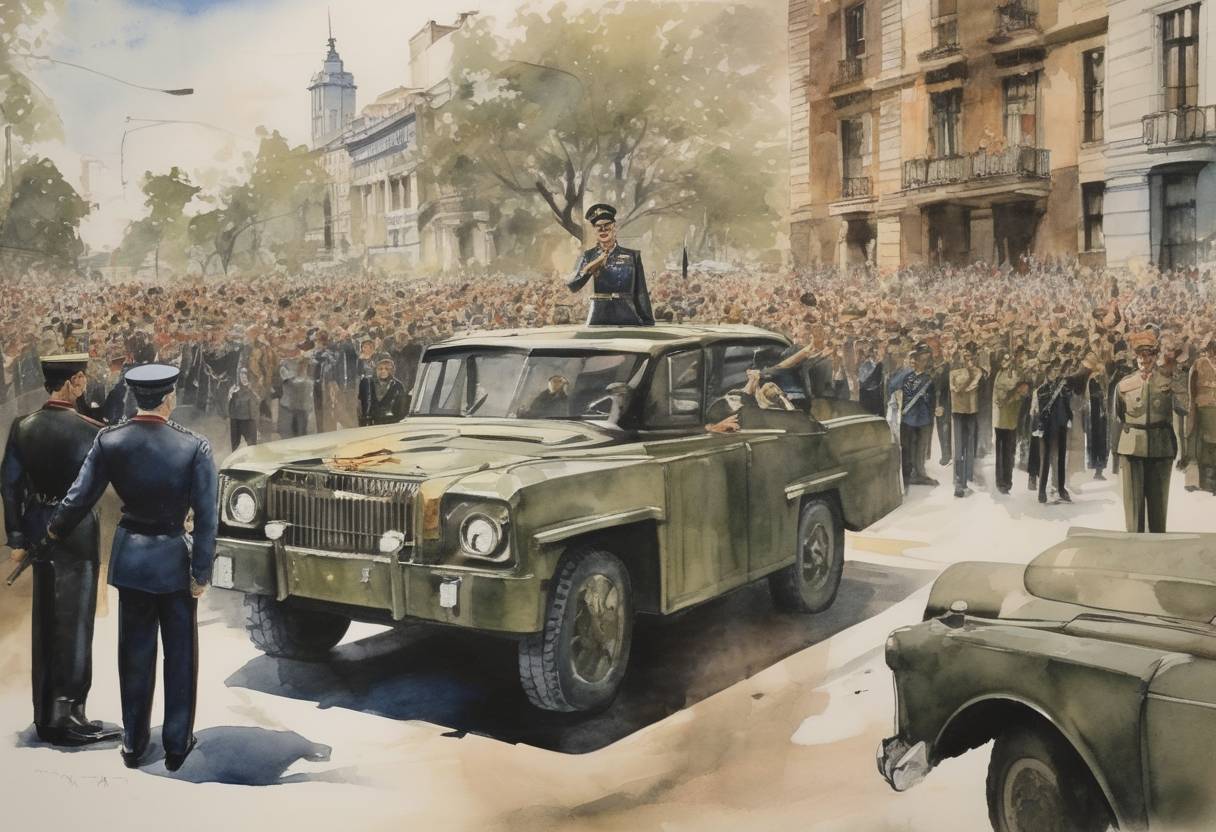
On March 24, 1976, a military coup in Argentina led by General Jorge Rafael Videla ousted President Isabel Perón, marking the beginning of a period of dictatorship known as the National Reorganization Process. This event was a pivotal moment in Argentine history, leading to significant political, social, and economic changes.
Political Instability: The coup was preceded by a period of severe political instability in Argentina. Isabel Perón, who became president after the death of her husband, Juan Domingo Perón, in 1974, faced numerous challenges, including economic turmoil, rampant inflation, and increasing violence from both left-wing guerrillas and right-wing death squads.
Economic Crisis: The Argentine economy was in disarray, with hyperinflation and a declining standard of living. The government’s inability to stabilize the economy contributed to widespread dissatisfaction.
Social Unrest: The country was plagued by social unrest, with frequent strikes and protests. The government struggled to maintain order as violence escalated between various political factions.
Execution: In the early hours of March 24, 1976, the Argentine military, led by General Jorge Rafael Videla, Admiral Emilio Eduardo Massera, and Brigadier General Orlando Ramón Agosti, executed a well-coordinated coup. They swiftly took control of key government buildings, communication centers, and military installations.
Removal of Isabel Perón: President Isabel Perón was arrested and detained. The military justified the coup by claiming it was necessary to restore order and combat terrorism.
Military Junta: The coup established a military junta that ruled Argentina until 1983. The junta was composed of leaders from the army, navy, and air force, with Videla serving as the de facto president.
Human Rights Violations: The regime is infamous for its brutal repression, known as the “Dirty War,” during which thousands of suspected dissidents were kidnapped, tortured, and killed. Many of these individuals became known as the “disappeared” (desaparecidos).
Economic Policies: The junta implemented neoliberal economic policies, including deregulation and privatization, which had mixed results and often exacerbated economic inequalities.
Return to Democracy: The dictatorship ended in 1983 following Argentina’s defeat in the Falklands War and growing public opposition. Democratic elections were held, leading to the presidency of Raúl Alfonsín.
Legacy: The period of military rule left a lasting impact on Argentine society, with ongoing efforts to address human rights abuses and bring perpetrators to justice. The Mothers of the Plaza de Mayo, a group of women whose children disappeared during the dictatorship, became a symbol of resistance and the fight for justice.
Historical Significance: The coup and subsequent dictatorship are critical in understanding Argentina’s modern history, highlighting the dangers of authoritarian rule and the importance of democratic governance.
The events of March 24, 1976, remain a somber chapter in Argentina’s history, serving as a reminder of the country’s struggle for democracy and human rights.
Source: www.britannica.com