1126 · Perth, Scotland
David I became King of Scots following the death of his brother, Alexander I. His reign marked a period of feudal transformation, religious reform, and administrative changes in Scotland.
March 2, 1127
Assassination of Charles the Good, Count of Flanders, in Bruges, which led to a succession crisis and a period of instability in the region.
Bruges, Belgium
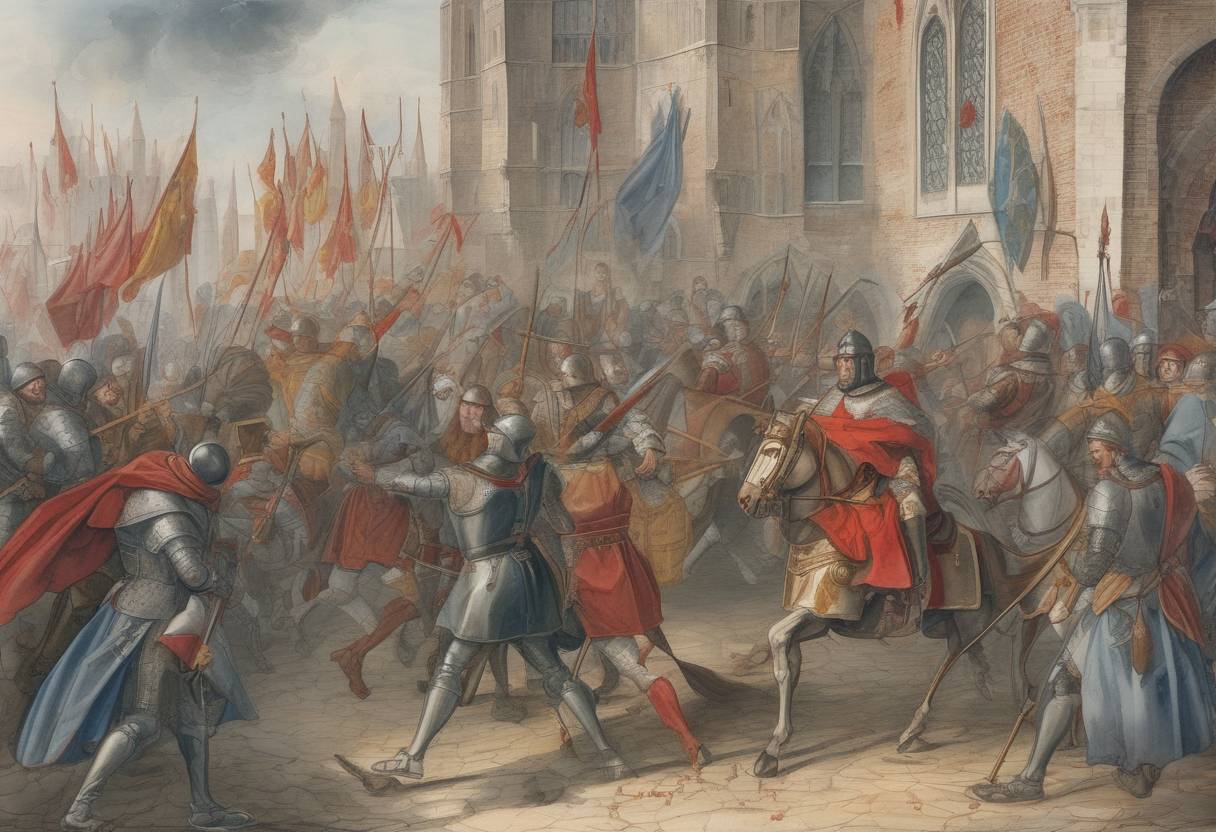
Charles the Good, born around 1084, was the son of King Canute IV of Denmark and Adela of Flanders. He became Count of Flanders in 1119, following the death of his cousin Baldwin VII. Charles was known for his piety and efforts to improve the welfare of his subjects, earning him the moniker “the Good.” His rule was marked by attempts to reform the administration and alleviate the suffering of the poor, particularly during times of famine.
On March 2, 1127, Charles the Good was assassinated while praying in the Church of St. Donatian in Bruges. The murder was orchestrated by the Erembald family, a powerful and influential clan within Flanders. The Erembalds were motivated by political and personal grievances, as Charles had been working to curb their influence and address corruption within the region. The assassination was a shocking event that reverberated throughout Flanders and beyond.
The death of Charles the Good plunged Flanders into a succession crisis. Charles had no direct heirs, and his assassination left a power vacuum. Several claimants emerged, leading to a period of instability and conflict:
William Clito: A nephew of Charles, he was initially supported by King Louis VI of France. However, his rule was contested by local factions and he struggled to maintain control.
Thierry of Alsace: Another claimant, Thierry eventually gained the support of the local nobility and was able to establish himself as the new Count of Flanders by 1128.
The power struggle led to a series of conflicts and shifting alliances, as various factions vied for control. The instability also attracted the attention of neighboring powers, including France and England, who sought to influence the outcome to their advantage.
The assassination of Charles the Good and the ensuing succession crisis had several significant consequences:
Political Realignment: The crisis led to a realignment of political power within Flanders, as new alliances were formed and old ones were broken.
Strengthening of Monarchical Power: The intervention of King Louis VI of France in the succession dispute highlighted the growing influence of the French monarchy in regional affairs.
Legacy of Reform: Despite the turmoil, Charles the Good’s legacy of reform and concern for the welfare of his subjects continued to influence the governance of Flanders.
The assassination of Charles the Good is a pivotal moment in the history of Flanders, illustrating the complex interplay of local and regional politics in medieval Europe. It underscores the fragility of power structures and the impact of individual leadership on the stability of a region.
Source: en.wikipedia.org